
Freediving for Focus: Why Going Underwater Can Quiet a Busy Mind
Your phone cannot follow you under water. Neither can the inbox, the open tabs or the message you forgot to answer. Here is why freediving feels so mentally clear, what the science can and cannot say about it, and how the quiet down there helps a busy mind slow down.
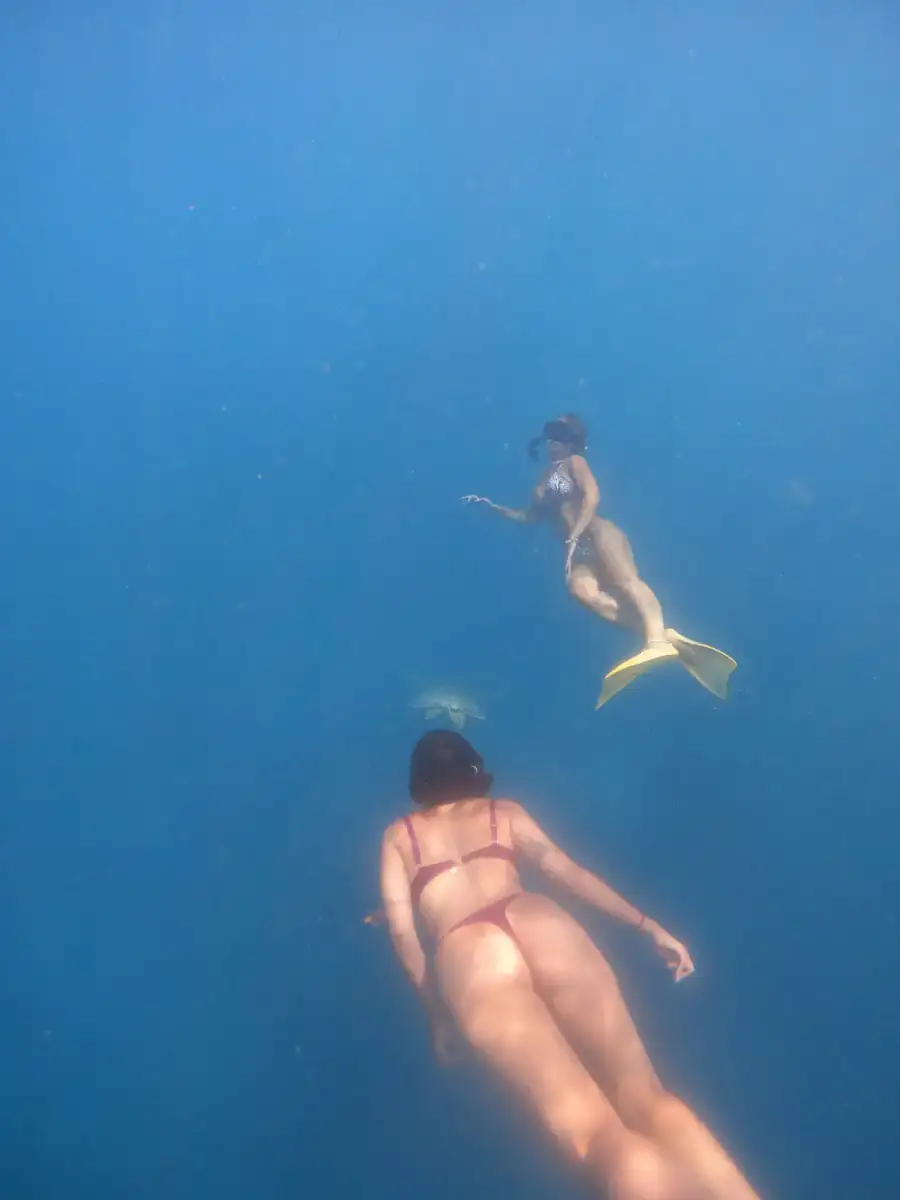
There are very few places left where the brain cannot multitask.
On land, everything wants something from you. The phone lights up. Someone needs an answer. There is a tab open you forgot about, a message you have not replied to, and at least three things you meant to do an hour ago. Even rest feels noisy now.
Then you put your face in the water. And for a while, none of it can reach you.
So, can freediving help with focus? For many people, yes, at least while they are in the water, and often for a while after. Not because it is magic, but because it takes away most distractions, gives your attention one clear job (your breath), and rewards calm instead of effort. That is the short answer. The longer one follows.
You are not checking anything. You are not replying to anyone. You are not planning dinner, or wondering whether that email sounded strange. You are just there: floating, breathing, listening, going down.
This is one of the things I love most about freediving. People often come to it because it looks graceful, a little mysterious, or simply different. Many stay for a quieter reason. It gives the mind a break. Not a dramatic awakening, not peace forever. Just a rare and satisfying kind of mental silence that you do not have to force.
The modern brain is tired
Most people do not need anyone to tell them they are overstimulated. They already know.
You feel it when your attention jumps from one thing to the next. You feel it when you cannot finish a thought without reaching for your phone. You feel it in that odd tiredness that comes from doing "not that much" and still ending the day empty.
For some people the noise runs even louder. Psychologist Elaine Aron coined the term "highly sensitive person" for a personality trait researchers call sensory processing sensitivity: picking up more detail, more mood, more atmosphere in a room without trying. It is described as a normal trait, not a diagnosis, and Psychology Today puts it at roughly 15 to 20 percent of people. If you carry it, switching off does not come easily. Rest becomes something you work toward, not something that simply arrives.
Freediving is interesting because it changes the whole setting. It does not ask the mind to calm down by force. It quietly removes much of what kept it busy.
Underwater, there is less for your brain to process
The underwater world is quieter in almost every way. Sound changes. What you see becomes simpler. Movement slows. No screens, no traffic, no chatter in the background, no little decisions piling up. Most of the usual clutter is just not there.
That is part of why freediving feels so clean. Your attention still has somewhere to go, only gently. It goes to your breath. To the temperature of the water on your skin. To the soft pressure in your ears. To how your body moves, and to the line in front of you. To the simple task of being here.
That kind of focus feels good because it is not split five ways. You hold one thing well instead of several things badly. Some days, that alone feels like a small luxury. It helps when your gear stays quiet too: a low-volume mask and a simple snorkel that fit well mean one less thing to fiddle with between breathe-ups.
Breath becomes the whole story
On land, most people ignore their breathing until something feels wrong. In freediving, breath sits at the centre of everything from the first minute.
Before a dive, you slow down. You breathe more on purpose. You let go of tension you did not know you were holding. That preparation alone starts to separate you from the noise you came in with.
There is real science behind why slow breathing feels settling. A 2018 systematic review in Frontiers in Human Neuroscience looked at studies of slow breathing (fewer than ten breaths a minute) in healthy adults. Only 15 studies met its criteria, so the evidence base is small, but they found more heart rate variability, changes in brain activity such as higher alpha power, and links with emotional control and psychological wellbeing. That does not prove freediving fixes anything. It is a reasonable explanation for why the minutes before a dive often feel like the calmest of the day.
Once you are in the dive, breath stops being background and becomes the thread that holds everything together. It is truly hard to drift into unrelated worries when your body is asking for all of you. You cannot be half in a freedive. You are there, or you are not. That alone is refreshing.
It is not about "emptying your mind"
When people hear words like calm or clarity, they sometimes picture becoming a totally different, serene version of themselves under water. That is not really what happens.
Freediving does not make you thoughtless. It makes you less divided. Your mind can still be active. You might feel a flutter of nerves before a dive, or catch an unhelpful thought at the worst moment. But under water a lot of that quiets down by itself, because nothing is feeding it. There is less to react to, so there is less scrambling inside.
The water does not turn you into someone else. It just gives you fewer reasons to scatter.
How does freediving build focus without force?
One of the most useful things freediving teaches is a focus that does not come from pushing harder.
In daily life, when we cannot concentrate, the instinct is to force it: more discipline, more effort, more control. That works for a while, but it is exhausting to keep up.
Freediving works the other way around. Tension, rushing and overthinking usually make a dive harder, not easier. A relaxed body and a slower heart use less oxygen, so the water rewards softness more than aggression. Smooth, unhurried finning helps too, which is one reason many beginners enjoy longer freediving fins once they feel at home. The less extra noise you bring in, the better things tend to go. That is a useful thing to notice about your own mind, on land as much as in the sea.
Sometimes focus gets better not because you hold on tighter, but because you finally stop fighting everything.
There is something oddly comforting about depth
People often imagine freediving as loud adrenaline. Sometimes it is. More often it feels like entering a different pace of life altogether.
The deeper you go, the less the surface world seems to matter. Everything down there is slower, cleaner, quieter, and because the setting is so simple, the mind tends to follow. Not simplistic. Just less cluttered.
You notice small things more clearly: how your body moves, whether your shoulders are tight, whether your thoughts help or get in the way, whether you are truly relaxed or just telling yourself you are. Water gives honest feedback, fast, which can be a strangely welcome thing after a life full of vaguer signals.
Safety, respect and the calm they make possible
This is the part I would never leave out. The quiet of freediving exists only because the safety around it is serious. Divers Alert Network explains that blackouts can happen in any body of water when a diver pushes their limits, and that recreational cases usually involve divers who are overexerted, overweighted and under-supervised. Low oxygen often gives little warning. That is why freediving is always done with a trained buddy watching from the surface, one up and one down, and why a proper course comes before any depth goal.
Respect for the animals belongs here too. A calm freediver is a quieter guest in the ocean: fewer bubbles, slower movements, no chasing. We never touch, chase or bait wildlife, and if a turtle or a ray decides to come closer, that is its choice, not ours. On sunny boat days a long-sleeve rash guard also means less sunscreen in the water, which is kinder to the reef you came to see.
We always dive with certified local instructors and vetted local experts who know these waters well. The calm in this article only really happens when the technical side is in safe, experienced hands, so nerves can stay out of the way. If you are starting from zero, our guide to freediving safety basics is a good first read.
The best part is often after the dive
One lovely surprise is that the feeling often follows you back to the surface.
You climb out and everything feels a little sharper, in a good way. You notice your breathing more. Your head feels less crowded. Not euphoric, just cleaner.
The world is still the world. Your inbox is still waiting. Nothing reorganised itself while you were under. But something in you feels a little less tangled. That is why many people keep coming back to freediving without chasing depth: they come back for how it leaves their mind. We wrote more about this in what makes a freediving retreat ethical.
For sensitive people, this can feel like relief
Freediving often speaks to people who feel things strongly, who get overwhelmed easily, whose minds rarely switch off, who want quiet but struggle to find real quiet at home. Often what they want from travel is not more stimulation, but something deeper and cleaner.
The ocean can offer that. Not because it fixes anyone, and not because it makes you invincible, but because it gives your nervous system a different kind of input: less broken up, less demanding, more rhythmic, more physical, more real. For some people that feels like relief. For others, clarity. For many, a bit of both. If this sounds like you, you may also like our piece on ocean travel for highly sensitive people.
Freediving is not escape. It is recalibration.
Freediving is not about disappearing from your life. It is about stepping out of the noise long enough to remember what your own mind feels like without constant interruption.
You go under. You breathe. You descend. You pay attention. You come back up a little different: not a new person, just less crowded. Sometimes that is enough. Sometimes the most precious thing the ocean gives you is not adventure at all. It is silence.
If this made you curious to feel it yourself, you can explore our small-group retreats.
Questions people ask
Can freediving help with focus?
For many people, yes, at least while they are in the water. Freediving removes most distractions and gives attention one clear task, the breath. Research on slow breathing links it with more heart rate variability and better emotional control in healthy adults, but the evidence base is still small.
Why does freediving feel mentally calming?
The underwater world is simpler: less noise, less visual clutter, fewer decisions. The diving reflex also slows the heart when you hold your breath with your face in the water, and being relaxed helps the body use oxygen more efficiently.
Is freediving good for highly sensitive people?
It can be. Sensory processing sensitivity is described as a normal personality trait, estimated at about 15 to 20 percent of people, and many sensitive people enjoy the quiet and slower pace under water. Everyone is different, and you can always stop or skip a session.
Do I need to be advanced to feel the mental benefits?
No. Even beginner sessions in shallow water, properly guided, can bring that feeling of presence. Depth is not the point.
Is it safe to freedive alone?
No. Divers Alert Network stresses that blackouts can happen in any water when a diver pushes limits, often with little warning. Always freedive with a trained buddy, after proper training.
Wildlife encounters are never guaranteed and never forced. Ocean Calling works only with vetted, ethical local operators, and every animal is free to approach, or not, entirely on its own terms.
Sources & further reading
- Shallow-Water Blackout. Divers Alert Network, Alert Diver, accessed 2026.
- Zaccaro et al. How Breath-Control Can Change Your Life: A Systematic Review on Psycho-Physiological Correlates of Slow Breathing. Frontiers in Human Neuroscience 12:353. PubMed, 2018.
- Heart rate changes and oxygen saturation in blood in relation to static apnea duration. Exercise and Quality of Life journal, 2012.
- Highly Sensitive Person (basics). Psychology Today, accessed 2026.
Further reading on Ocean Calling: More from the journal · Wildlife & the law · See the retreats · Ocean Atlas
Freediving certification in Bali: Amed, USAT Liberty wreck and Ubud
Freediving certification · Amed & Ubud, Bali, Indonesia
Ocean breath first, sacred water after. If this made you want to learn to freedive, this is our beginner-friendly course.