
Anegada rock iguana
Cyclura pinguis
A heavy, slow rock iguana of Anegada's scrub, and one of the rarest lizards in the Caribbean. No sighting is ever a promise.
Critically Endangered (IUCN; sources cite the latest assessment as 2019 or 2020) means it faces an extremely high risk of extinction in the wild.
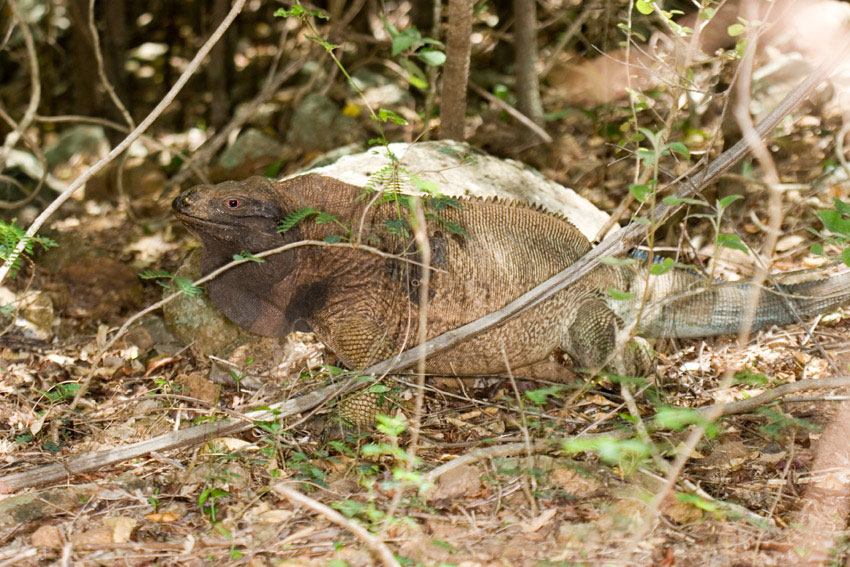
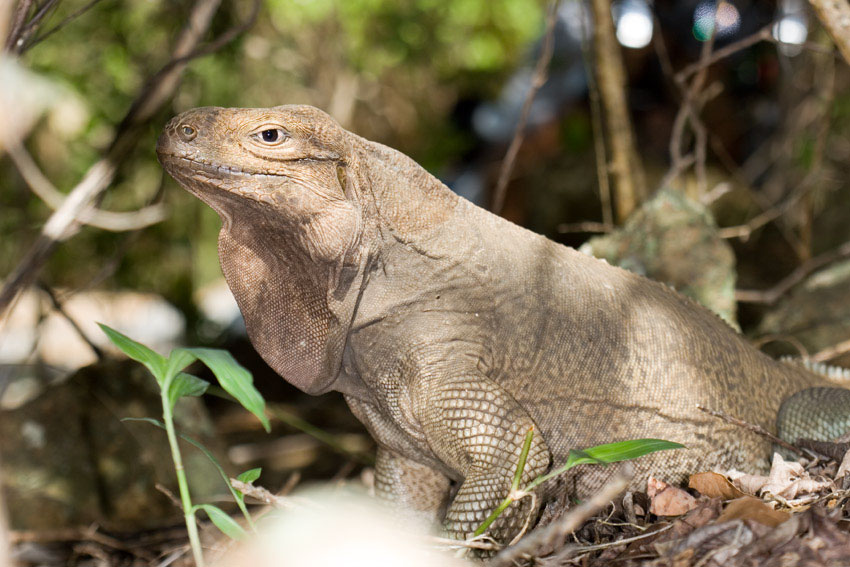
Photos show the species, not always the places on this page.
Length
Snout to vent up to about 56 cm (22 in); the tail adds about 60 cm (24 in)
Weight
Males average about 4 kg (8.8 lb) and females about 2.9 kg (6.4 lb)
Next to a person
Close to a metre from nose to tail tip, about the weight of a large cat
What it eats
Mostly leaves, flowers and fruit. Where livestock has eaten the best plants, it also takes plants they reject and small invertebrates such as centipedes, millipedes and roaches.
Around people
Calm, give space
How it lives
It lives in sandy scrub and rocky woodland on a low limestone island. A female lays one clutch of about 12 to 16 eggs a year in late spring or early summer. The wild population has about two males for every female. Zoo sources say it probably lives 60 to 80 years, though this is still being studied.
Where it goes
It stays on land and shelters in limestone caves and burrows. Where livestock has taken its food, iguanas now range more widely in search of mates and food. It lives only on Anegada and on Guana Island, where eight animals were moved in the 1980s.
We only draw a journey on the map when scientists have tracked it or clearly documented it. For this animal we have not found one yet.
Populations
Critically Endangered, and on CITES Appendix I. Population estimates differ by source and year: fewer than 300 (Wikipedia), about 200 to 300 (a San Diego Zoo fact sheet) and about 550 to 600 (International Iguana Foundation). Numbers fell by at least 80 percent over 40 years. Feral cats and dogs kill nearly all hatchlings and juveniles, and free-roaming cattle, donkeys and goats overgraze the scrub and trample nests. A headstart facility on Anegada has operated since 1997, and 32 iguanas were released in 2003.
Meet it respectfully
Keep well back, move slowly and stay on paths so you do not crush burrows or nests. Never touch, chase, feed or pick up an iguana. Do not leave food or rubbish, which draws feral cats and dogs, and keep pets away from iguana areas. If you meet one, let it keep its distance and leave it to rest. Local rules were not checked for this card, so follow your guide.
Fun fact
Tap the bulb to light it up.
Cats kill most hatchlings, so the wild population is mostly old adults.
A headstart facility on Anegada has raised young iguanas until they are large enough to survive predators since 1997.
An annual Iguana Festival has been held on Anegada since October 2012 to share the iguana's story.
Anegada rock iguana in the Ocean Atlas
Places we have researched where this animal is recorded. It is never guaranteed, and some places are for watching from the boat only.
Travel with usComing soonTrusted referralExploringOn pause, story onlyEthics pass
Country colour: pink where we travel, blue where we are exploring or refer, grey for story only.
 British Virgin Islands
Sources for this page
- International Iguana Foundation, Anegada rock iguana
- Wikipedia, Cyclura pinguis
- San Diego Zoo Wildlife Alliance, Anegada iguana fact sheet
- Wikipedia, Anegada
- GBIF, IUCN category
Facts checked 5 October 2026. Photos: Unsplash licence, or Creative Commons as shown on each photo.
Work in ocean travel?
We are always happy to hear from exceptional local operators, accommodation, conservation organisations and destination experts. If your work fits responsible, small-group ocean travel, we would love to learn more.
Partner with Ocean Calling