
Australian fur seal
Arctocephalus pusillus doriferus
A big, noisy fur seal of the cold southern rocks. No sighting is ever a promise, and a colony is best watched from a respectful distance.
Least Concern (IUCN) means it is not at high risk of extinction. This category is for the species Arctocephalus pusillus as a whole; I could not open a separate assessment for the Australian subspecies. It is listed as Vulnerable in New South Wales.
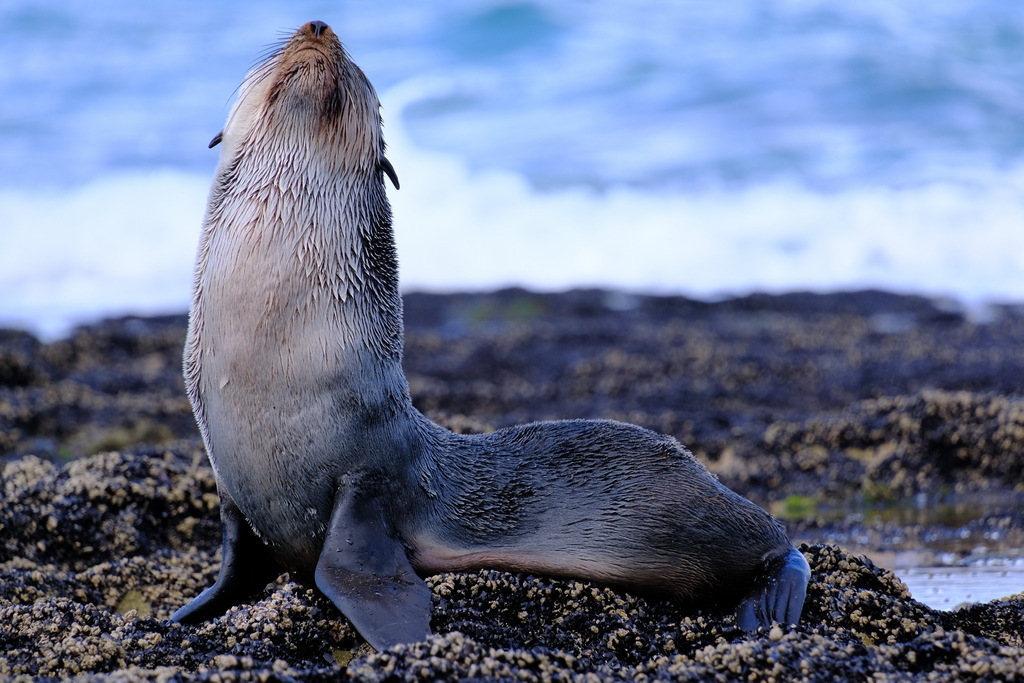
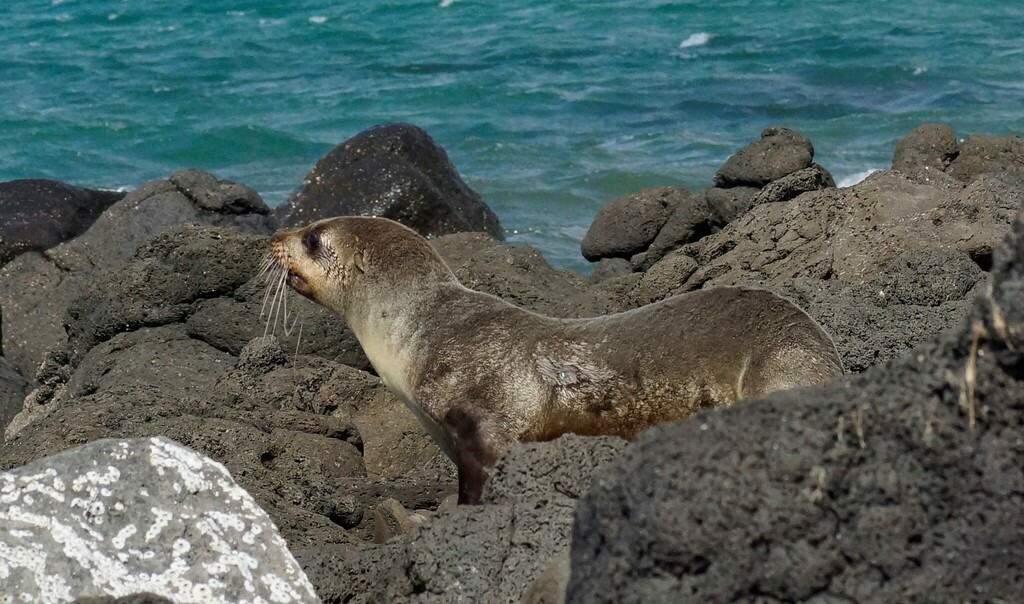
Photos show the species, not always the places on this page.
Length
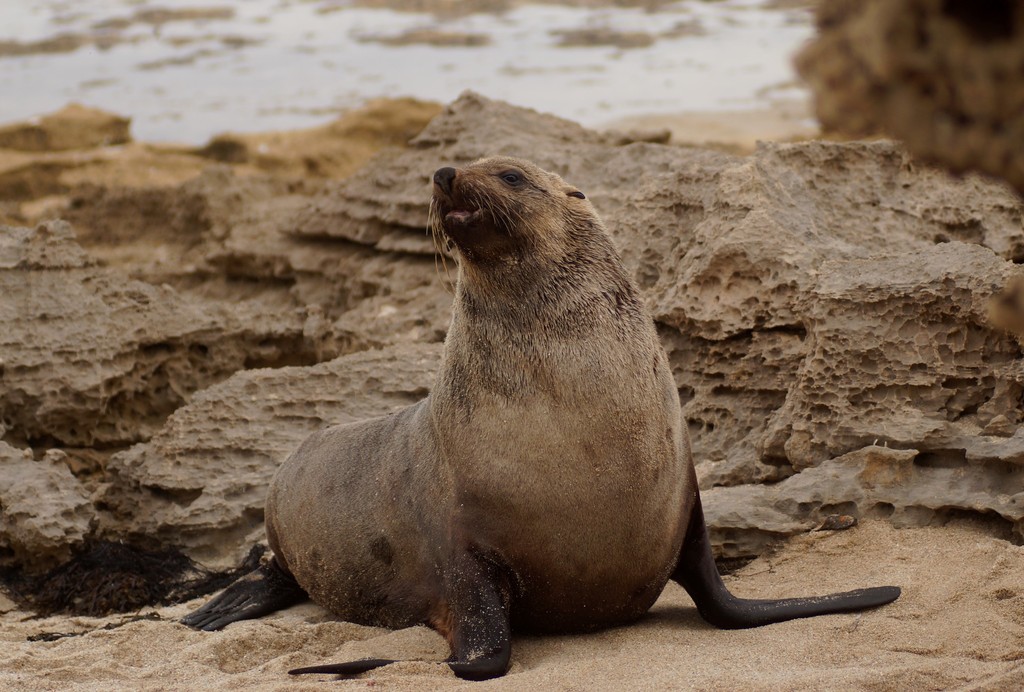
Males about 1.8 to 2.3 m (5.9 to 7.5 ft); females about 1.2 to 1.8 m (3.9 to 5.9 ft). Sources give slightly different ranges
Weight
Males about 190 to 360 kg (420 to 790 lb); females about 35 to 110 kg (77 to 240 lb). Newborn pups about 5 to 8 kg
Next to a person
A big male is longer than most adults are tall and can weigh as much as three or four adults. Females are nearer a person in length but still heavier.
What it eats
Octopus, squid, cuttlefish, lobsters and fish such as sardines, anchovies, mackerel and hake. Dives average about 120 m and can reach about 200 m, and the whiskers help detect prey.
Around people
Calm, give space
How it lives
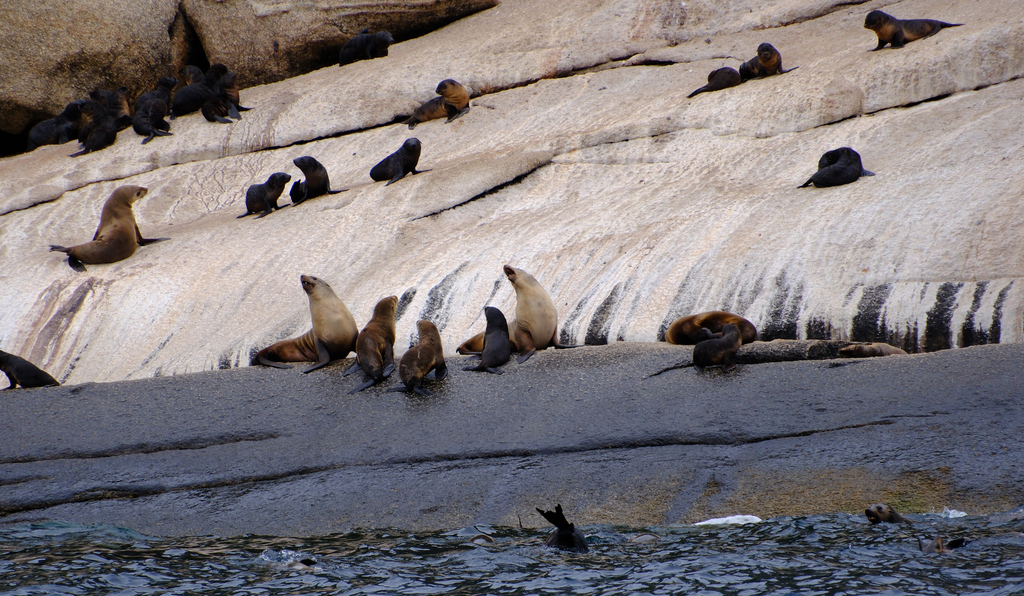
It rests and breeds on rocky islands and outcrops in Bass Strait, on four islands off Victoria and five off Tasmania. Females breed from about 3 to 4 years and have one pup a year, born from early November to late December. Pups are nursed for about 8 to 10 months. Males take about 9 years to hold a territory. At resting sites the seals lie close together, often touching.
Where it goes
Seals breed on rocky islands in Bass Strait and rest on haul-outs along the Tasmanian and mainland coasts. At Montague Island in New South Wales, more than 1,000 fur seals can be present in winter and spring, falling to about 200 after December, and they do not stay long at one spot. Females alternate 3 to 4 days feeding at sea with 2 to 3 days nursing ashore.
We only draw a journey on the map when scientists have tracked it or clearly documented it. For this animal we have not found one yet.
Populations
Least Concern on the IUCN Red List for the species Arctocephalus pusillus as a whole, which also includes the African subspecies. The Australian form was hunted heavily from 1798 to 1825, and sealing stopped in Australia in 1923. Numbers are recovering: a count in 2007 found 21,882 live pups, similar to 2002, with three new breeding sites, and growth of about 5% a year was recorded since the 1980s. The largest colonies are Seal Rocks off Phillip Island (5,660 pups in 2007) and Lady Julia Percy Island (5,574 pups). Phillip Island Nature Parks says about 20,000 seals use Seal Rocks, about a quarter of the population, and that the population is about half of its original size. Estimates differ by source and year. It is listed as Vulnerable in New South Wales.
Meet it respectfully
Watch from a distance and never land at a seal colony, because pups can be hurt in a stampede. Do not touch, feed, chase or corner seals, and take rubbish home. Tasmania asks boats to stay at least 100 m from a colony in November and December and at least 50 m at other times, and to slow to under 10 knots within 200 m and 5 knots within 100 m. Seals can bite. Other states and sites have their own rules, so follow your guide.
Fun fact
Tap the bulb to light it up.
Australian fur seals pile onto rocks, often on top of one another. New Zealand fur seals that share the same island keep more space and defend it.
Seal Rocks off Phillip Island hosts about 20,000 seals, about a quarter of the population.
Males live about 19 years and females about 21 years, according to MarineBio.
Australian fur seal in the Ocean Atlas
Places we have researched where this animal is recorded. It is never guaranteed, and some places are for watching from the boat only.
Travel with usComing soonTrusted referralExploringOn pause, story onlyEthics pass
Country colour: pink where we travel, blue where we are exploring or refer, grey for story only.
 Australia
Sources for this page
- Wikipedia, Brown fur seal, 2026
- Kirkwood et al., Marine and Freshwater Research, 2010
- Phillip Island Nature Parks, 2026
- MarineBio Conservation Society, 2026
- NRE Tasmania, Seal watching guidelines, 2026
- NSW National Parks, Australian fur seal, 2026
- Montague Island Tours, Wildlife, 2026
- IUCN Red List (species), via GBIF, 2026
Facts checked 5 October 2026. Photos: Unsplash licence, or Creative Commons as shown on each photo.
Work in ocean travel?
We are always happy to hear from exceptional local operators, accommodation, conservation organisations and destination experts. If your work fits responsible, small-group ocean travel, we would love to learn more.
Partner with Ocean CallingShop with Ocean Calling
Visit the Ocean Calling storefront on Amazon.
As an Amazon Associate I earn from qualifying purchases. You are not only choosing products that respect the ocean, you are also helping us keep going: paying our local partners fairly and keeping our retreats ethical, sustainable and honestly priced for you. 💗