
Bat ray
Myliobatis californica
A dark wing gliding over sand and kelp. Bat rays come and go as they please, and no sighting is ever a promise.
Least Concern (IUCN) means it is not at high risk of extinction. Wikipedia dates the assessment to 2015 and California Sea Grant says it has been Least Concern since 2006; I could not open the IUCN page itself to confirm the year.
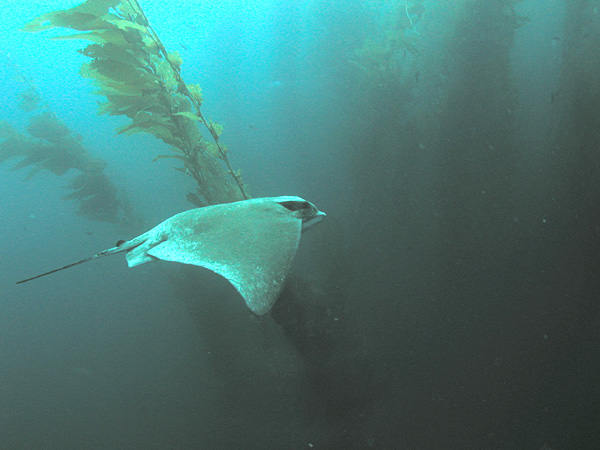
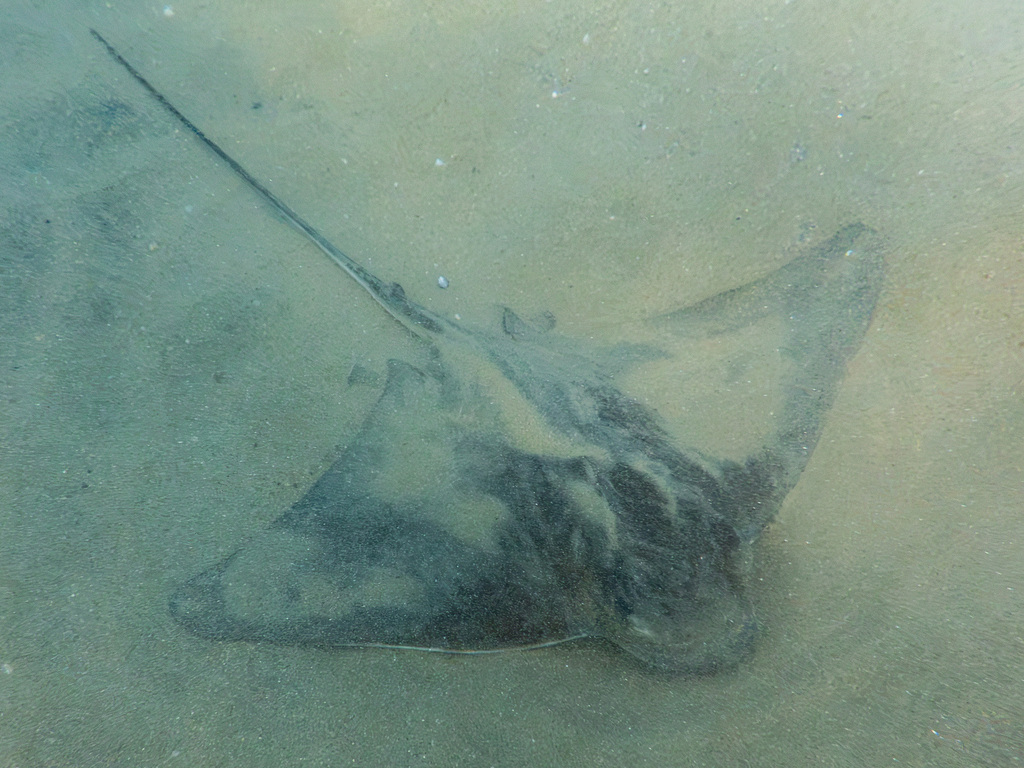
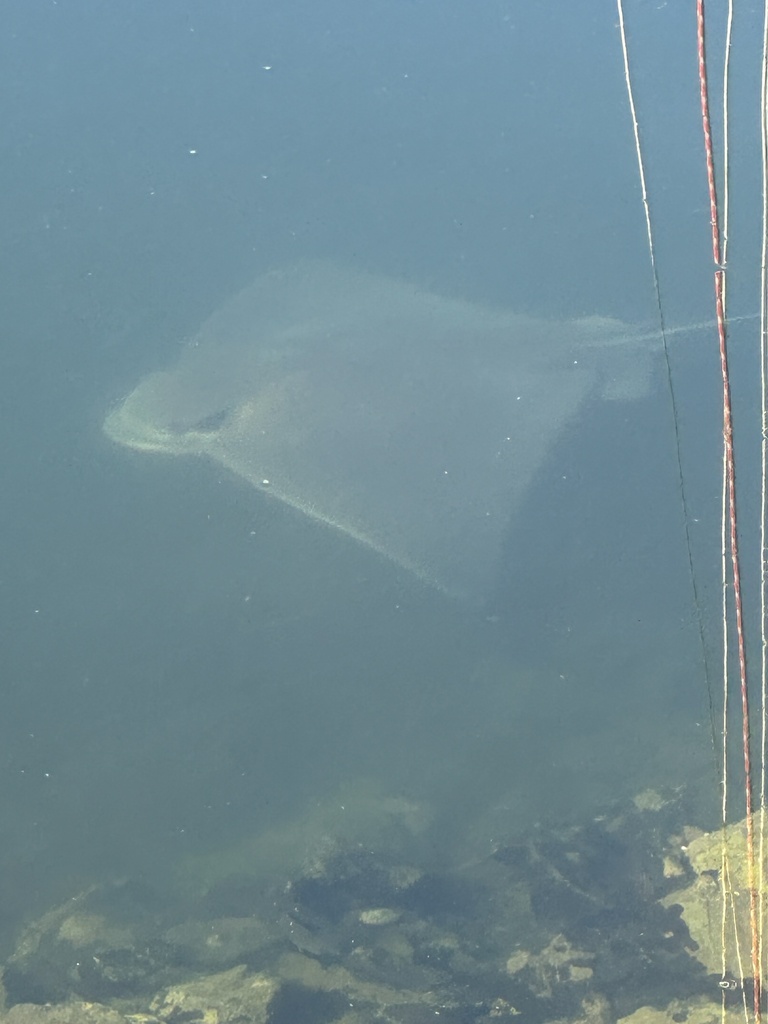
Photos show the species, not always the places on this page.
Length
Disc width up to about 1.8 m (5 ft 11 in) in most sources; California Sea Grant gives about 2 m (6 ft) for the largest females. Males are smaller, with the largest caught about 1 m (3 ft) across. FishBase gives a common width of about 1 m (3 ft 3 in)
Weight
Females up to about 90 kg (200 lb) and males up to about 17 kg (37 lb) according to Monterey Bay Aquarium and Sea Grant. FishBase lists a maximum published weight of 82.1 kg (181 lb), and Wikipedia says typical animals weigh about 9 to 14 kg (20 to 31 lb)
Next to a person
A large female is about as wide as a tall adult is tall, and can weigh as much as a heavy adult
What it eats
Clams, snails, crabs, shrimp, worms and some small fish. It uncovers prey by flapping its pectoral fins and digging with its snout, and crushes shells with flat, fused tooth plates. Wikipedia says it can dig trenches up to 20 cm (8 in) deep. California Sea Grant notes that it also eats crabs.
Around people
Calm, give space
How it lives
Bat rays live up to about 23 years. They give birth to live young (ovoviviparous): pregnancy lasts about 9 to 12 months, with 2 to 10 pups. Mating is in spring or summer. Males mature at about 2 to 3 years and females at about 5 to 6 years (Wikipedia). They are found from the surface to at least 108 m (FishBase), and California Sea Grant says to 180 m, over sand, mud, rock, kelp beds and in bays and estuaries. Some live alone and some gather in schools of thousands. They can leap out of the water. Predators include California sea lions and broadnose sevengill sharks.
Where it goes
Bat rays can be solitary or in large groups. Animal Diversity Web describes females as highly mobile within their range, and California Sea Grant says shallow bays and sloughs act as nurseries. I did not open a source with firm migration routes.
We only draw a journey on the map when scientists have tracked it or clearly documented it. For this animal we have not found one yet.
Populations
The range runs from central Oregon to the Gulf of California, including the Galapagos Islands (Wikipedia, FishBase). It is rated Least Concern by IUCN. California Sea Grant says stocks are considered stable and increasing, with sport and incidental catch but no formal management plan. There is no commercial fishery in California, while Wikipedia and Monterey Bay Aquarium say it is fished in Mexican waters. FishBase rates it as very vulnerable to fishing (75 out of 100) with low resilience, so population doubling takes 4.5 to 14 years.
Meet it respectfully
Watch from a calm distance and let the ray choose where it goes. Never chase, touch, ride, feed or corner a bat ray. It has one to three venomous spines at the base of the tail, used only in defence, and Wikipedia says it is not considered dangerous unless attacked or frightened. Keep clear of resting rays on the seabed and in shallow bays. Follow local rules and your guide.
Fun fact
Tap the bulb to light it up.
Bat rays can leap clear of the water and skim along the surface.
Their flat, fused teeth crush whole clams, and the shells are then spat out.
California sea lions and broadnose sevengill sharks are among the animals that prey on them.
Bat ray in the Ocean Atlas
Places we have researched where this animal is recorded. It is never guaranteed, and some places are for watching from the boat only.
Travel with usComing soonTrusted referralExploringOn pause, story onlyEthics pass
Country colour: pink where we travel, blue where we are exploring or refer, grey for story only.
 Mexico
 United States
Sources for this page
- Wikipedia, 2026
- FishBase, 2026
- Monterey Bay Aquarium, 2026
- California Sea Grant, 2026
- Animal Diversity Web, 2026
- MarineBio Conservation Society, 2026
- GBIF, IUCN Red List category, 2026
Facts checked 5 October 2026. Photos: Unsplash licence, or Creative Commons as shown on each photo.
Work in ocean travel?
We are always happy to hear from exceptional local operators, accommodation, conservation organisations and destination experts. If your work fits responsible, small-group ocean travel, we would love to learn more.
Partner with Ocean Calling7-day freediving course in Coron, Palawan
CHF 1,480