
Burrunan dolphin
Tursiops australis
A rare dolphin of a few southern Australian bays and lakes. Seeing one is never promised, and each sighting is a privilege.
Not Evaluated means the IUCN has not assessed this species. In Victoria it is listed as Critically Endangered under state law (October 2021).


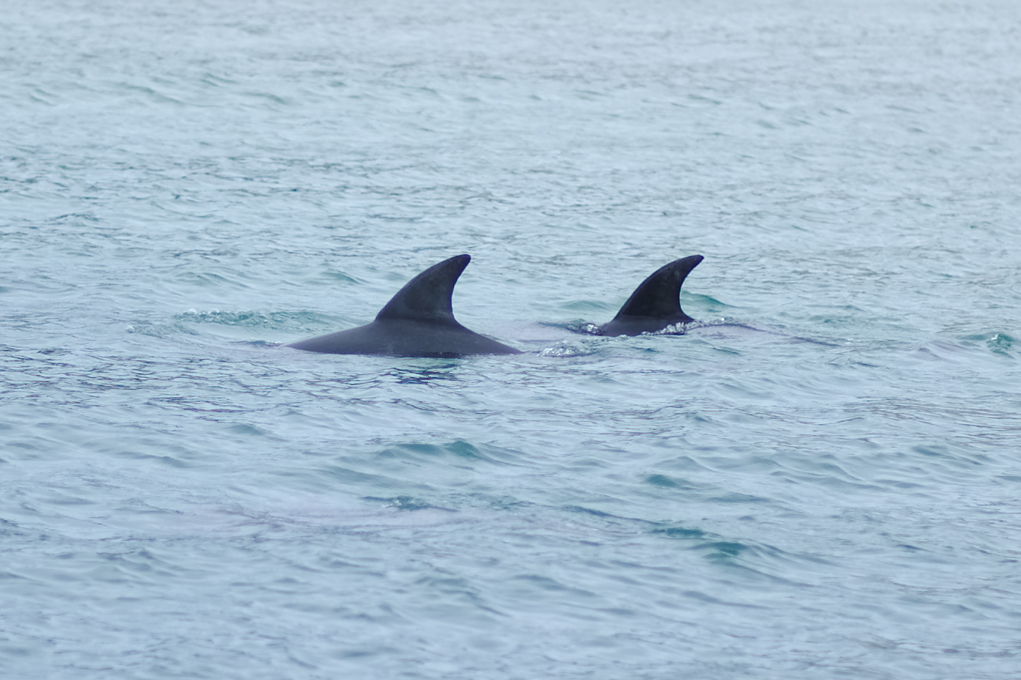
Photos show the species, not always the places on this page.
Length
Mean about 2.57 m (8.4 ft), range 2.27 to 2.78 m (7.4 to 9.1 ft) in the original description
Weight
Weight is not given in the sources read. It is smaller than the common bottlenose dolphin, which can reach about 4 m (13 ft)
Next to a person
About 1.5 times as long as an adult person is tall
What it eats
The diet is only suspected. Studies in Port Phillip Bay list garfish, calamari squid, snapper, sand flathead, yellowfin bream, barracouta, King George whiting and Australian salmon. Where prey is, the dolphins tend to follow.
Around people
Calm, give space
How it lives
Burrunan dolphins are tri-coloured: a darker grey back, lighter grey flanks and a white belly, with a curved dorsal fin and a short, stubby beak. Scientists tell individuals apart by the nicks and notches in the dorsal fin. Calves are born with clean fins that pick up marks over time. In Port Phillip Bay the dolphins favour waters about 5 to 15 m deep, especially where seagrass, rhodolith beds and rock meet soft sediment. Breeding and lifespan were not described in the sources read.
Where it goes
Port Phillip Bay dolphins are present all year in the southern bay. In winter and spring they spread further north, probably following prey. Two resident groups are known in Victoria, in Port Phillip Bay and the Gippsland Lakes. Genetic matches have also been found in Tasmania and South Australia.
We only draw a journey on the map when scientists have tracked it or clearly documented it. For this animal we have not found one yet.
Populations
Counts differ with method and year. The 2011 species description gave about 90 animals in Port Phillip Bay and about 50 in the Gippsland Lakes. A 2015 to 2021 boat survey estimated about 150 resident dolphins in Port Phillip Bay. A research foundation lists 120 in Port Phillip Bay and 65 in the Gippsland Lakes. The species has not been assessed by IUCN. In Victoria it has been listed as Critically Endangered under the Flora and Fauna Guarantee Act 1988 since October 2021. It is not formally listed under the national EPBC Act. Some scientists treat it as a form of the Indo-Pacific bottlenose dolphin, so its status as a full species is debated.
Meet it respectfully
Let the dolphins set the distance and keep your approach calm. Never chase, surround, touch, feed or bait them. In Victoria, the guidance read asks boats, paddle boards and kayaks to stay at least 100 m away, and jet skis 300 m. Slow down, do not head straight at the dolphins, and move away if they change direction or splash their tails. Follow local rules and your guide.
Fun fact
Tap the bulb to light it up.
It was described as a new species in 2011.
Its name comes from an Aboriginal word for a large sea fish of the porpoise kind.
Fin nicks work like fingerprints, so individuals can be recognised over time.
Burrunan dolphin in the Ocean Atlas
Places we have researched where this animal is recorded. It is never guaranteed, and some places are for watching from the boat only.
Travel with usComing soonTrusted referralExploringOn pause, story onlyEthics pass
Country colour: pink where we travel, blue where we are exploring or refer, grey for story only.
 Australia
Sources for this page
- Charlton-Robb et al., 2011, PLoS ONE
- Wikipedia, Burrunan dolphin, 2026
- Marine Mammal Foundation, 2026
- Beddoe et al., 2024, Ecology and Evolution
- GBIF, IUCN Red List category, 2026
Facts checked 5 October 2026. Photos: Unsplash licence, or Creative Commons as shown on each photo.
Work in ocean travel?
We are always happy to hear from exceptional local operators, accommodation, conservation organisations and destination experts. If your work fits responsible, small-group ocean travel, we would love to learn more.
Partner with Ocean CallingSwim with humpback whales in Moʻorea, September 2027
from CHF 4,500