
California sheephead
Semicossyphus pulcher
A pink-banded fish with a dark head, moving through the kelp in its own time. No sighting is ever a promise.
Vulnerable (IUCN, 2006) means it is at high risk of extinction in the wild, mainly because fishing off southern California has removed many of the largest fish.
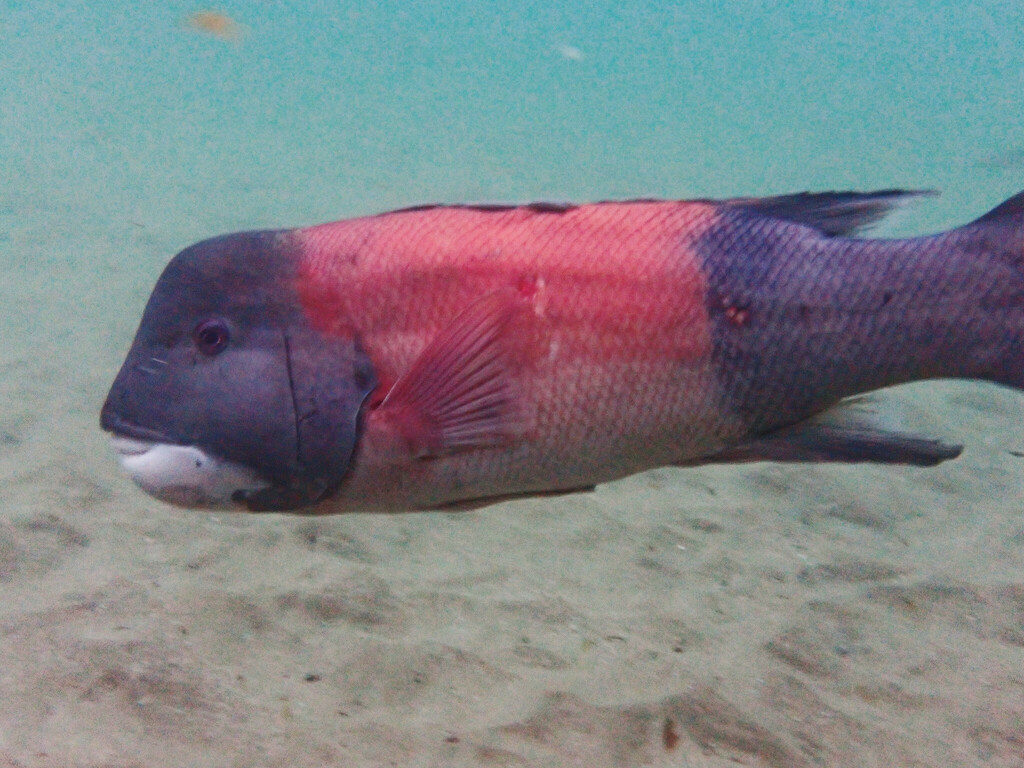
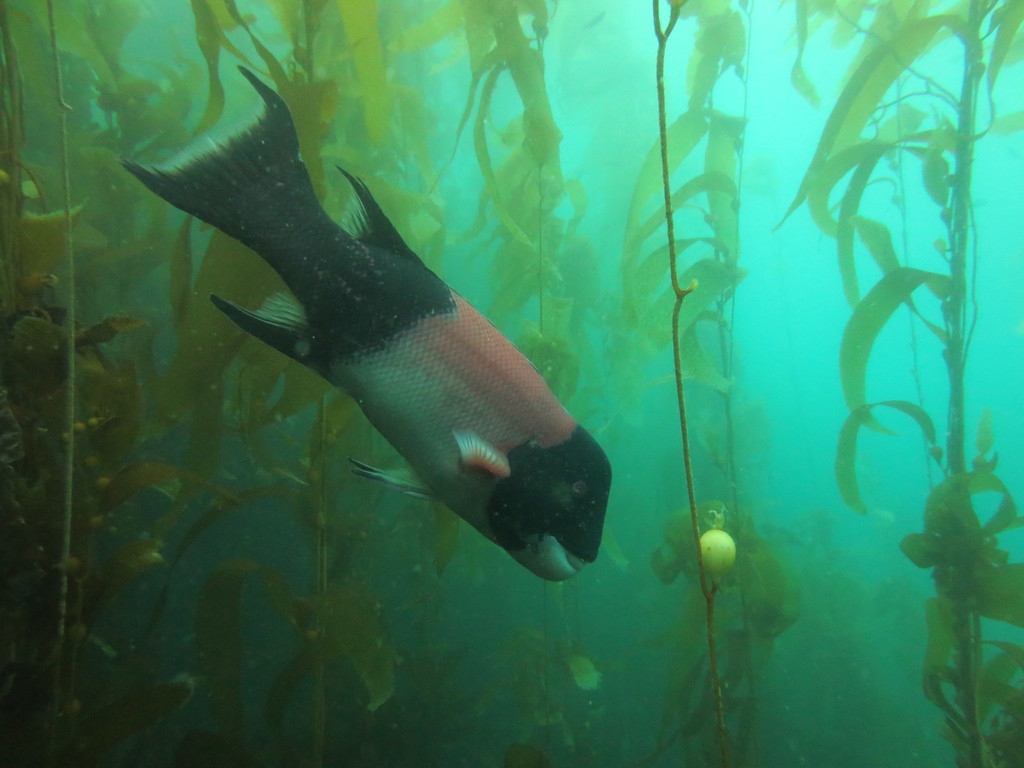
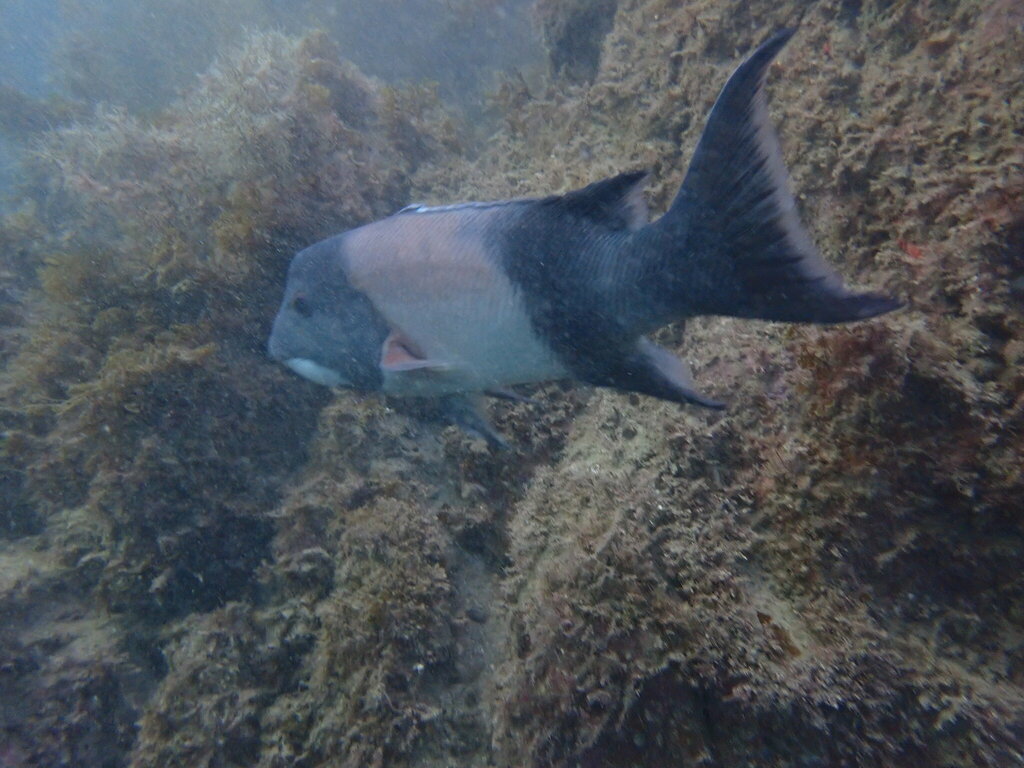
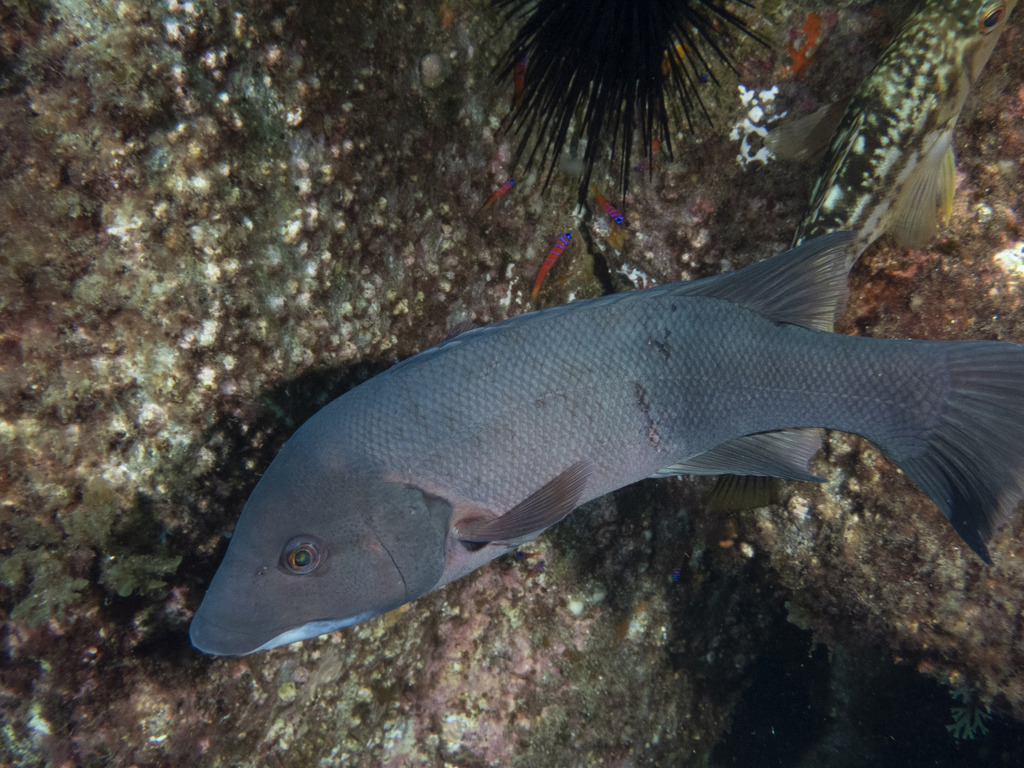
Photos show the species, not always the places on this page.
Length
Up to about 91 cm (36 in). Typical adult size is not well documented.
Weight
Up to about 16 kg (35 lb) reported.
Next to a person
The largest are about half the height of an adult, and as heavy as a young child.
What it eats
Hard-shelled animals such as sea urchins, mussels, clams, snails, crabs and lobsters, plus barnacles, squid and sand dollars. Strong jaws and a plate of teeth in the throat crush the shells. Studies in southern California found that larger sheephead eat more urchins and larger urchins than small ones.
Around people
Calm, give space
How it lives
Sheephead hunt by day and shelter in rock crevices at night, wrapped in a mucus cocoon. They usually live on rocky reefs and kelp beds, mostly 3 to 30 m deep, with records down to 150 m. All start life as females and some later change into males, at ages that range from about 5 to 13 years depending on food and local conditions. Breeding runs from late June to early September, when males become territorial. Sexual maturity comes at around age 4, and the oldest recorded fish reached 53 years.
Where it goes
No long migration is described in the sources read. Adults live around rocky reefs and kelp beds and shelter in crevices at night. The range runs from Monterey Bay to the Gulf of California, and sheephead are rarely found north of Point Conception except in warm El Nino periods.
We only draw a journey on the map when scientists have tracked it or clearly documented it. For this animal we have not found one yet.
Populations
Listed as Vulnerable by the IUCN (assessment dated 2006, criteria A2bd), with overfishing as the main threat. California carried out its first stock assessment in 2004. A study of southern California published in 2015 found that fishing reduces the size of sheephead, while marine reserves and effort limits bring back higher density, larger size and more biomass. In Baja California, a 2025 study found larger sheephead inside community-led reserves than in federally managed areas. A total population count is not available in the sources read.
Meet it respectfully
Give the fish room and let it come and go. Never chase, touch, feed or bait it, and do not poke into the crevices where sheephead rest at night. Males defend territory in summer, so keep extra distance from a large male. Large teeth can cause serious bite wounds if a fish is handled. Take care not to kick or stand on reef and kelp. Follow local rules and your guide.
Fun fact
Tap the bulb to light it up.
Every sheephead starts life as a female, and some later become males.
At night a sheephead tucks into a crevice and wraps itself in a mucus cocoon, which is thought to mask its scent.
Larger sheephead eat more and bigger sea urchins, so big fish help keep urchins from overgrazing kelp.
California sheephead in the Ocean Atlas
Places we have researched where this animal is recorded. It is never guaranteed, and some places are for watching from the boat only.
Travel with usComing soonTrusted referralExploringOn pause, story onlyEthics pass
Country colour: pink where we travel, blue where we are exploring or refer, grey for story only.
 Chile
 Mexico
 United States
Sources for this page
- Monterey Bay Aquarium, California sheephead
- FishBase, 2026
- Animal Diversity Web, University of Michigan
- California Sea Grant, UC San Diego
- California Department of Fish and Wildlife, 2004 stock assessment
- Hamilton and Caselle, 2015, Proceedings of the Royal Society B
- Bauer et al., 2025, Scientific Reports
- GBIF, IUCN Red List category
Facts checked 5 October 2026. Photos: Unsplash licence, or Creative Commons as shown on each photo.
Work in ocean travel?
We are always happy to hear from exceptional local operators, accommodation, conservation organisations and destination experts. If your work fits responsible, small-group ocean travel, we would love to learn more.
Partner with Ocean Calling7-day freediving course in Coron, Palawan
CHF 1,480