
Cocos buff-banded rail
Hypotaenidia philippensis andrewsi
A small barred rail found nowhere else on Earth, and no sighting is ever a promise.
Endangered (The Action Plan for Australian Birds 2020, using IUCN criteria) applies to this Cocos subspecies. The buff-banded rail as a whole is Least Concern on the IUCN Red List.
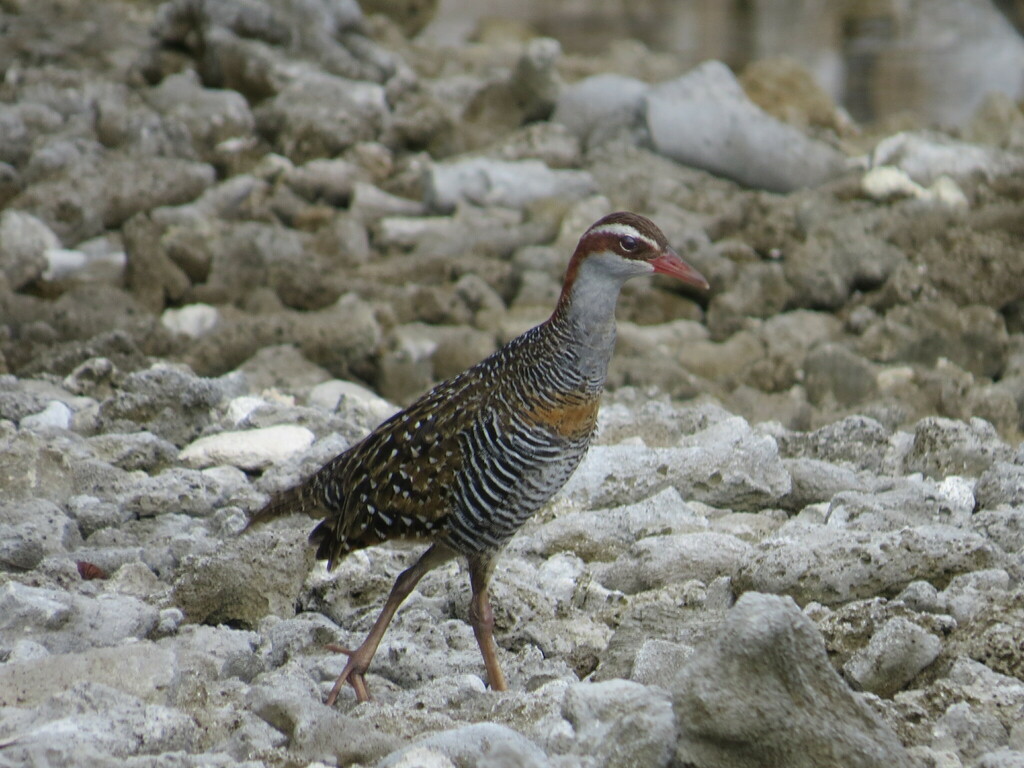
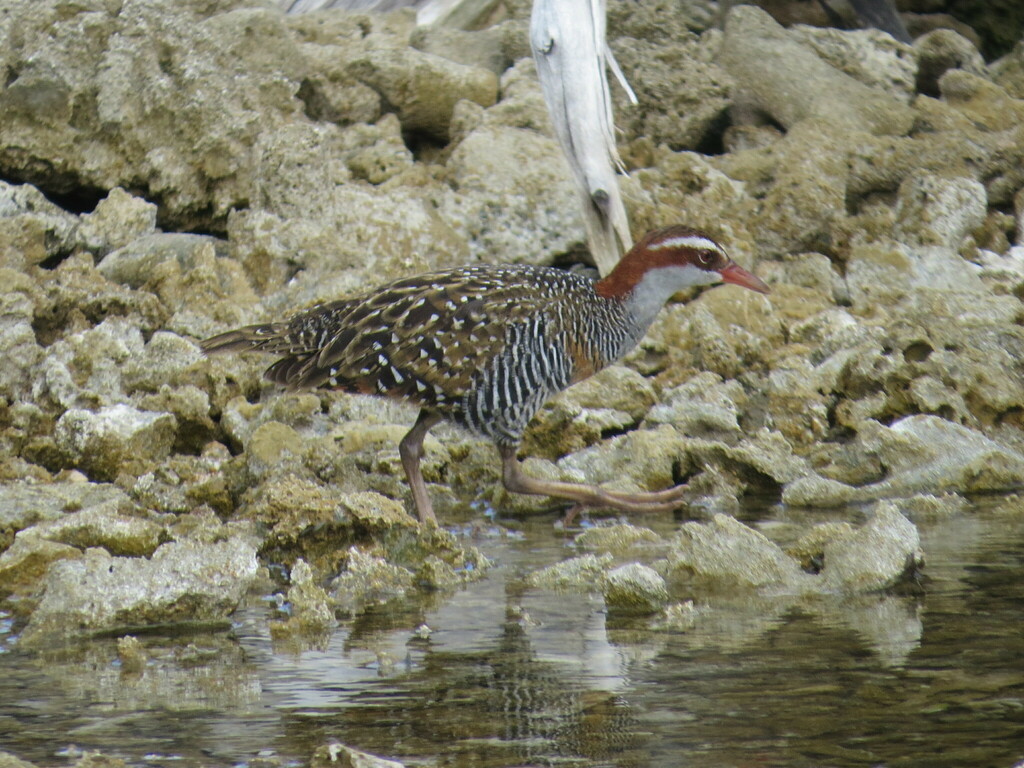
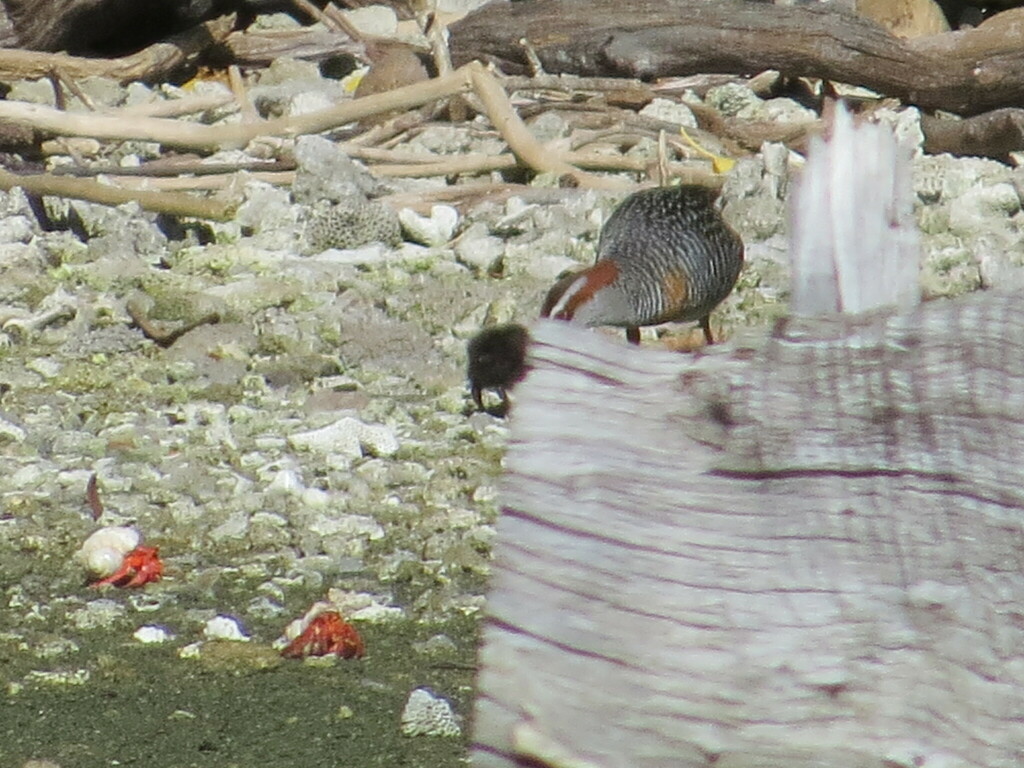
Photos show the species, not always the places on this page.
Length
About 25 to 33 cm (10 to 13 in) for the buff-banded rail as a whole, with a wingspan of 40 to 52 cm (16 to 20 in). Pulu Keeling National Park describes the Cocos form as about the size of a small chicken
Weight
Buff-banded rails average about 185 g (6.5 oz) for males and 172 g (6.1 oz) for females, up to 303 g (10.7 oz). I did not read weights measured on the Cocos form
Next to a person
About the length of an adult's forearm and hand, and about as heavy as a large apple
What it eats
Crustaceans, molluscs, insects, worms, seeds, fruits, eggs and carrion. On North Keeling it is often seen foraging for crustaceans along the lagoon shore.
Around people
Calm, give space
How it lives
The Cocos rail uses all ground habitats on North Keeling, from the lagoon shore to the forest floor, at about 7 to 8 birds per hectare according to Wikipedia. I did not read a source on its own breeding. For the buff-banded rail as a whole, nests are in dense vegetation near water, clutches are 2 to 8 eggs, both parents incubate for 18 to 19 days, and chicks leave the nest soon after hatching.
Where it goes
This rail lives on the ground and was once found across the southern atoll before disappearing there. People have since moved it: in April 2013, 39 rails from Pulu Keeling were released on Horsburgh Island in the southern atoll. Buff-banded rails as a species can fly and are highly dispersive, but I did not read how far this subspecies travels.
We only draw a journey on the map when scientists have tracked it or clearly documented it. For this animal we have not found one yet.
Populations
This is a subspecies of the buff-banded rail, which is Least Concern worldwide. The Cocos form is listed as Endangered under Australia's EPBC Act, and The Action Plan for Australian Birds 2020 assesses it as Endangered against IUCN criteria (A2b, B1+2ab(v), C1). It declined after human settlement of the southern atoll and the last confirmed record there before the reintroduction was in 1991, leaving about 800 birds on Pulu Keeling. The population on Horsburgh Island grew from 39 released birds to about 54 in October 2014 and about 121 in June 2015. Pulu Keeling National Park now says about 700 rails live in the park, while Wikipedia gives 850 to 1,000. The action plan says the small Pulu Keeling population appeared to have declined steeply in recent years. Listed threats include introduced yellow crazy ants, a possible arrival of new predators and cyclones.
Meet it respectfully
Keep your distance, never chase, feed or handle a bird, and stay away from nesting ground. Rails are wild ground-dwelling birds, and introduced predators and ants are among the listed threats. North Keeling Island is open by permit only and all birds in Pulu Keeling National Park are protected under the EPBC Act. I did not read viewing rules for the southern islands, so follow local guidance. A sighting is never a promise.
Fun fact
Tap the bulb to light it up.
It is the only bird in the Cocos (Keeling) Islands that is found nowhere else in the world.
In 2013, 39 rails were moved to Horsburgh Island, and the group there reached about 121 birds by June 2015.
It has appeared several times on postage stamps issued by the Australian Government.
Cocos buff-banded rail in the Ocean Atlas
Places we have researched where this animal is recorded. It is never guaranteed, and some places are for watching from the boat only.
Travel with usComing soonTrusted referralExploringOn pause, story onlyEthics pass
Country colour: pink where we travel, blue where we are exploring or refer, grey for story only.
 Cocos (Keeling) Islands
Sources for this page
- Pulu Keeling National Park, Cocos buff-banded rail
- Wikipedia, Cocos buff-banded rail, 2026
- Wikipedia, Buff-banded rail, 2026
- Woinarski et al., 2016, Emu
- Flores et al., 2021, The Action Plan for Australian Birds 2020, CSIRO
- Parks Australia, 2026
- Pulu Keeling National Park, Birds
- Wikipedia, Pulu Keeling National Park, 2026
Facts checked 5 October 2026. Photos: Unsplash licence, or Creative Commons as shown on each photo.
Work in ocean travel?
We are always happy to hear from exceptional local operators, accommodation, conservation organisations and destination experts. If your work fits responsible, small-group ocean travel, we would love to learn more.
Partner with Ocean Calling7-day freediving course in Coron, Palawan
CHF 1,480