
Commerson's dolphin
Cephalorhynchus commersonii
A small black-and-white dolphin riding the waves of a Patagonian bay. We watch from a respectful distance, and no sighting is ever a promise.
Least Concern (IUCN, 2017) means it is not at high risk of extinction right now, though local groups are small and vulnerable to fishing nets.
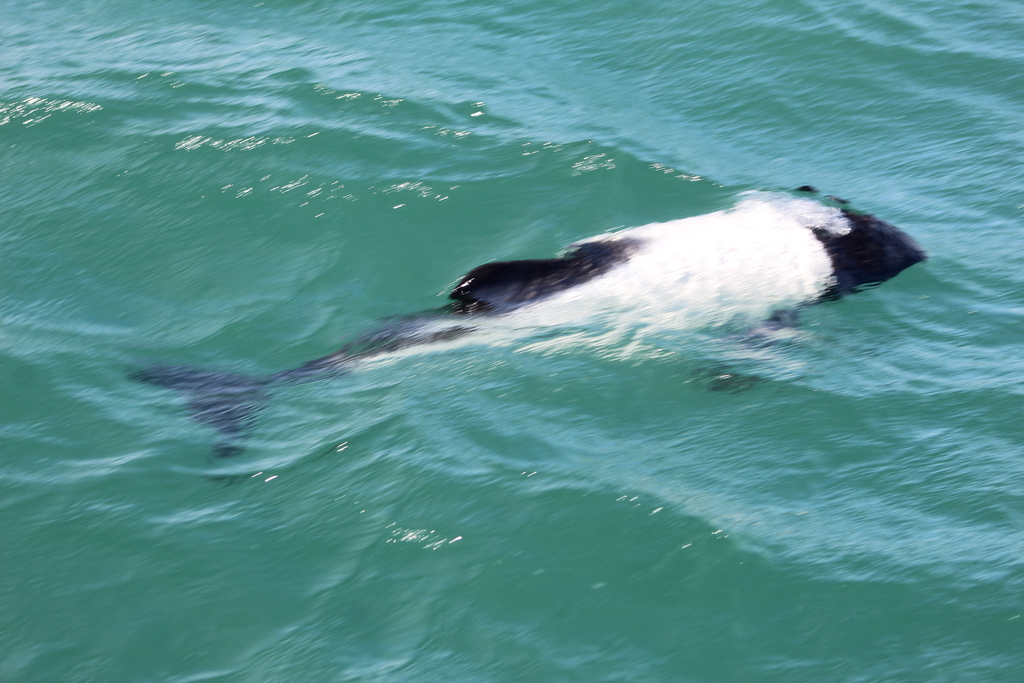
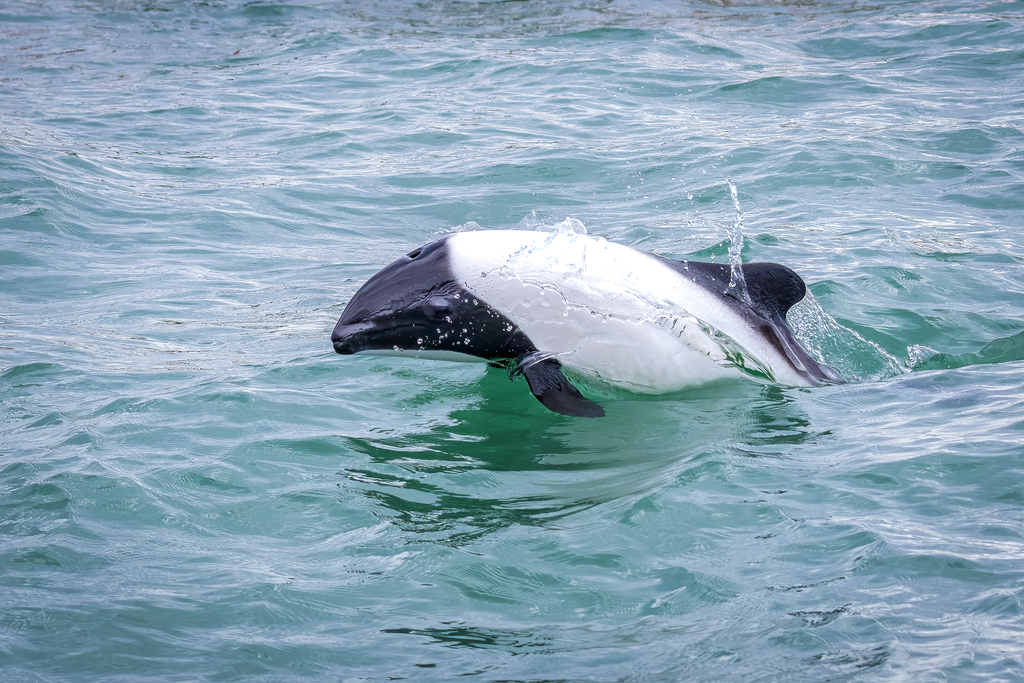
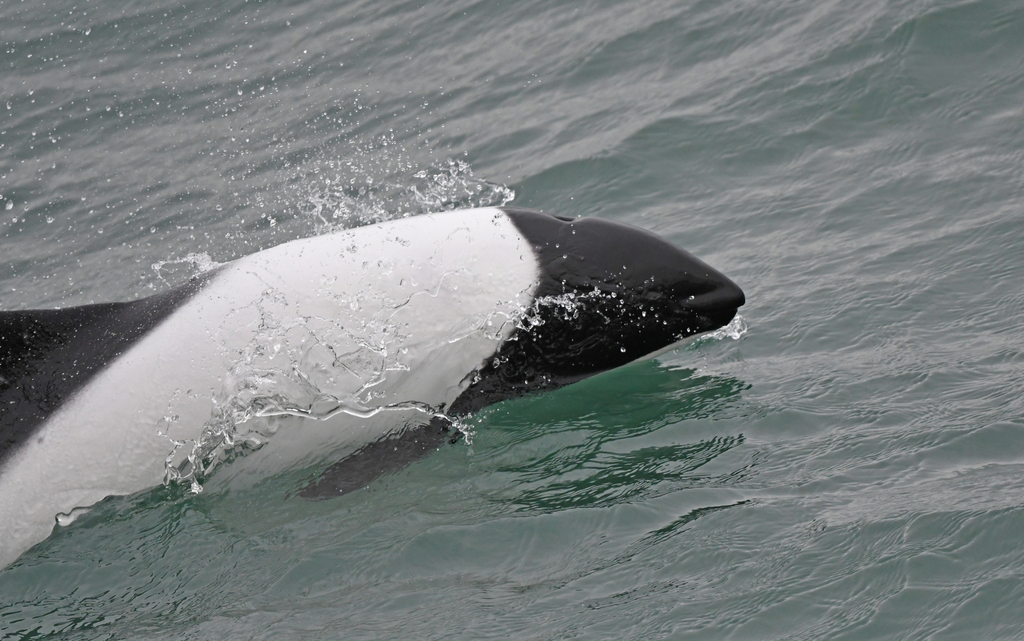
Photos show the species, not always the places on this page.
Length
About 1.2 to 1.5 m (3.9 to 4.9 ft)
Weight
About 35 to 65 kg (77 to 143 lb)
Next to a person
A little shorter than an adult is tall, and about as heavy as a small adult
What it eats
Mysid shrimp and small fish such as silversides, sardines and Argentine hake, plus squid, octopus and marine worms. Groups hunt by themselves or together, depending on the bay.
Around people
Playful, let it come
How it lives
Wild dolphins typically live about 10 years, and some reach 18 to 23. Calves are born from late September to early February after 10 to 12 months of pregnancy, and a female has one calf. Females first breed at about 5 to 9 years. Groups are usually one to three animals, and sometimes up to about 100.
Where it goes
Commerson's dolphins stay close to the coast, within about 60 km of shore and in water shallower than 200 m. Groups in different bays can be genetically distinct, and some, such as the group at Bahia Engano, are mostly year-round residents. A separate subspecies lives near the Kerguelen Islands, about 8,500 km away.
We only draw a journey on the map when scientists have tracked it or clearly documented it. For this animal we have not found one yet.
Populations
No overall population estimate was found. Surveys from 2009 to 2015 estimated about 21,933 dolphins in southern Patagonian waters in summer and autumn, with a wide margin of error (6,013 to 80,012). A 1984 survey counted about 3,200 in the Strait of Magellan. Local groups are small: about 350 at Bahia Engano, about 239 at Camarones, and 95 identified at Bahia San Julian since 1996. IUCN global status is Least Concern (2017). Gillnet entanglement is a known threat.
Meet it respectfully
Let the dolphins choose whether to come near. Keep the boat slow and steady, never chase, encircle or cut across their path, and never try to touch or feed them. Do not enter the water to approach them. Move away if the animals seem disturbed. Gillnets are a known danger, so choose boat trips that follow local rules. I did not read a specific local rule for this species, so follow your guide.
Fun fact
Tap the bulb to light it up.
Commerson's dolphin is one of the smallest dolphins, at about 1.5 m long at most.
Two groups live about 8,500 km apart: one around southern South America and the Falkland Islands, and one at the Kerguelen Islands.
They swim fast near the surface, leap and ride waves, at routine speeds of about 11 to 13 km/h.
Commerson's dolphin in the Ocean Atlas
Places we have researched where this animal is recorded. It is never guaranteed, and some places are for watching from the boat only.
Travel with usComing soonTrusted referralExploringOn pause, story onlyEthics pass
Country colour: pink where we travel, blue where we are exploring or refer, grey for story only.
 Argentina
 Chile
Chile Falkland Islands
Sources for this page
- Wikipedia, Commerson's dolphin
- Animal Diversity Web, Cephalorhynchus commersonii
- IMMA, Commerson's Dolphin Habitat Network
- Dellabianca et al., 2016, PLOS ONE
Facts checked 5 October 2026. Photos: Unsplash licence, or Creative Commons as shown on each photo.
Work in ocean travel?
We are always happy to hear from exceptional local operators, accommodation, conservation organisations and destination experts. If your work fits responsible, small-group ocean travel, we would love to learn more.
Partner with Ocean CallingShop with Ocean Calling
Visit the Ocean Calling storefront on Amazon.
As an Amazon Associate I earn from qualifying purchases. You are not only choosing products that respect the ocean, you are also helping us keep going: paying our local partners fairly and keeping our retreats ethical, sustainable and honestly priced for you. 💗