
Frogfish
Antennariidae
Look twice: a frogfish often looks like a sponge or a stone and can sit still for a long time. Spotting one takes patience and luck, and no sighting is a promise.
IUCN status varies by species. Most frogfishes checked were assessed as Least Concern around 2021, a few are Data Deficient or Not Evaluated.
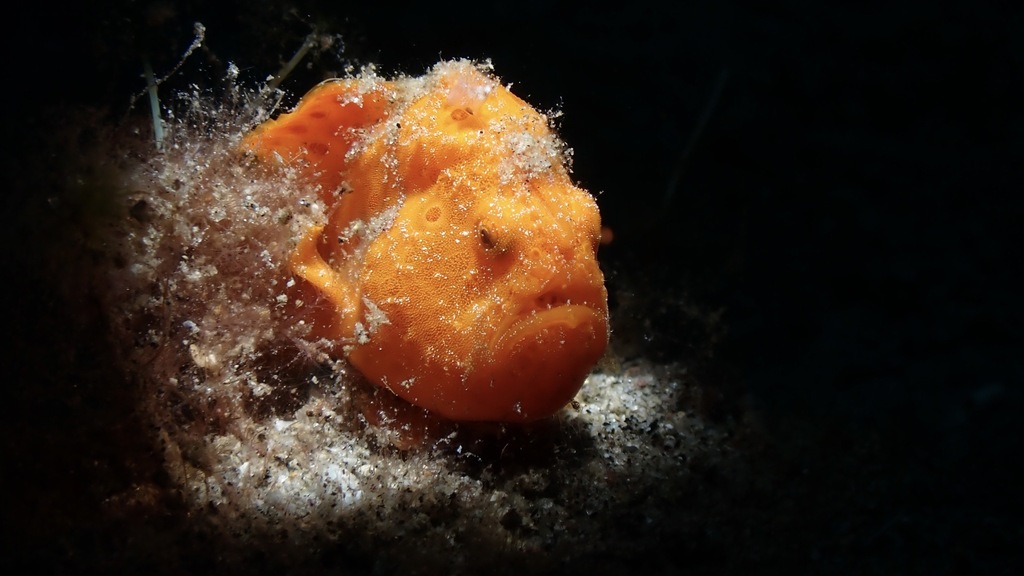
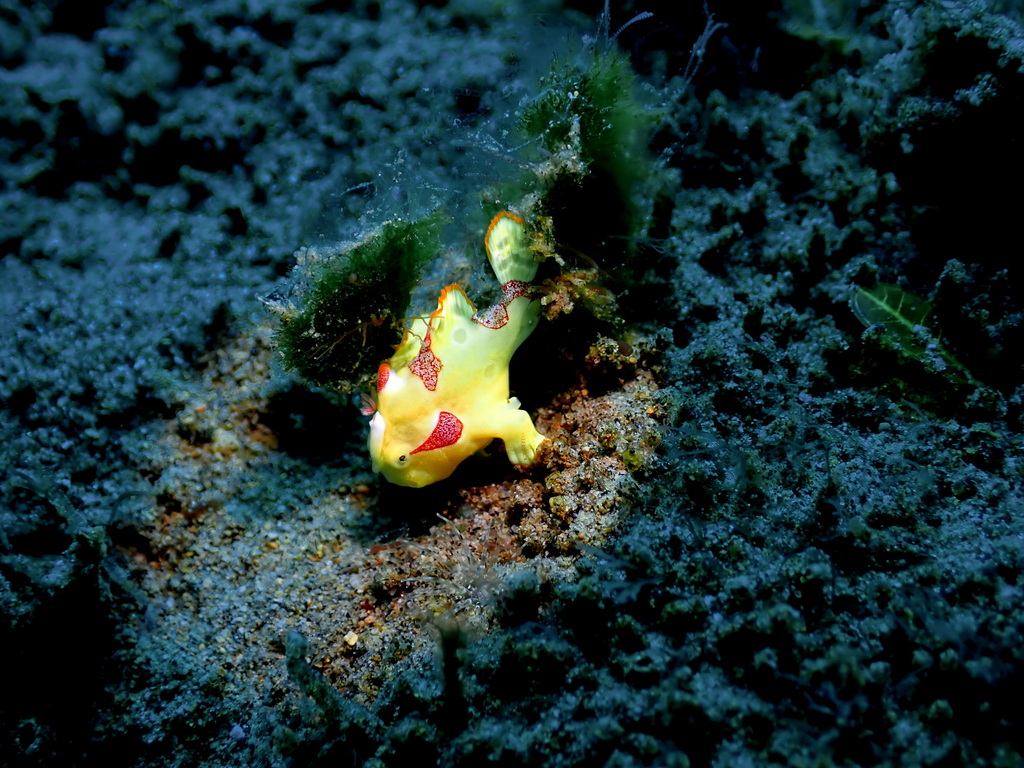
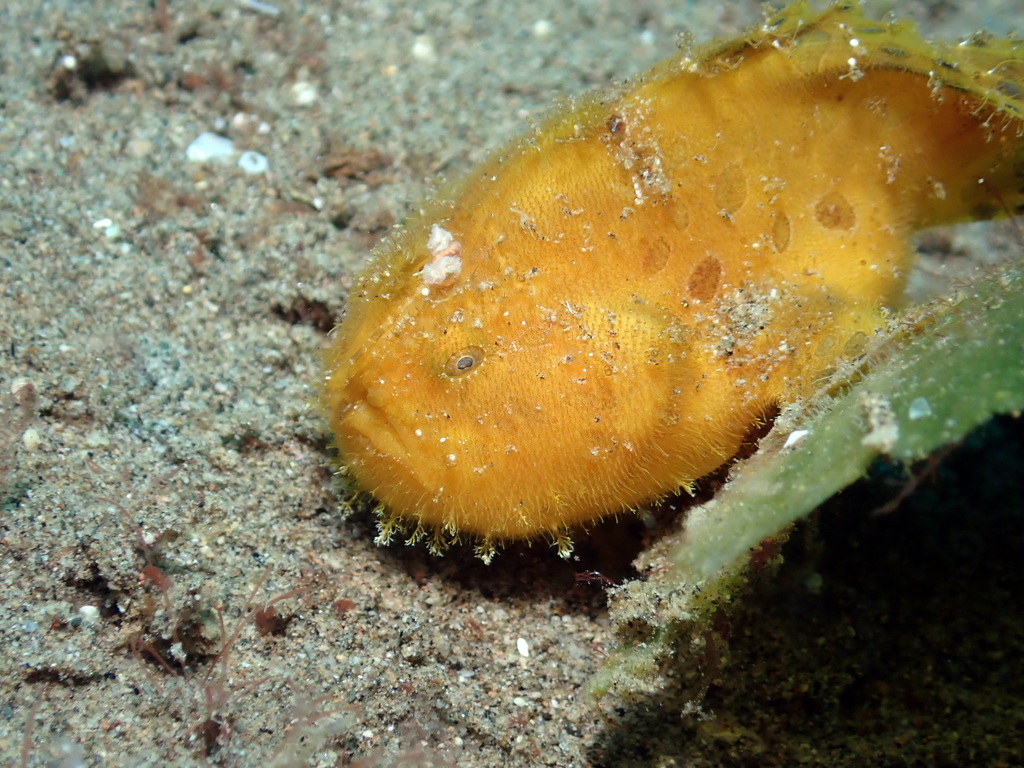
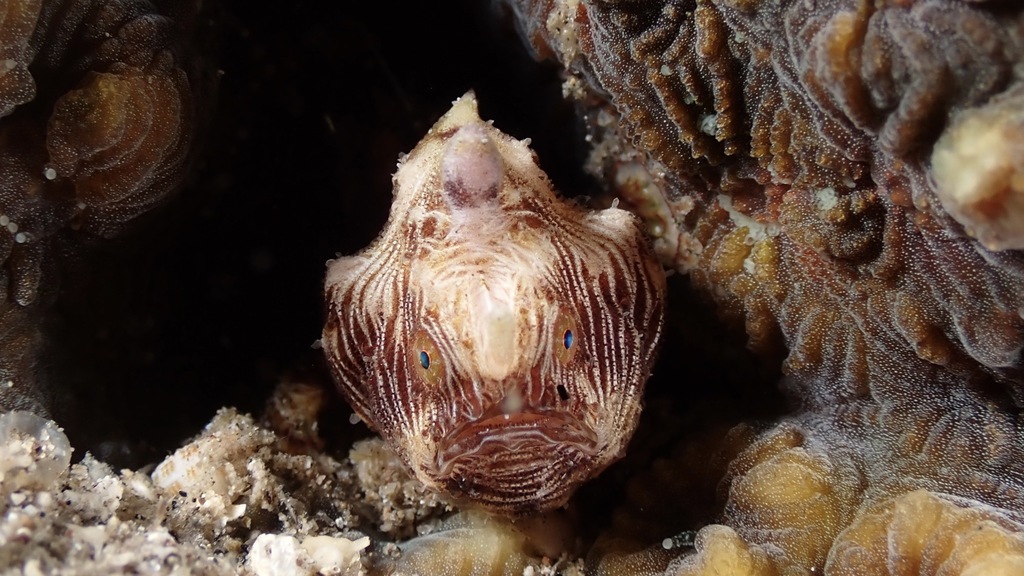
Photos show the species, not always the places on this page.
Length
About 2.5 to 38 cm (1 to 15 in) across the family; FishBase gives up to 45 cm (18 in) for Commerson's frogfish, one of the largest
Weight
Not given in the sources checked. They are small, stocky, scaleless fish.
Next to a person
From thumb-sized to about the length of a forearm and hand, depending on the species
What it eats
Crustaceans and other fish, and even other frogfish. A frogfish waves a lure on the tip of its first dorsal spine, then opens its jaws so fast that the mouth cavity swells up to 12 times in volume and sucks the prey in along with water. The strike can take as little as 6 milliseconds, and it can stretch its stomach to swallow animals up to twice its size.
Around people
Still, hands off
How it lives
Frogfishes are small and stocky, with scaleless skin that is often covered in bumpy spinules. Many species change colour, though a change can take days to weeks. They rarely swim, and prefer to clamber over the bottom on their fins. Most species spawn into open water, and the eggs form a floating gelatinous mass that can hold up to 180,000 eggs. A few species lay on a solid surface, and some males carry or guard the eggs. GBIF holds 112 records of frogfishes from Papua New Guinea, covering more than a dozen names, among them Antennatus coccineus, Antennarius hispidus, Histrio histrio, Antennarius pictus and Antennarius commerson. The sources checked do not break records down by province, so Milne Bay is not confirmed here.
Where it goes
Frogfishes mostly stay put. They wait on the sea floor for prey and cover only short stretches by walking on their fins. After hatching, the young drift as plankton for one to two months before settling on the bottom as tiny frogfish. The sargassumfish has fins adapted to grab strands of sargassum weed and climb through it.
We only draw a journey on the map when scientists have tracked it or clearly documented it. For this animal we have not found one yet.
Populations
There is no family-wide figure, and status differs by species. Of 12 frogfish species checked through GBIF's IUCN link, 9 are Least Concern (Antennatus coccineus, Antennarius hispidus, Antennatus nummifer, Antennatus tuberosus, Antennarius pictus, Antennarius commerson, Antennarius striatus, Antennarius maculatus, Antennarius randalli), Antennarius biocellatus is Data Deficient, Histiophryne cryptacanthus is Not Evaluated, and no category was found for the sargassumfish (Histrio histrio). FishBase lists the painted and Commerson's frogfish as Least Concern, assessed in 2021, and says they are of no interest to fisheries. The family is found in almost all tropical and subtropical seas.
Meet it respectfully
Look, but do not touch. Frogfish are scaleless and rely on staying hidden, and fish such as clownfish, damselfish and wrasses have been seen attacking a frogfish that was flushed from its hiding spot. Never move, poke, pose or feed one, and keep fins and hands off the sponge, sand or coral it sits on. Give your guide time to find them, and never promise yourself a sighting.
Fun fact
Tap the bulb to light it up.
A frogfish can swallow prey in about 6 milliseconds, too fast for other animals to see it happen.
The first dorsal spine works like a fishing rod. Its lure, called the esca, can look like a worm, shrimp or small fish, and it can be regrown if lost.
A colour change can last from a few days to several weeks, and what triggers it is unknown.
Frogfish in the Ocean Atlas
Places we have researched where this animal is recorded. It is never guaranteed, and some places are for watching from the boat only.
Travel with usComing soonTrusted referralExploringOn pause, story onlyEthics pass
Country colour: pink where we travel, blue where we are exploring or refer, grey for story only.
 Papua New Guinea
Sources for this page
- Wikipedia, Frogfish, 2026
- GBIF, frogfish records in Papua New Guinea, 2026
- FishBase, Antennarius pictus, 2026
- FishBase, Antennarius commerson, 2026
- Grobecker and Pietsch, Science, 1979
- Bootless Bay fish checklist, BMC Ecology, 2012
- GBIF, IUCN Red List categories by species, 2026
Facts checked 5 October 2026. Photos: Unsplash licence, or Creative Commons as shown on each photo.
Work in ocean travel?
We are always happy to hear from exceptional local operators, accommodation, conservation organisations and destination experts. If your work fits responsible, small-group ocean travel, we would love to learn more.
Partner with Ocean CallingNew: mobula rays in La Ventana, May 2027
CHF 2,720