
Ganges river dolphin
Platanista gangetica
A long snout and a grey back break the surface of a brown river, then are gone. A brief glimpse is never a promise.
Endangered (IUCN, 2022) means the Ganges river dolphin is at very high risk of extinction in the wild, because dams, fishing nets and pollution are breaking up and shrinking its river habitat.

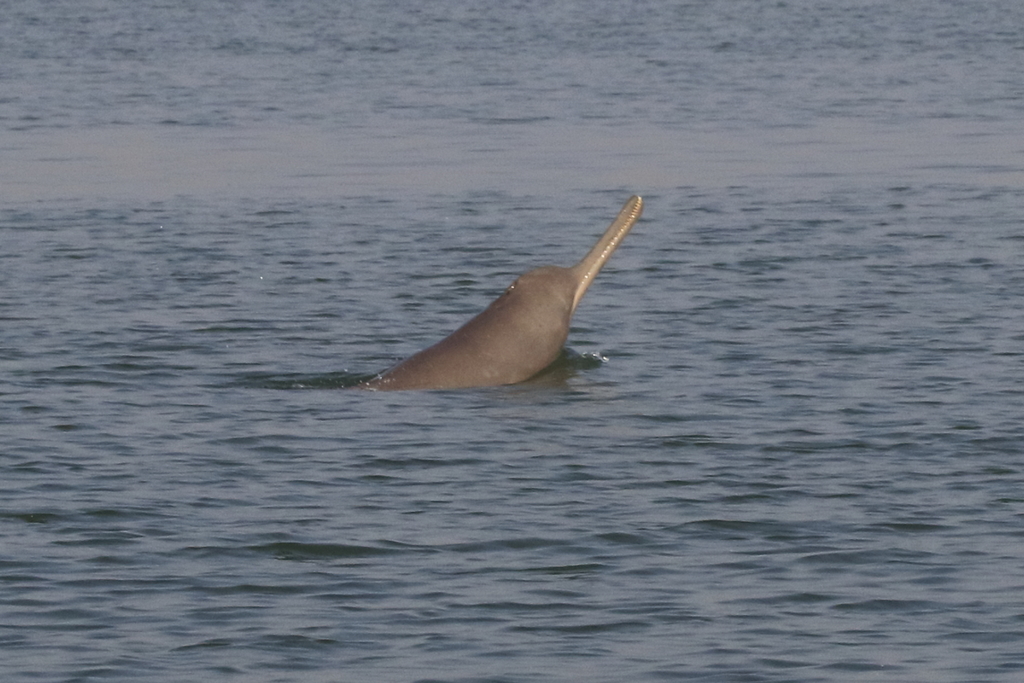


Photos show the species, not always the places on this page.
Length
Usually about 2.2 to 2.6 m (7.2 to 8.5 ft), with females larger than males. Animal Diversity Web gives a wider range of 2 to 4 m (6.6 to 13 ft). Newborns are about 70 cm (28 in)
Weight
About 51 to 89 kg (112 to 196 lb) according to Animal Diversity Web
Next to a person
A little longer than a tall adult, and about as heavy as one or two adults
What it eats
Fish such as carp, catfish and gobies, and crustaceans such as prawns. It feeds on and near the riverbed and uses echolocation to find prey hidden in the mud, because its eyes are poor and it is described as functionally blind.
Around people
Quiet, brief glimpses
How it lives
There is no single breeding season, though births peak from about October to January. Pregnancy lasts about 8 to 12 months and a single calf is born. The calf stays with its mother for about a year. Both sexes mature at about 10 years. Wild life span is thought to be about 18 to 30 years, and the oldest recorded male was 28. The dolphin swims on its side, tilted at about 10 degrees, and nods its head to search the riverbed. It surfaces every few minutes, and in a survey in Bangladesh single dolphins dived for about 68 seconds on average and groups of three for about 41 seconds.
Where it goes
Ganges river dolphins live in the Ganges, Brahmaputra, Meghna and Karnaphuli river basin across Nepal, India and Bangladesh. They prefer deep pools and eddies, and a study of the basin describes a strongly seasonal movement linked to river flow. In the Bangladesh Sundarbans, their distribution is linked to low salinity, high turbidity and moderate depth. Dolphins have also been surveyed in the Halda, Sangu and Karnaphuli rivers near Chattogram.
We only draw a journey on the map when scientists have tracked it or clearly documented it. For this animal we have not found one yet.
Populations
The IUCN lists the Ganges river dolphin as Endangered (assessed July 2022, status unchanged). The 2022 assessment put numbers at roughly 5,000 adults and juveniles, which is higher than earlier figures because more of the rivers in India, Nepal and Bangladesh were surveyed. Experts still describe a continuing, steady decline. A paper on the basin reports a fall from about 4,000 to 5,000 in 1982 to 3,526 in 2014, with 42 dams and barrages and six lost local populations. Wikipedia reports a 2025 survey that counted 6,324 dolphins in Indian waterways. In Bangladesh, the tidal waterways of the Sundarbans held about 225 Ganges river dolphins in a 2006 survey (Smith et al.), and some major Bangladeshi rivers have not yet been surveyed.
Meet it respectfully
Watch from a quiet, slow boat and let the dolphin choose the distance. Never chase, touch, feed or bait it, and never block its path or crowd it in a narrow channel. Keep boat speed low, and keep clear of fishing nets, because entanglement is a main threat to the species. Dives are short and usually only a back or snout shows, so sightings are brief and never guaranteed. I did not read local viewing rules for Bangladesh, so follow local rules and your guide.
Fun fact
Tap the bulb to light it up.
It swims on its side, tilted at about 10 degrees, and nods its head to search the riverbed.
It is functionally blind and finds its way and its food by echolocation in muddy water.
In the Bangladesh Sundarbans it shares the waterways with the Irrawaddy dolphin, with about 451 of those counted there.
Ganges river dolphin in the Ocean Atlas
Places we have researched where this animal is recorded. It is never guaranteed, and some places are for watching from the boat only.
Travel with usComing soonTrusted referralExploringOn pause, story onlyEthics pass
Country colour: pink where we travel, blue where we are exploring or refer, grey for story only.
 Bangladesh
 India
India Pakistan
Sources for this page
- Wildlife Conservation Trust, 2022
- GBIF, IUCN Red List category, 2026
- Marine Mammal Protected Areas Task Force, Sundarbans IMMA
- Factors affecting the persistence of endangered Ganges River dolphins, 2020
- Richman et al., 2014, PLOS ONE
- Animal Diversity Web, Platanista gangetica
- Wikipedia, Ganges river dolphin
Facts checked 5 October 2026. Photos: Unsplash licence, or Creative Commons as shown on each photo.
Work in ocean travel?
We are always happy to hear from exceptional local operators, accommodation, conservation organisations and destination experts. If your work fits responsible, small-group ocean travel, we would love to learn more.
Partner with Ocean Calling