
Garibaldi
Hypsypops rubicundus
A bright orange fish guarding its patch of reef. Garibaldi stay close to home, but no sighting is ever a promise.
Least Concern (IUCN) means it is not at high risk of extinction. Wikipedia dates the assessment to 2010 and FishBase to 2007; I could not open the IUCN page itself.

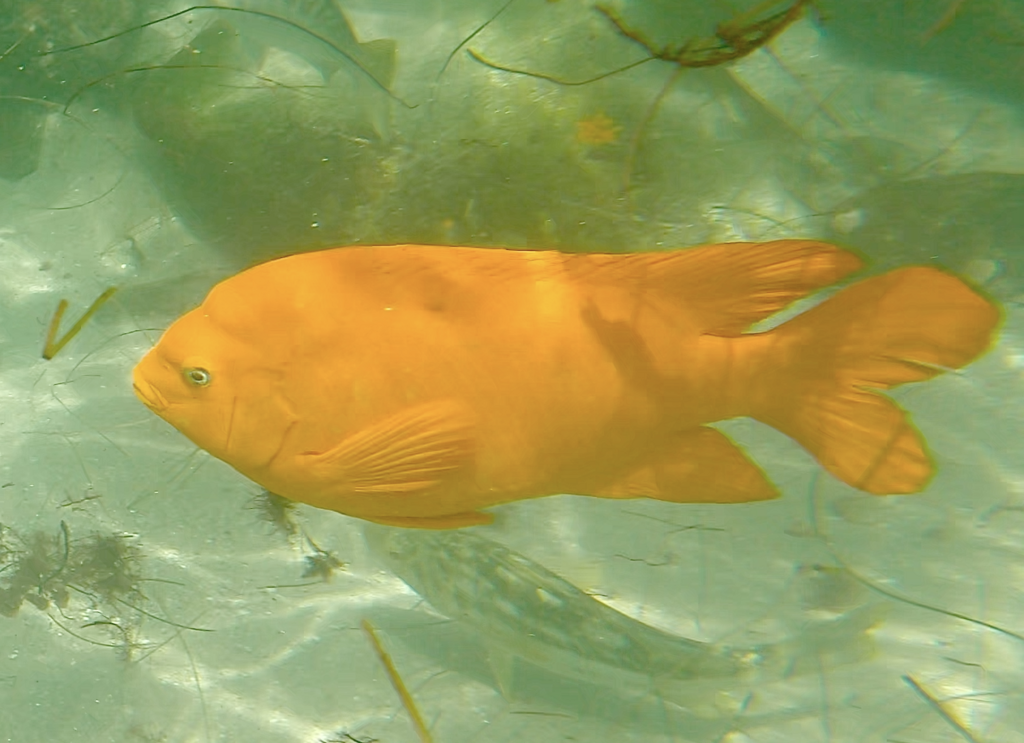
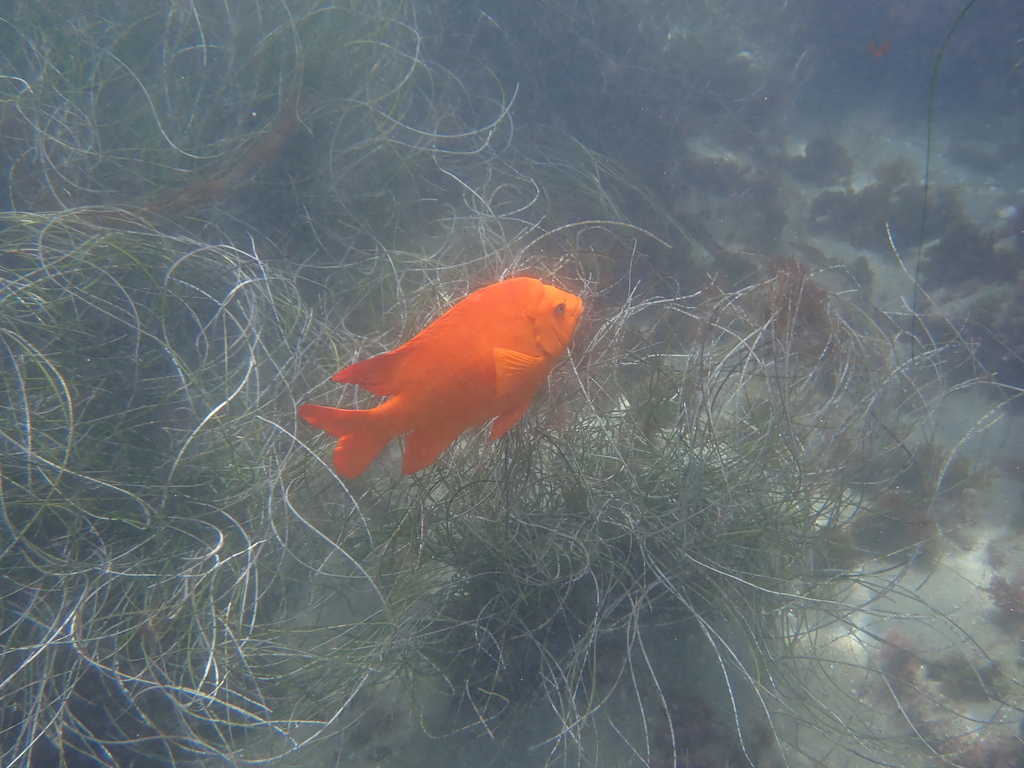

Photos show the species, not always the places on this page.
Length
Up to about 35.6 cm (14 in) according to Wikipedia and Monterey Bay Aquarium; FishBase lists 30 cm (12 in) standard length and Aquarium of the Pacific says up to 38 cm (15 in). Males grow a little larger than females
Weight
Not reported in the sources I opened
Next to a person
Roughly as long as an adult's hand and forearm together
What it eats
Mostly attached and bottom-living invertebrates such as sponges, worms, anemones, bryozoans, small shellfish, crabs, shrimps and sea stars, plus some algae. Females sometimes eat their own eggs. They feed during the day inside their territories.
Around people
Calm, give space
How it lives
Wikipedia gives an average life span of about 12 years, while Aquarium of the Pacific says 20 to 30 years is typical. A 2022 study aged one fish at 57 years, the longest-lived damselfish known by two decades. Adults are bright orange and juveniles are reddish orange with iridescent blue spots. They live over rocky reefs and kelp forests from the shallows to about 30 m. Breeding runs from March to July: the male clears and tends a nest on the reef, a female lays the eggs, and he guards and fans them until they hatch after about 19 to 21 days. Males defend a territory of about 3 to 10 square metres and may chase away intruders, including divers. Adults also gather in peaceful groups called kelp socials.
Where it goes
Garibaldi are very local. Males keep a nest territory year-round (Wikipedia), and Monterey Bay Aquarium describes permanent nesting territories on reefs. I did not find tagging studies on longer movements.
We only draw a journey on the map when scientists have tracked it or clearly documented it. For this animal we have not found one yet.
Populations
It ranges from Monterey Bay, California, to Guadalupe Island and southern Baja California, Mexico. IUCN rates it Least Concern; Wikipedia dates the assessment to 2010 and FishBase to 2007. Aquarium of the Pacific describes the population as stable with fluctuations. Historically it was exploited by the aquarium trade. It became California's state marine fish in 1995, and taking it from California waters now needs a special permit. Warming seas could shift its range (Aquarium of the Pacific), and FishBase rates its vulnerability to fishing as moderate to high.
Meet it respectfully
Admire it from a distance. A guarding male may charge or nip at divers who come near its nest, so if one does, calmly back away and give the nest more room. Never chase, touch, feed or bait a garibaldi, and never take one: removal from California waters needs a special permit. Follow local rules and your guide.
Fun fact
Tap the bulb to light it up.
A garibaldi from a 2022 study was 57 years old, the longest-lived damselfish known.
Males make clucking or thumping sounds to attract a mate and to warn off intruders.
It is California's official state marine fish.
Garibaldi in the Ocean Atlas
Places we have researched where this animal is recorded. It is never guaranteed, and some places are for watching from the boat only.
Travel with usComing soonTrusted referralExploringOn pause, story onlyEthics pass
Country colour: pink where we travel, blue where we are exploring or refer, grey for story only.
 Mexico
 United States
Sources for this page
- Wikipedia, 2026
- FishBase, 2026
- Monterey Bay Aquarium, 2026
- US National Park Service, Channel Islands, 2026
- Williams et al., Frontiers in Marine Science, 2022
- Aquarium of the Pacific, 2026
- GBIF, IUCN Red List category, 2026
Facts checked 5 October 2026. Photos: Unsplash licence, or Creative Commons as shown on each photo.
Work in ocean travel?
We are always happy to hear from exceptional local operators, accommodation, conservation organisations and destination experts. If your work fits responsible, small-group ocean travel, we would love to learn more.
Partner with Ocean CallingSwim with humpback whales in Moʻorea, September 2027
from CHF 4,500