
Guitar rays (wedgefishes and guitarfishes)
Rhinidae, Glaucostegidae and Rhinobatidae
Shark-like rays that rest on sand and slip away quietly. Very few people see one, and no sighting is a promise.
Status varies by species. The wedgefish and bowmouth guitarfish recorded in New Caledonia are Critically Endangered (IUCN, 2018), which means an extremely high risk of extinction in the wild.


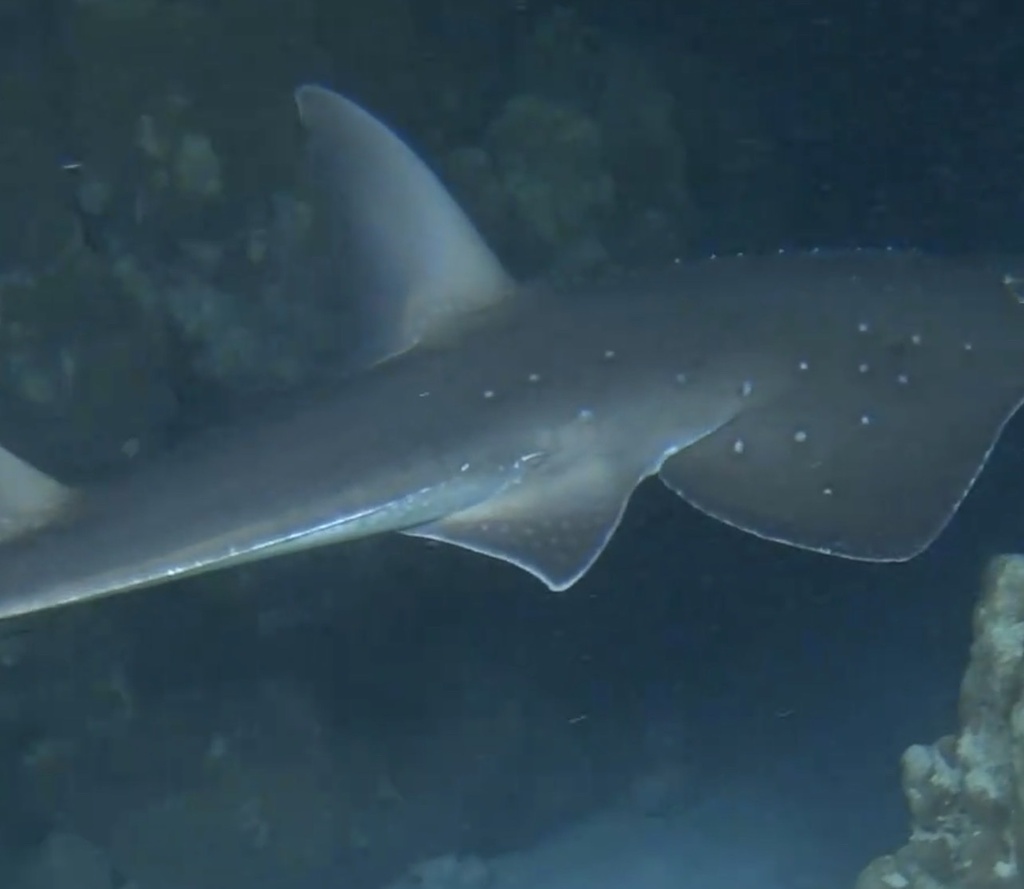
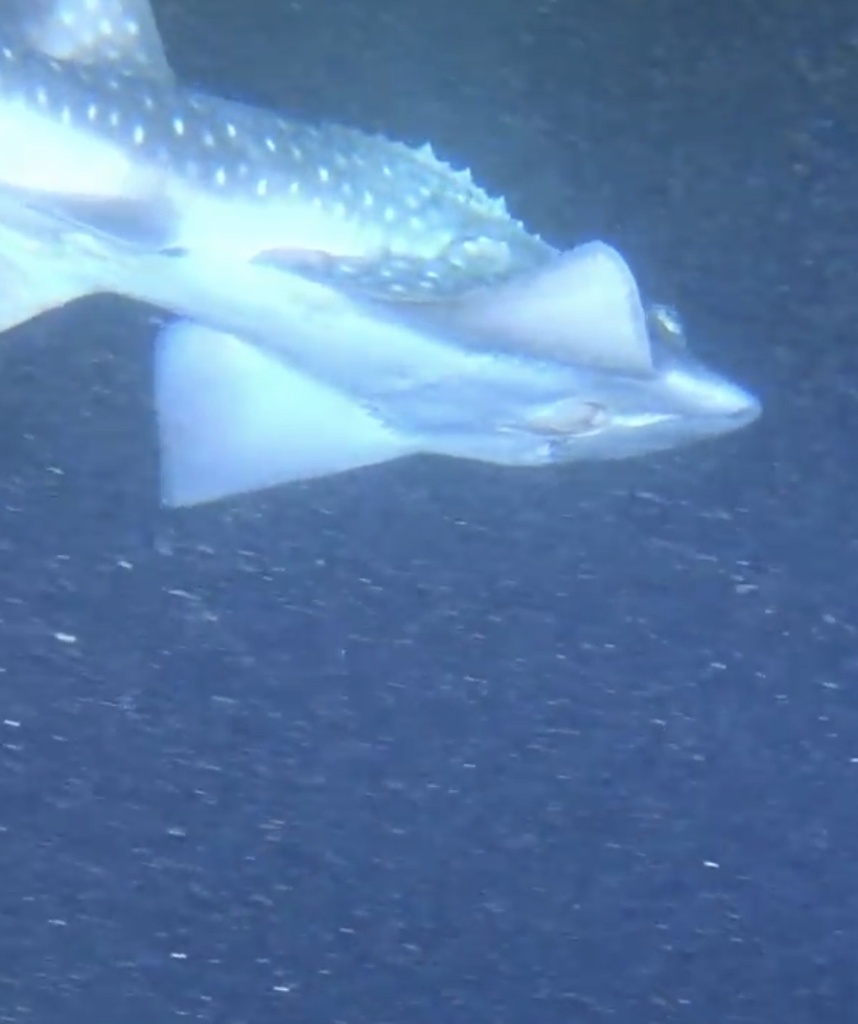
Photos show the species, not always the places on this page.
Length
Varies by species. Bottlenose wedgefish about 3 m (10 ft), with FishBase giving up to 124 cm (4.1 ft) for males and up to 300 cm (9.8 ft) for females. Bowmouth guitarfish up to 300 cm (9.8 ft).
Weight
Bowmouth guitarfish up to about 135 kg (298 lb) published. No weight was found for the wedgefishes in the sources checked.
Next to a person
The largest are up to about 1.7 times as long as an adult is tall, and a bowmouth can outweigh most adults
What it eats
Bottom feeders. Wedgefish and bowmouth guitarfish eat crabs, prawns, bivalves and other molluscs, cephalopods and bottom-dwelling fish. Guitarfishes bury themselves in mud or sand and eat worms, crabs and clams.
Around people
Calm, give space
How it lives
Guitarfishes and wedgefishes have bodies between those of a shark and a ray, with a shark-like tail and a triangular, guitar-shaped head. They give birth to live young: a bowmouth guitarfish has litters of 2 to 11 pups about 45 cm long. Bottlenose wedgefish live from the shallows down to about 60 m, on soft bottoms and near coral reefs, and bowmouth guitarfish from 3 to 90 m. A bowmouth has a row of large spines above the eye and on the shoulder that can be used for butting. New Caledonia: GBIF holds records of bottlenose wedgefish (Rhynchobatus australiae, mostly recent observations) and bowmouth guitarfish (Rhina ancylostoma), plus older specimens filed under Rhynchobatus djiddensis.
Where it goes
Movements are poorly described in the sources checked. These rays live close to the bottom, inshore, over sand and mud and near coral reefs. The bowmouth guitarfish is sometimes found in the water column.
We only draw a journey on the map when scientists have tracked it or clearly documented it. For this animal we have not found one yet.
Populations
Among the most threatened marine fish. A 2019 assessment found that all but one of 16 wedgefish and giant guitarfish species face an extremely high risk of extinction, mainly from fishing for meat and fins, and said they have overtaken sawfishes as the most imperilled marine fish families. The bottlenose wedgefish and the bowmouth guitarfish are both Critically Endangered (IUCN, assessed December 2018) and both are on CITES Appendix II. Rhynchobatus djiddensis is also Critically Endangered. Australia is described as a lifeboat for several of these species because fishing pressure there is low. No population figure for New Caledonia was found.
Meet it respectfully
Stay low, move slowly and give the ray room to rest or leave. Never chase, touch, feed or bait a guitar ray, and do not block its path or stir up the sand around it. Spines and thorns are real, so keep your hands away. Rules differ by place, so follow your guide and local rules.
Fun fact
Tap the bulb to light it up.
Wedgefishes and giant guitarfishes have overtaken sawfishes as the most imperilled marine fish families, according to a 2019 assessment.
A bowmouth guitarfish has heavy ridges of spiky thorns over the eyes and along the back and shoulders.
Guitarfishes look like a cross between a shark and a ray: a shark-like tail with a flattened head and trunk.
Guitar rays (wedgefishes and guitarfishes) in the Ocean Atlas
Places we have researched where this animal is recorded. It is never guaranteed, and some places are for watching from the boat only.
Travel with usComing soonTrusted referralExploringOn pause, story onlyEthics pass
Country colour: pink where we travel, blue where we are exploring or refer, grey for story only.
 New Caledonia
Sources for this page
- Wikipedia, Guitarfish, 2026
- Wikipedia, Wedgefish, 2026
- Wikipedia, Rhynchobatus australiae, 2026
- FishBase, Rhynchobatus australiae, 2026
- FishBase, Rhina ancylostoma, 2026
- Kyne et al., extinction risk in wedgefishes and giant guitarfishes, 2019
- GBIF, Rhinidae records in New Caledonia, 2026
Facts checked 5 October 2026. Photos: Unsplash licence, or Creative Commons as shown on each photo.
Work in ocean travel?
We are always happy to hear from exceptional local operators, accommodation, conservation organisations and destination experts. If your work fits responsible, small-group ocean travel, we would love to learn more.
Partner with Ocean Calling5-day freediving course in Bali
CHF 1,180