
Northern rockhopper penguin
Eudyptes moseleyi
A small penguin with a wild yellow crest, far from most coasts. It lives by its own timetable, and no sighting is ever a promise.
Endangered (IUCN, 2020) means it faces a very high risk of extinction in the wild. Numbers fell steeply over the last century, and the causes are still being studied.
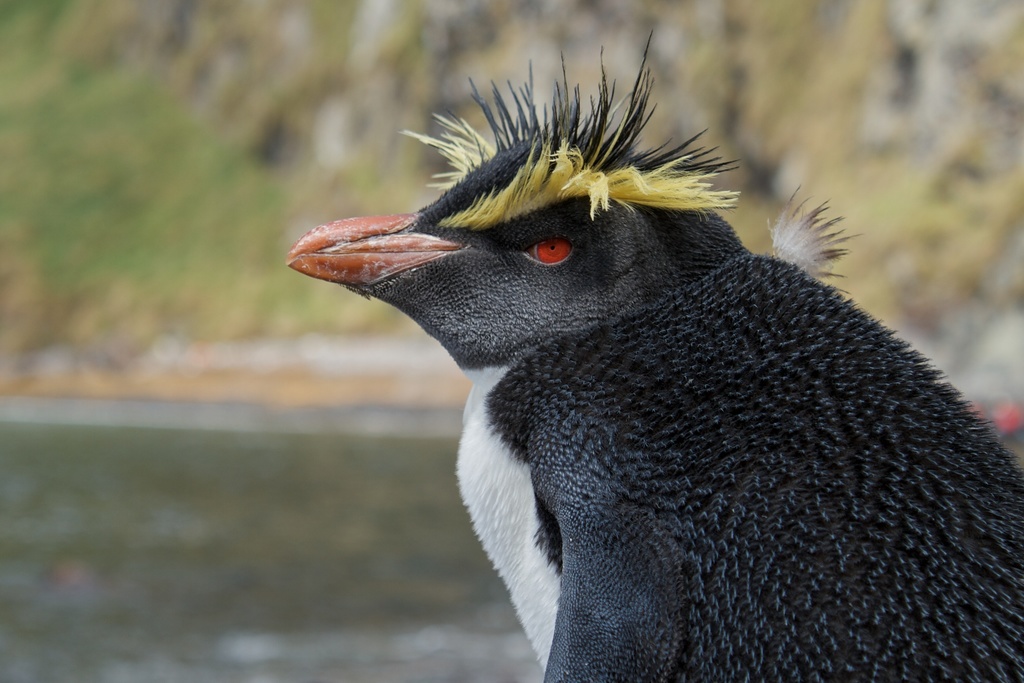
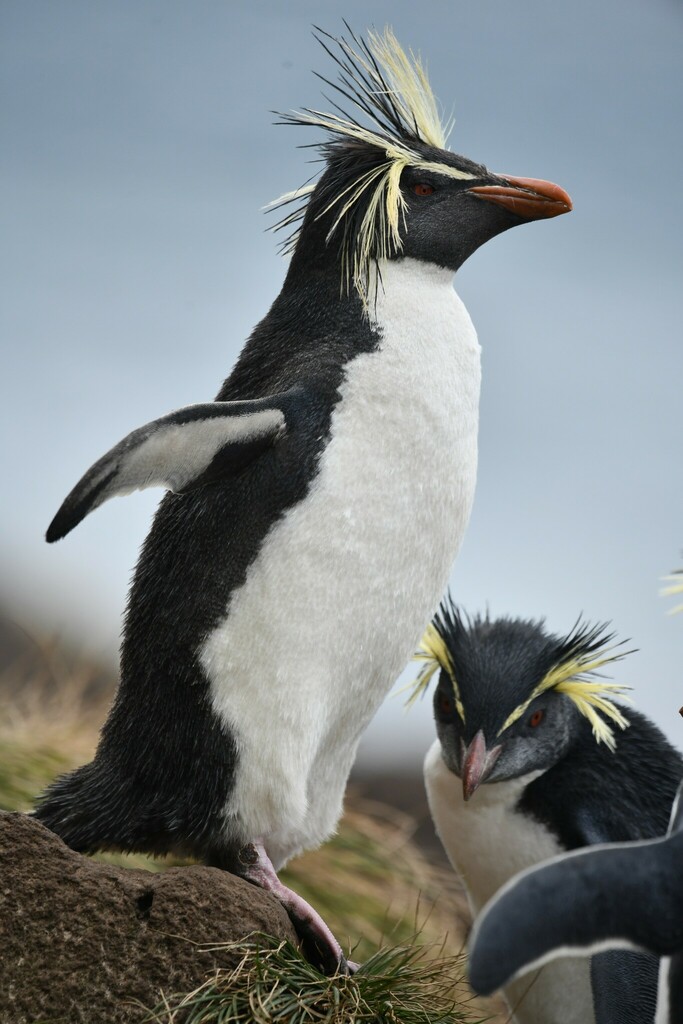
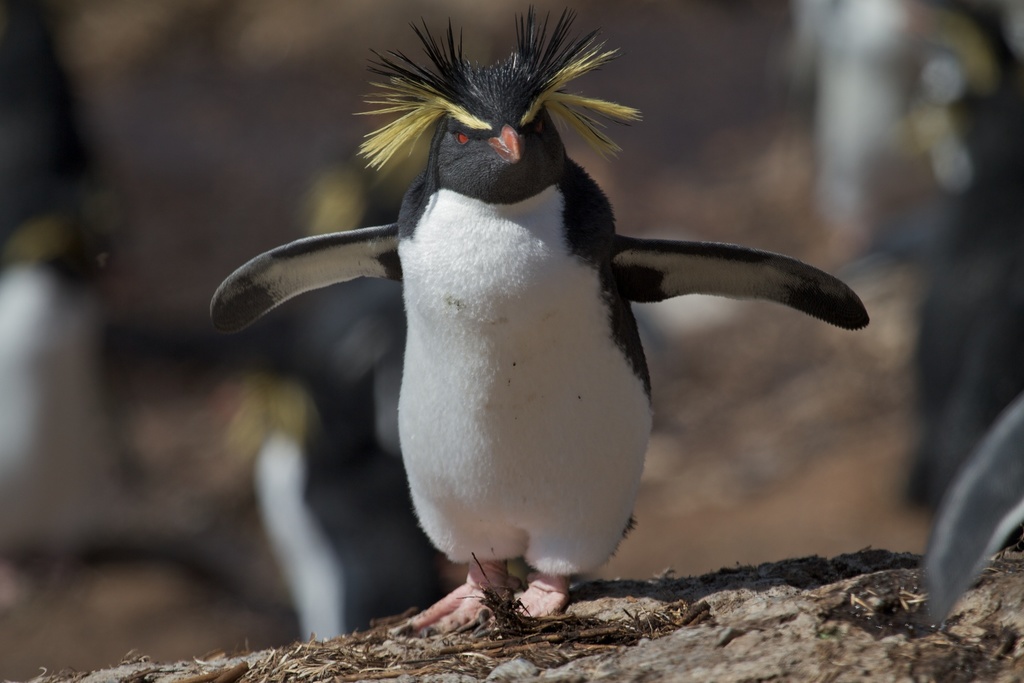
Photos show the species, not always the places on this page.
Length
Roughly 42 to 58 cm (17 to 23 in), depending on the source and how it is measured. It is larger than the other two rockhopper forms.
Weight
About 3 kg (6.6 lb) at the start of breeding, about 4.3 kg (9.5 lb) before the moult, and about 2.5 kg (5.5 lb) by the end of it.
Next to a person
About a third of an adult's height, and as heavy as a newborn baby
What it eats
Krill and other crustaceans, squid, octopus and fish. In some areas crustaceans make up to about 90% of the diet, and squid becomes important when chicks are young. Adults feed their chicks lower-level prey than they eat themselves.
Around people
Calm, give space
How it lives
Northern rockhoppers nest in colonies from the shore to cliff sides and sometimes inland. Adults return to the colonies in late July and August. Incubation lasts about 32 to 34 days, and chicks fledge about 9 to 10 weeks after hatching. Adults come back in February to moult. The sources I read do not give a lifespan.
Where it goes
Northern rockhoppers breed on seven islands: five in the Tristan da Cunha group in the South Atlantic and two in the southern Indian Ocean. After breeding and moulting they feed widely at sea. Birds seen elsewhere, such as the Falkland Islands, Australia or South Africa, are wanderers.
We only draw a journey on the map when scientists have tracked it or clearly documented it. For this animal we have not found one yet.
Populations
Estimates put the world population at roughly 190,000 to 240,000 breeding pairs. About 90% breed in the Atlantic, most of them on Gough Island and the Tristan da Cunha islands. A study found the Atlantic population fell by more than 50% between 1975 and 2005, and some sources give a larger fall since the 1950s. Trends differ by island. On Amsterdam Island, avian cholera caused complete breeding failure from 2013 to 2016, and a fire at a main colony has been linked to a further decline. IUCN lists the species as Endangered (2020).
Meet it respectfully
Keep a calm distance, move slowly and let the birds go about their day. Never chase, touch, feed or block a path to the sea. Colonies are on rocky, remote shores, so stay on marked routes and keep clear of nests. Follow the rules of the island and your guide.
Fun fact
Tap the bulb to light it up.
It breeds on only seven islands, five in the Tristan da Cunha group and two in the southern Indian Ocean.
During the moult it can drop from about 4.3 kg to about 2.5 kg.
It is larger than the other two rockhopper forms, and the three differ in crest length and in the colour of the gape margin.
Northern rockhopper penguin in the Ocean Atlas
Places we have researched where this animal is recorded. It is never guaranteed, and some places are for watching from the boat only.
Travel with usComing soonTrusted referralExploringOn pause, story onlyEthics pass
Country colour: pink where we travel, blue where we are exploring or refer, grey for story only.
 Australia
 Falkland Islands
 Saint Helena
Sources for this page
- Wikipedia, Northern rockhopper penguin
- BMC Genomics, 2025 (open-access copy)
- Bird Conservation International, Cambridge University Press, Tristan da Cunha population revision
- Australian Antarctic Program, Northern rockhopper penguin
- Global Penguin Society, Northern rockhopper penguin
- GBIF, IUCN Red List category, 2026
Facts checked 5 October 2026. Photos: Unsplash licence, or Creative Commons as shown on each photo.
Work in ocean travel?
We are always happy to hear from exceptional local operators, accommodation, conservation organisations and destination experts. If your work fits responsible, small-group ocean travel, we would love to learn more.
Partner with Ocean Calling5-day freediving course in Bali
CHF 1,180