
Peale's dolphin
Cephalorhynchus australis
A dark, falcate fin and a flash of pale flank in cold southern water. Peale's dolphins keep their own distance, and no sighting is ever a promise.
Least Concern (IUCN, 2019) means the species is not currently close to being threatened with extinction. The assessment uses the older name Lagenorhynchus australis.
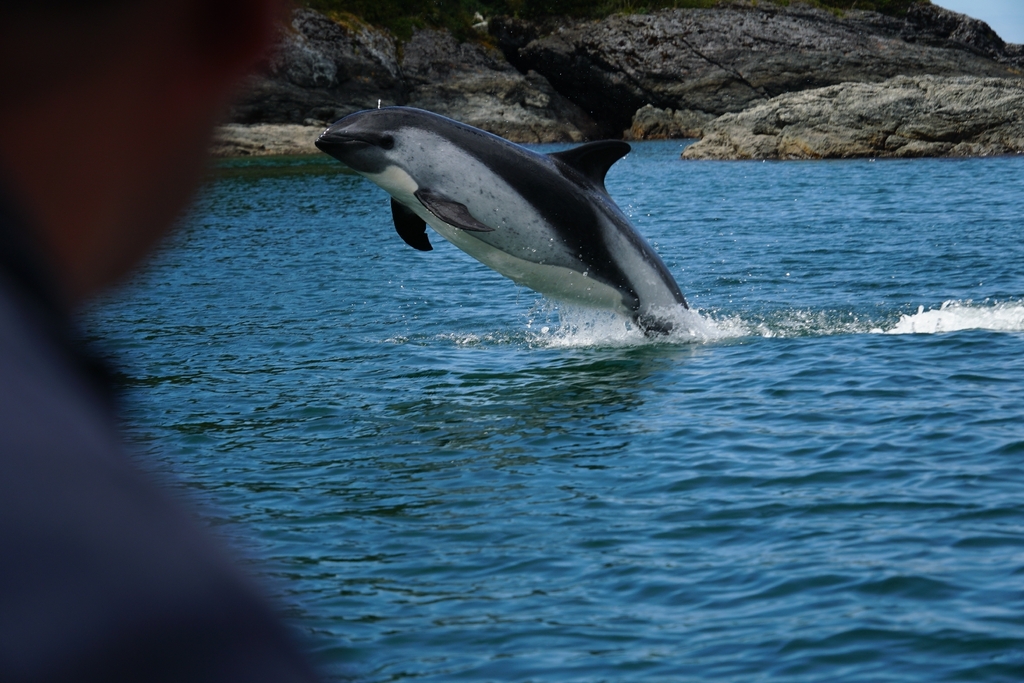
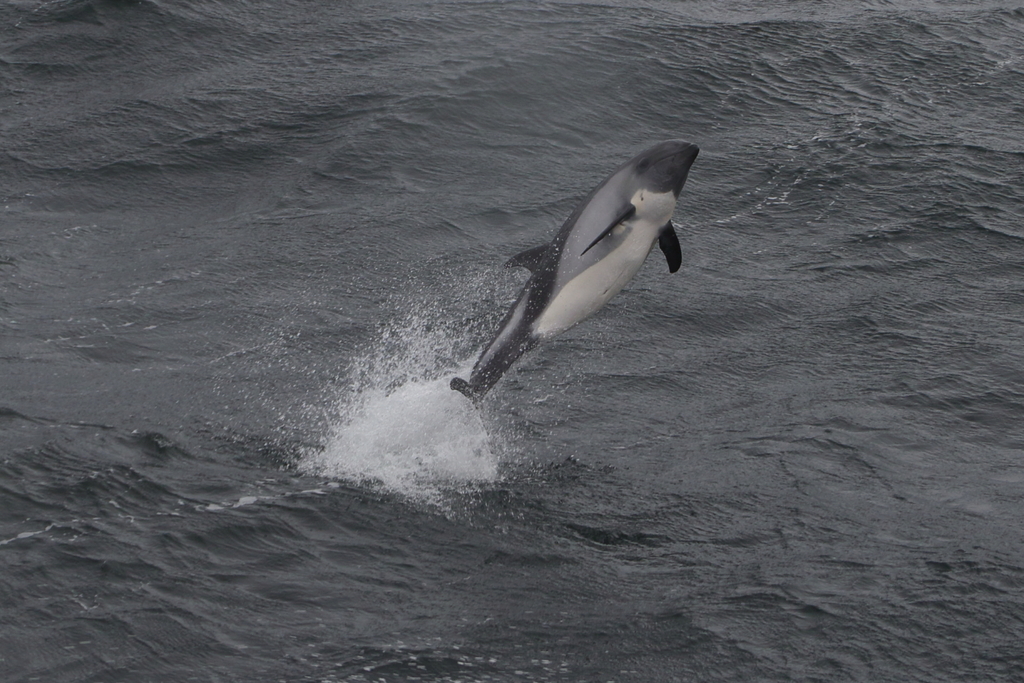
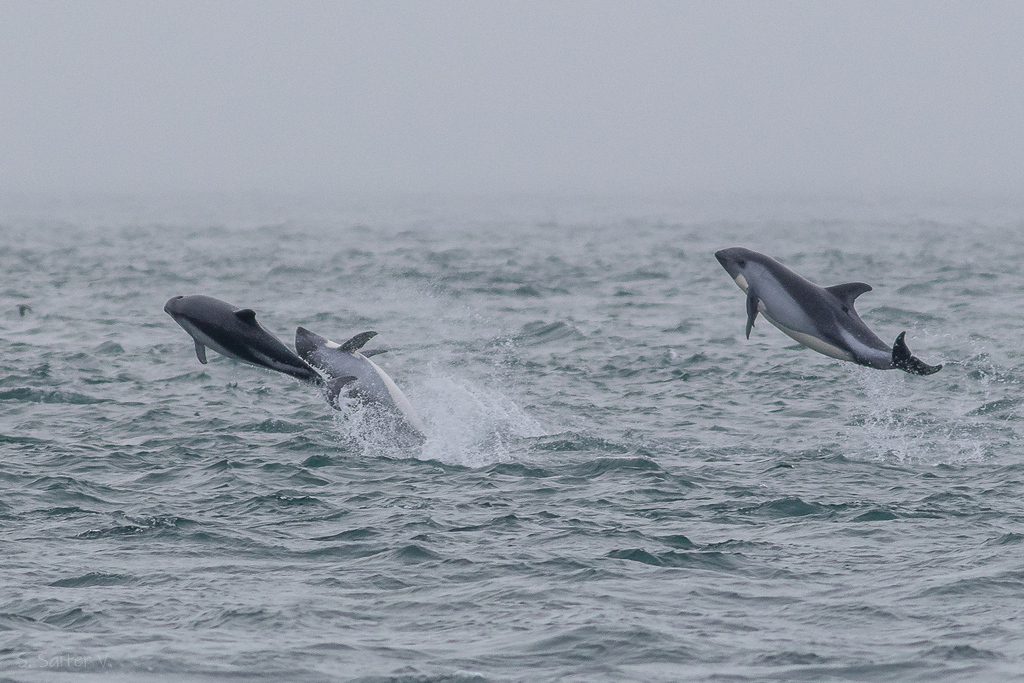
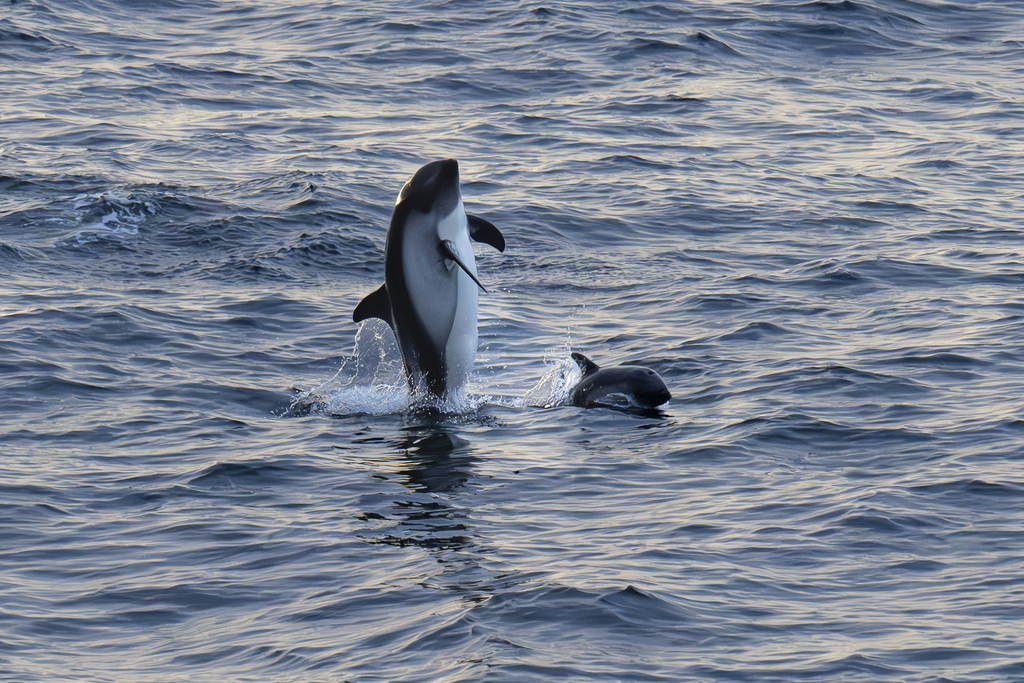
Photos show the species, not always the places on this page.
Length
About 1 m (3.3 ft) at birth and about 2.1 m (6.9 ft) when fully grown
Weight
About 115 kg (254 lb) as adults. No range or sex difference was found in the sources opened.
Next to a person
A little longer than a tall adult is tall, and about as heavy as one and a half adults
What it eats
Bottom-living fish, southern cod, Patagonian grenadier, octopus, squid and shrimp. They feed mostly near kelp beds, and some groups feed cooperatively.
Around people
Calm, give space
How it lives
Adults have a dark grey face and chin, a black back with off-white stripes, a white belly, pale patches behind the flippers and a large, curved dorsal fin. Groups are usually about five, sometimes up to 20. In the 2017 Falklands aerial survey the average group was 4.47 dolphins (range 1 to 21). In a December 2021 study in the Strait of Magellan, groups were 1 to 5 animals, often with juveniles, and 88% of observed events were slow travel. This is a poorly studied species because much of its range is remote and stormy.
Where it goes
Peale's dolphin lives only in the coastal waters of southern South America, from Valdivia in Chile (about 38°S) around Tierra del Fuego to Argentina, and around the Falkland Islands. In the Falklands, surveys in 2017 to 2019 recorded the species in every survey month. Models suggest they use open, exposed water, with similar densities from about 4 to 25 km offshore, while Commerson's dolphins stay closer to the coast. In the Falklands they were found mostly off the southern and north-western coasts.
We only draw a journey on the map when scientists have tracked it or clearly documented it. For this animal we have not found one yet.
Populations
The IUCN lists Peale's dolphin as Least Concern (2019), under its old name Lagenorhynchus australis. CMS has listed it on Appendix II since 1991. A 2017 aerial survey of inshore Falklands waters, flown by SAERI, estimated 1,896 dolphins (CV 0.33), and the team notes this is likely an underestimate because availability bias was not yet included. One estimate for the South Atlantic part of the range is about 21,800. Past threats include hunting for crab bait in the 1970s and 1980s, and entanglement in gill nets is still a concern. Shipping, aquaculture and coastal development are raised as concerns in the Strait of Magellan.
Meet it respectfully
Watch from a slow, steady boat or from shore, and let the dolphins choose the distance. Never chase, surround, touch, feed or bait them, and keep noise and speed low, especially near groups with young. Local rules for dolphin watching differ by place, so follow your guide and any local guidance, as none were checked for this card. Whether you see Peale's dolphins depends on weather, sea state and luck.
Fun fact
Tap the bulb to light it up.
Peale's dolphin was long placed with the Lagenorhynchus dolphins, but a 2025 study of DNA, body shape and sound moved it into Cephalorhynchus, the genus that includes Commerson's dolphin.
The 2017 Falklands aerial survey flew 217 transects totalling 4,317 km and recorded 60 groups of Peale's dolphins.
In a December 2021 study in the Strait of Magellan, underwater loggers recorded over 14,000 clicks, about 2.3 times more at night than by day.
Peale's dolphin in the Ocean Atlas
Places we have researched where this animal is recorded. It is never guaranteed, and some places are for watching from the boat only.
Travel with usComing soonTrusted referralExploringOn pause, story onlyEthics pass
Country colour: pink where we travel, blue where we are exploring or refer, grey for story only.
 Falkland Islands
Sources for this page
- GBIF, IUCN Red List category for Lagenorhynchus australis
- Wikipedia, Peale's dolphin
- American Society of Mammalogists, Mammal Diversity Database, Cephalorhynchus australis
- South Atlantic Environmental Research Institute, DOKE island-wide transect survey
- Frontiers in Marine Science, 2020, dolphin habitat models for the Falkland Islands
- PLOS ONE, 2020, suitable coastal habitat for whales and dolphins around the Falkland Islands
- Acoustic and visual monitoring of Peale's dolphins in the Magellan Strait, 2025
- Convention on Migratory Species, Lagenorhynchus australis
Facts checked 5 October 2026. Photos: Unsplash licence, or Creative Commons as shown on each photo.
Work in ocean travel?
We are always happy to hear from exceptional local operators, accommodation, conservation organisations and destination experts. If your work fits responsible, small-group ocean travel, we would love to learn more.
Partner with Ocean CallingGili Trawangan in 5 days
from CHF 790