
Rice's whale
Balaenoptera ricei
A rare whale of the deep Gulf slope. It is one of the least-seen large whales, and no sighting is ever a promise.
Critically Endangered (IUCN, 2022) means it faces an extremely high risk of extinction in the wild, because only about 50 whales are thought to remain in a single area.
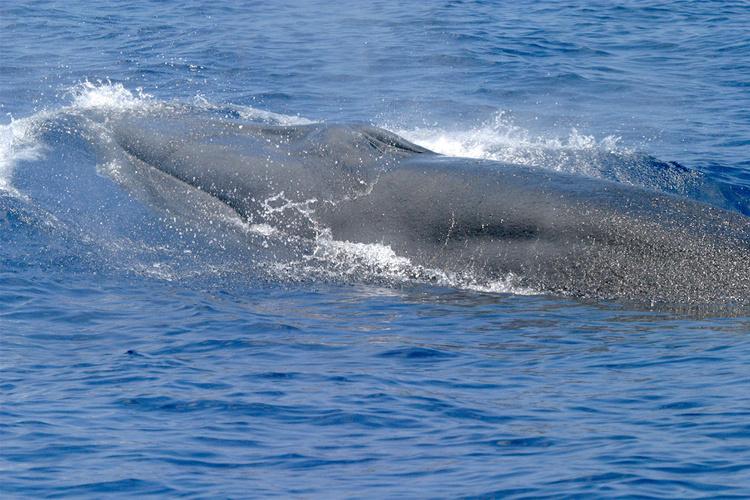


Photos show the species, not always the places on this page.
Length
Up to about 12.65 m (41.5 ft); NOAA gives up to 41 ft. The largest one measured was a lactating female
Weight
Up to about 27 tonnes (60,000 lb) per NOAA. A review gives estimates of 13.9 to 27.2 tonnes (about 30,600 to 60,000 lb), depending on the method
Next to a person
About 7 times as long as a tall adult, and as heavy as roughly 300 adults
What it eats
Fish, caught near the seabed in the daytime. A 2023 study of body tissue found that silver-rag driftfish made up about two thirds of the diet (66.8 percent), with lanternfish, Atlantic pearlside and squid making up the rest. The whales pick this fish even though it is not the most common prey in their area, probably because it is richer in energy. They dive to about 150 to 250 m.
Around people
Rare, give space
How it lives
Rice's whales are usually seen alone or in pairs, and sometimes in looser groups thought to be linked to feeding. NOAA says they likely mature at about nine years old and have a calf every two to three years. Lifespan is unknown. They have a dark grey body, a pale to pink belly, three ridges along the top of the head and a strongly hooked dorsal fin about two thirds of the way back.
Where it goes
Rice's whales do not migrate. They stay in the Gulf of Mexico all year, mostly on the upper continental slope in the northeastern Gulf, in water about 100 to 400 m deep off the west coast of Florida. Some are also recorded in the western Gulf off Louisiana and Texas, and recent sound recordings include Mexican waters.
We only draw a journey on the map when scientists have tracked it or clearly documented it. For this animal we have not found one yet.
Populations
The best estimate is about 51 whales (2017 to 2018 surveys), with roughly 26 mature animals, and NOAA says fewer than 100 remain. The population may have fallen by up to 22 percent after the Deepwater Horizon oil spill. It lives only in the Gulf of Mexico. The IUCN lists it as Critically Endangered (2022). In the United States it was listed as endangered in 2019 as a Bryde's whale subspecies and again as its own species in 2021, and it is on CITES Appendix I. NOAA proposed critical habitat in July 2023.
Meet it respectfully
Rice's whales are very rare, so any encounter should be quiet and short. Never chase, approach, touch, feed or bait one. NOAA guidance asks boats to stay at least 100 yards (about 91 m) away and to keep watching to 30 minutes or less. Slow down in the whale's area, because ship strikes are a known danger, and keep noise low. Never expect a sighting.
Fun fact
Tap the bulb to light it up.
It was long counted as a Gulf population of Bryde's whale. In 2021 scientists named it as its own species, after the whale expert Dale Rice.
It lives in one small area of the Gulf slope and nowhere else in the world.
NOAA says the whales spend most of the night near the surface, which raises the risk of being hit by ships.
Rice's whale in the Ocean Atlas
Places we have researched where this animal is recorded. It is never guaranteed, and some places are for watching from the boat only.
Travel with usComing soonTrusted referralExploringOn pause, story onlyEthics pass
Country colour: pink where we travel, blue where we are exploring or refer, grey for story only.
 United States
Sources for this page
- NOAA Fisheries, Rice's whale
- Wikipedia, Rice's whale
- Kiszka et al., 2023, Scientific Reports
- GBIF, IUCN Red List category
Facts checked 5 October 2026. Photos: Unsplash licence, or Creative Commons as shown on each photo.
Work in ocean travel?
We are always happy to hear from exceptional local operators, accommodation, conservation organisations and destination experts. If your work fits responsible, small-group ocean travel, we would love to learn more.
Partner with Ocean Calling5-day freediving course in Bali
CHF 1,180