
Ross seal
Ommatophoca rossii
A pale shape on dense pack ice, and one of the least seen seals on Earth. Sightings are a gift of the ice, never a promise.
Least Concern (IUCN, 2015) means it is not close to threatened at present. Counts are old and uncertain, so the population trend is unknown.
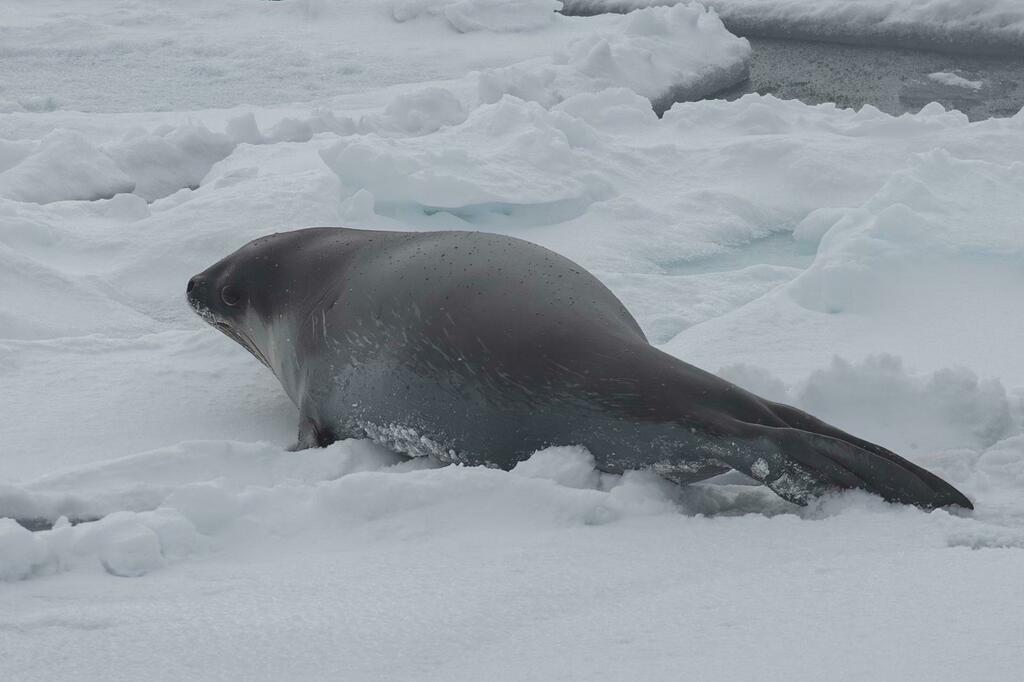
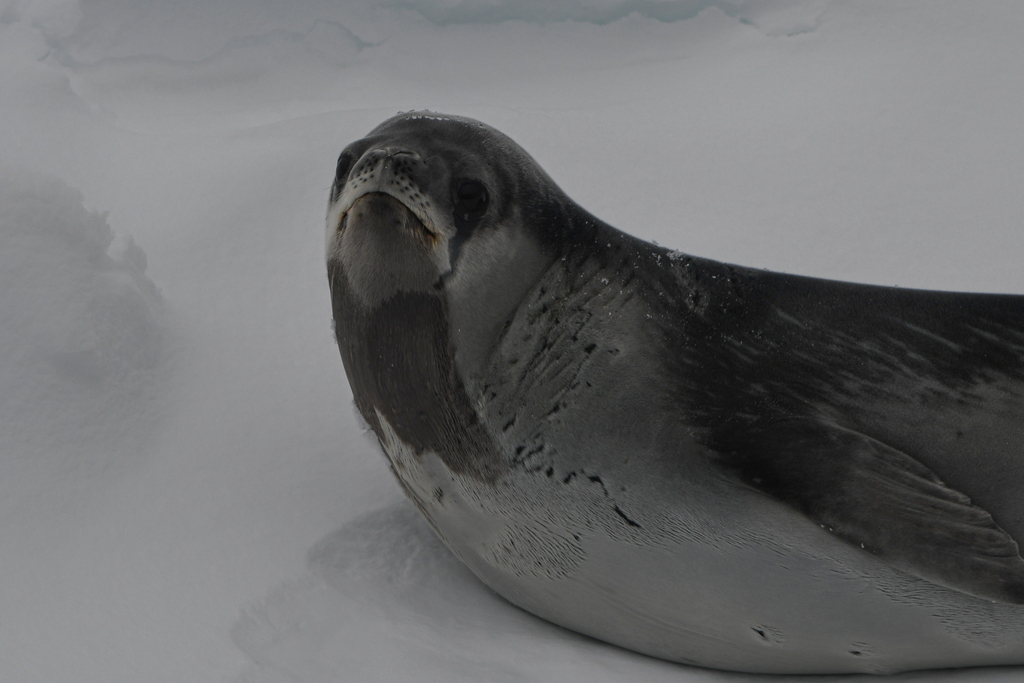
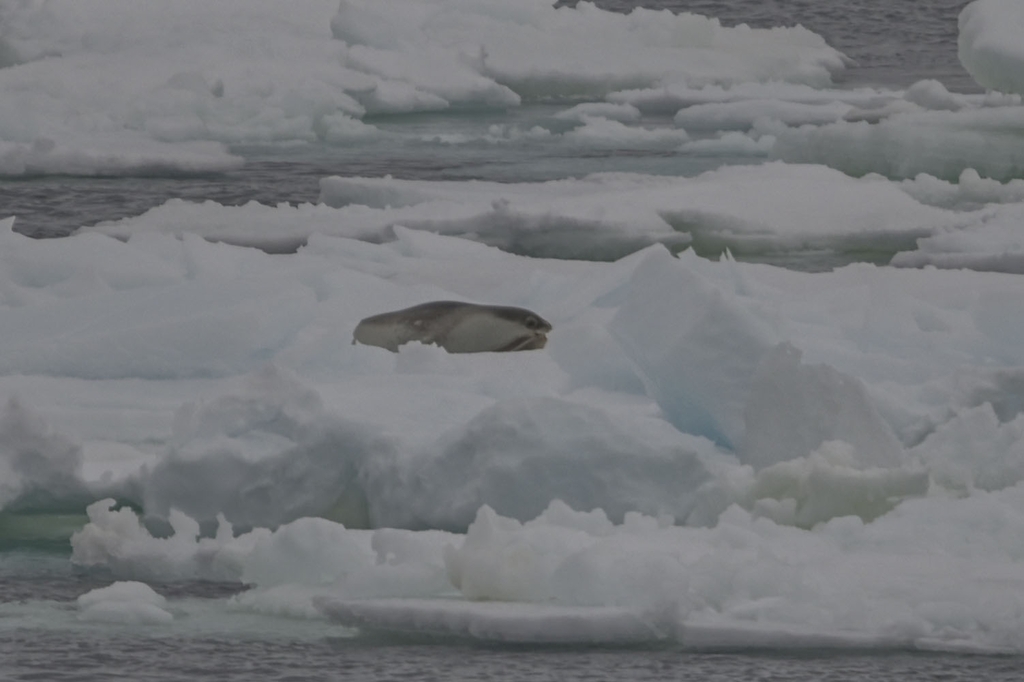
Photos show the species, not always the places on this page.
Length
Adults about 1.7 to 2.4 m (5.6 to 7.9 ft), with females slightly longer than males; one source gives up to about 3 m (9.8 ft)
Weight
Males about 130 to 215 kg (290 to 470 lb); females about 160 to 200 kg (350 to 440 lb). Pups weigh roughly 16 to 27 kg (35 to 60 lb) at birth, depending on the source
Next to a person
About as long as a tall adult, or a little longer, and as heavy as two or three adults
What it eats
Mostly squid and fish, with some krill and other invertebrates. One summary gives 47% squid, 34% fish (mainly Antarctic silverfish) and 19% invertebrates. It hunts at mid-water depth, usually about 100 to 200 m, and sometimes down to about 400 m. Its very large eyes probably help in the dark.
Around people
Shy, give space
How it lives
Ross seals live alone or in loose company on dense pack ice, which makes them hard to find and study. Pups are born in about mid-October to November. A mother nurses her pup alone for roughly 2 to 4 weeks, and mating follows after weaning, in the water. Adults moult from about late December to mid-February. Maturity comes at around 3 to 4 years in many sources, and wild animals live at least 18 to 20 years. Killer whales and possibly leopard seals take some of them.
Where it goes
Ross seals breed in dense pack ice, then move to more stable floes near the ice edge to moult. For the rest of the year they seem to spend much of their time in ice-free ocean, so where they are is poorly known. Sightings north of 60 degrees south are extremely rare. No fixed migration route has been described.
We only draw a journey on the map when scientists have tracked it or clearly documented it. For this animal we have not found one yet.
Populations
Circumpolar around Antarctica, with the most seals thought to be in the Ross Sea and King Haakon VII Sea. The total is uncertain. Survey-based estimates range from about 20,000 to 220,000 animals, and genetic estimates are about 130,000 to 254,000. A recent summary gives about 130,000 (with a wide range of 20,000 to 227,000). Direct counts probably undercount them, because many seals are in the water. The trend is unknown. IUCN: Least Concern (2015). It is also a Specially Protected Species under the Antarctic Treaty.
Meet it respectfully
Watch from a distance and keep voices low. Never chase, approach closely, touch, feed or bait a seal, and never block its path to the water. Ross seals are shy and often alone, so a seal that raises its head or shifts away is telling you to give more space. Follow your expedition leader and the Antarctic rules that apply to your trip. Sightings are rare and never guaranteed.
Fun fact
Tap the bulb to light it up.
Its eyes are disproportionately large, up to about 7 cm across.
It can make a range of calls with its mouth closed.
It prefers the densest pack ice, which is why it is among the least known seals.
Ross seal in the Ocean Atlas
Places we have researched where this animal is recorded. It is never guaranteed, and some places are for watching from the boat only.
Travel with usComing soonTrusted referralExploringOn pause, story onlyEthics pass
Country colour: pink where we travel, blue where we are exploring or refer, grey for story only.
 Antarctica
Sources for this page
- Wikipedia, Ross seal, 2026
- Australian Antarctic Division, 2026
- Pinniped Conservation, Ross seal, 2026
- Antarctic Environments Portal, Ross seal, 2026
- GBIF, IUCN Red List category, 2026
Facts checked 5 October 2026. Photos: Unsplash licence, or Creative Commons as shown on each photo.
Work in ocean travel?
We are always happy to hear from exceptional local operators, accommodation, conservation organisations and destination experts. If your work fits responsible, small-group ocean travel, we would love to learn more.
Partner with Ocean CallingSwim with humpback whales in Moʻorea, September 2027
from CHF 4,500