
Spotted handfish
Brachionichthys hirsutus
A small spotted fish that walks across the sand of one Tasmanian estuary, and no sighting is ever a promise.
Critically Endangered (IUCN, assessed 2018, published 2020) means it faces an extremely high risk of extinction in the wild.

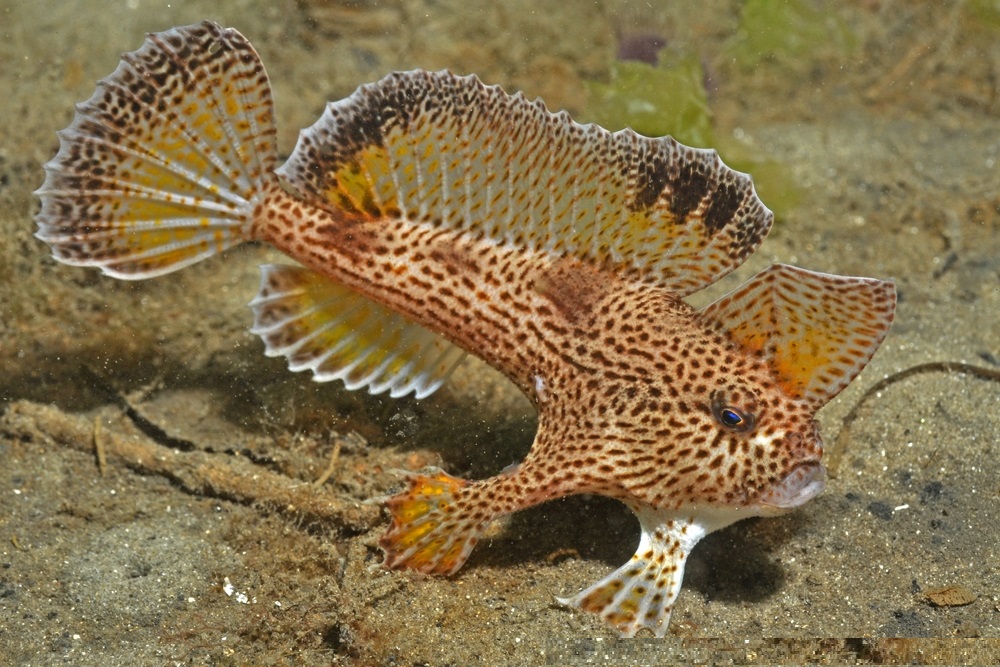


Photos show the species, not always the places on this page.
Length
Adults are commonly about 6 to 7.5 cm (2.4 to 3 in) standard length, and the largest reach about 12 cm (4.7 in)
Weight
No body weight was reported in the sources opened
Next to a person
About as long as an adult's hand is wide, and very light
What it eats
Little is known. In the wild it is reported to take small shellfish, shrimps and worms from the seabed.
Around people
Rare, look only
How it lives
It lives on soft sediment from about 1 to 60 m deep, and is most often seen at 5 to 15 m. It prefers hollows and ripples filled with shells. It has no swim bladder and walks on its fins. It matures at about 2 years, and one project gives a lifespan of 5 to 10 years. Spawning runs from September to November. Females lay 60 to 250 eggs on upright objects such as stalked sea squirts. The eggs hatch after about 2 months into fully formed young that settle straight onto the seabed.
Where it goes
The spotted handfish does not migrate. It has no drifting larval stage and travels little, walking slowly on its hand-like fins, so each local group stays near its own patch of seabed. Nine small groups in the Derwent Estuary have been monitored since 1997, and another was found in the D'Entrecasteaux Channel in 2015.
We only draw a journey on the map when scientists have tracked it or clearly documented it. For this animal we have not found one yet.
Populations
The IUCN (assessed 2018, published 2020) rates it Critically Endangered, and in 1996 it was the first marine fish listed as Critically Endangered. It is also Critically Endangered under Australian law. Estimates differ: no more than about 3,000 fish (ABC News, 2025) and fewer than 2,000 (CSIRO, 2024). Across nine Derwent sites, densities ranged from 1.58 to 43 fish per hectare (Wong et al., 2018). Main concerns are the introduced northern Pacific seastar, which eats the sea squirts it lays eggs on, past scallop dredging, coastal development and moorings, and warming water. About 14,000 artificial spawning units have been placed since 1998, and the population appears to have stabilised. In April 2025, 15 captive-bred juveniles were released into the River Derwent, the first such release.
Meet it respectfully
Look only, from a calm distance, and let it stay where it is. Never touch, move or crowd a handfish or its eggs, and keep fins, hands and anchors off the shell-filled hollows and the sea squirts it depends on. In Tasmania, collecting handfish without a permit is prohibited. Local access rules for dive sites were not found in the sources opened, so follow your guide. A sighting is never guaranteed.
Fun fact
Tap the bulb to light it up.
It walks along the seabed on hand-like fins and has no swim bladder.
In 1996 it became the first marine fish listed as Critically Endangered on the IUCN Red List.
In April 2025, 15 six-month-old captive-bred handfish were released into the River Derwent.
Spotted handfish in the Ocean Atlas
Places we have researched where this animal is recorded. It is never guaranteed, and some places are for watching from the boat only.
Travel with usComing soonTrusted referralExploringOn pause, story onlyEthics pass
Country colour: pink where we travel, blue where we are exploring or refer, grey for story only.
 Australia
Sources for this page
- GBIF, with IUCN Red List category, 2025
- FishBase, 2025
- Wong et al., 2018, PLoS One
- CSIRO, Spotted handfish
- CSIRO, 2024
- NESP Marine and Coastal Hub, Project 1.23
- ABC News, 2025
- Wikipedia, Spotted handfish, 2026
Facts checked 5 October 2026. Photos: Unsplash licence, or Creative Commons as shown on each photo.
Work in ocean travel?
We are always happy to hear from exceptional local operators, accommodation, conservation organisations and destination experts. If your work fits responsible, small-group ocean travel, we would love to learn more.
Partner with Ocean CallingNot sure where to go? Get your Ocean Match
from CHF 19