
Weedy seadragon
Phyllopteryx taeniolatus
A drifting shape of leaf-like fins among the kelp, and no sighting is ever a promise.
Vulnerable (IUCN, assessed 2024, published 2025) means it faces a high risk of extinction in the wild. The assessment suspects a population decline.
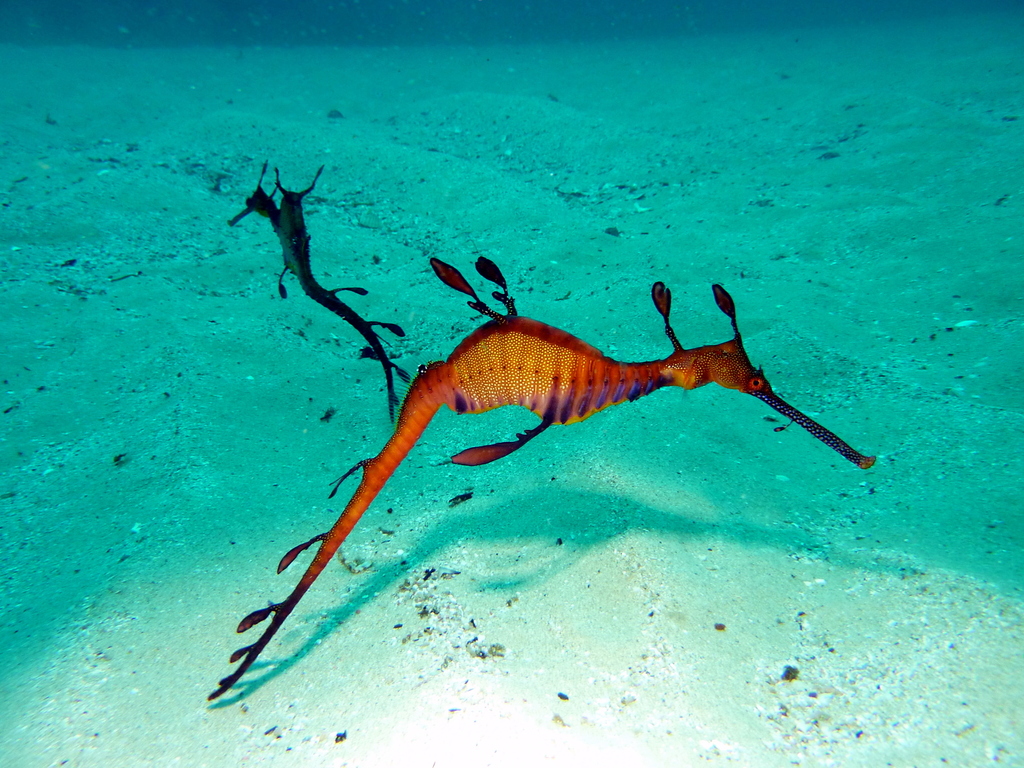
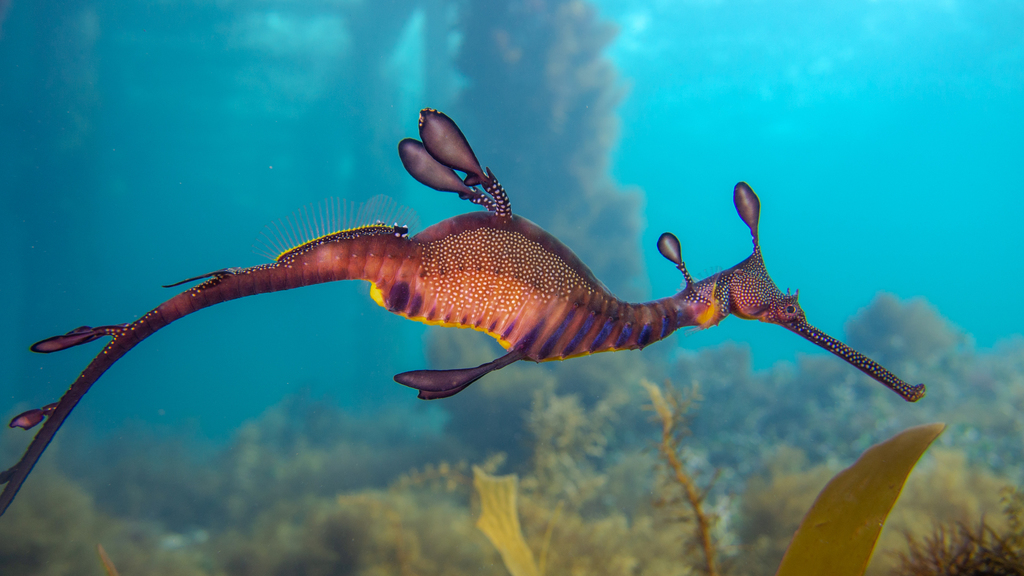
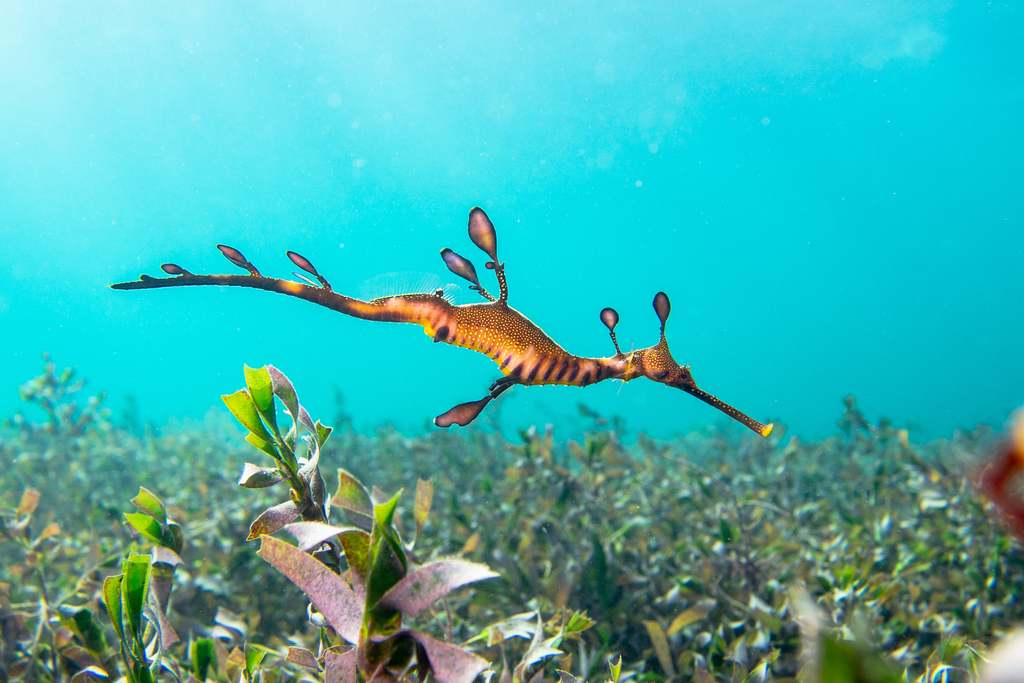
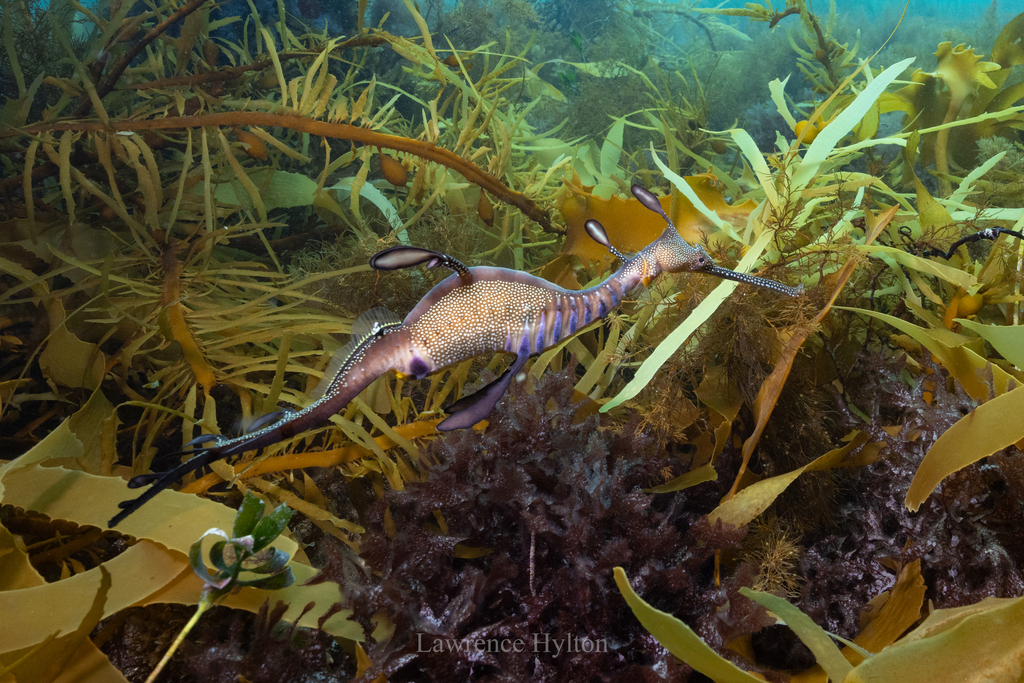
Photos show the species, not always the places on this page.
Length
Adults are usually about 35 to 45 cm (14 to 18 in) long; FishBase gives a maximum of 46 cm (18 in)
Weight
No body weight was reported in the sources opened
Next to a person
About as long as an adult's forearm and hand, and very slim
What it eats
Tiny crustaceans, especially swarms of mysid shrimp, which it sucks into its toothless, tube-shaped mouth. Its leafy appendages and colours camouflage it among seaweed while it feeds.
Around people
Gentle, look only
How it lives
It lives in kelp and seagrass beds beside shallow rocky reefs, mostly at about 2 to 30 m, and is seen alone or in pairs. It is a weak swimmer. The male carries the eggs fixed to the underside of his tail. One source reports about 120 eggs laid on the male, and another reports up to 250 young from a single brood. Incubation is roughly 4 to 8 weeks depending on the source. Fish become mature at about 2 years, and tagged adults in a Sydney study lived for more than 8 years.
Where it goes
Weedy seadragons do not migrate. Adults stay close to home: most tagged adults moved under 200 m over their lifetime in one Sydney study, and another study gives 50 to 500 m. Genetic work found separate groups in central New South Wales, southern New South Wales, Victoria and Tasmania, which points to little mixing between regions.
We only draw a journey on the map when scientists have tracked it or clearly documented it. For this animal we have not found one yet.
Populations
The IUCN (assessed 2024, published 2025) rates it Vulnerable under criteria A2bc, meaning a suspected population decline. Earlier it was rated Least Concern (2016). Its range runs along southern Australia from about Port Stephens in New South Wales to Geraldton in Western Australia, including Tasmania. No total population count was found. A 2023 analysis of citizen-science survey data reported a 59% decline between 2011 and 2021, but a 2024 preprint by Schlögl and Booth concluded that the data are too sparse to support that figure. Habitat loss, pollution and warming seas are named as the main concerns. The species is protected in New South Wales and Tasmania.
Meet it respectfully
Look from a calm distance and let it drift on its own. Never touch, hold, chase, lift or bait a seadragon, and keep fins and hands away from the kelp and seagrass it hides in. It is a weak swimmer and moves little, so disturbance can matter. In Tasmania the species is protected, with a zero possession limit, and any seadragon caught by accident must go straight back into the water. Follow local rules and your guide. A sighting is never guaranteed.
Fun fact
Tap the bulb to light it up.
The male, not the female, carries the eggs, fixed to the underside of his tail.
Its leaf-like appendages make it look like drifting kelp.
In March and April 2022, more than 200 weedy seadragons washed ashore in Sydney after record waves and rain.
Weedy seadragon in the Ocean Atlas
Places we have researched where this animal is recorded. It is never guaranteed, and some places are for watching from the boat only.
Travel with usComing soonTrusted referralExploringOn pause, story onlyEthics pass
Country colour: pink where we travel, blue where we are exploring or refer, grey for story only.
 Australia
Sources for this page
- GBIF, with IUCN Red List category, 2025
- FishBase, 2025
- Australian Museum, 2022
- Tasmanian Government, Common seadragon
- Klanten et al., 2020, PLoS One
- Booth et al., 2025, Journal of Fish Biology
- Schlögl and Booth, 2024, bioRxiv
- Wikipedia, Common seadragon, 2026
Facts checked 5 October 2026. Photos: Unsplash licence, or Creative Commons as shown on each photo.
Work in ocean travel?
We are always happy to hear from exceptional local operators, accommodation, conservation organisations and destination experts. If your work fits responsible, small-group ocean travel, we would love to learn more.
Partner with Ocean CallingGili Trawangan in 5 days
from CHF 790