
Wolf eel
Anarrhichthys ocellatus
A gentle-looking face in a rocky den, seen only when the fish chooses. No sighting is ever a promise.
Least Concern (IUCN, 2020) means it is not currently considered at risk of extinction in the wild.
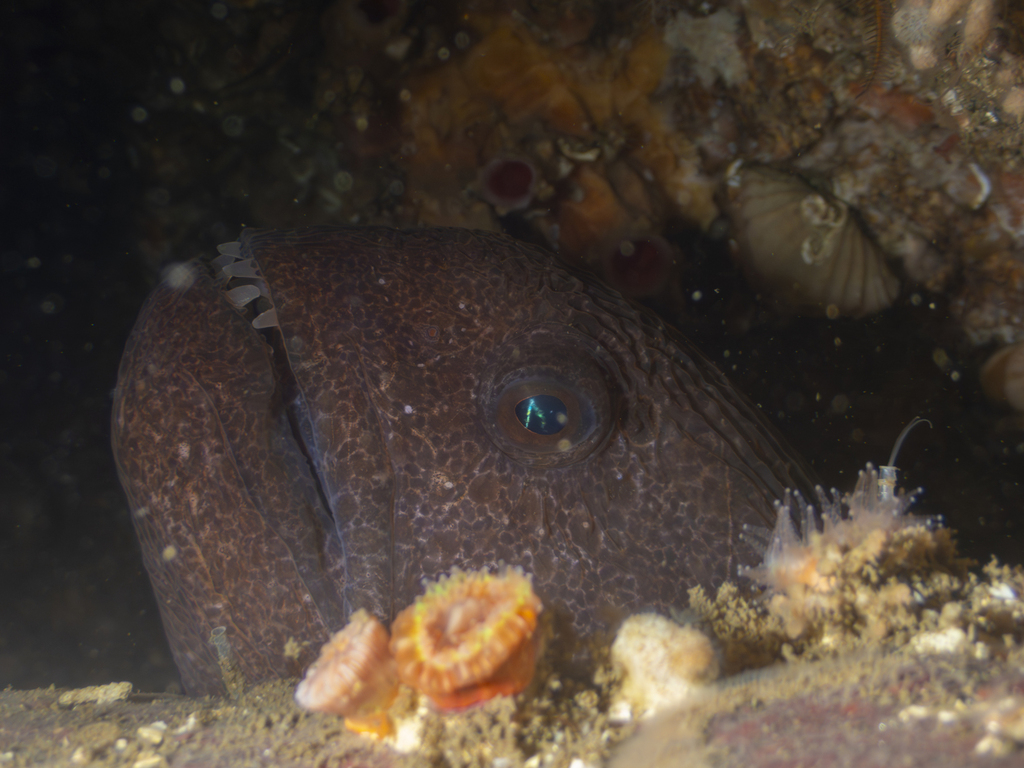
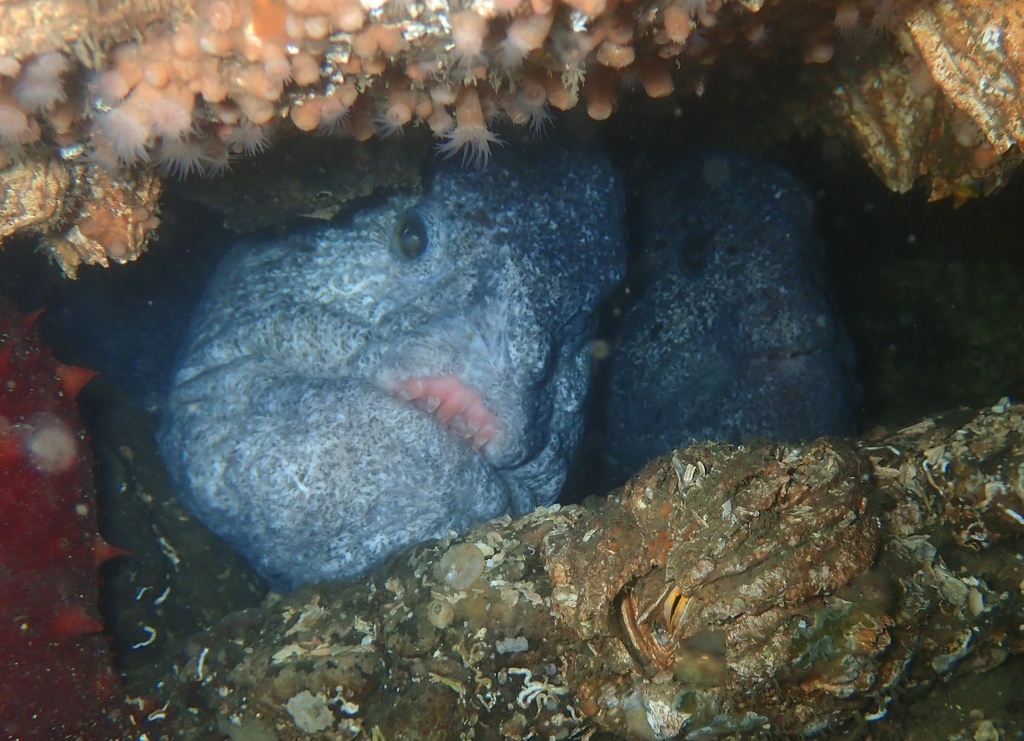
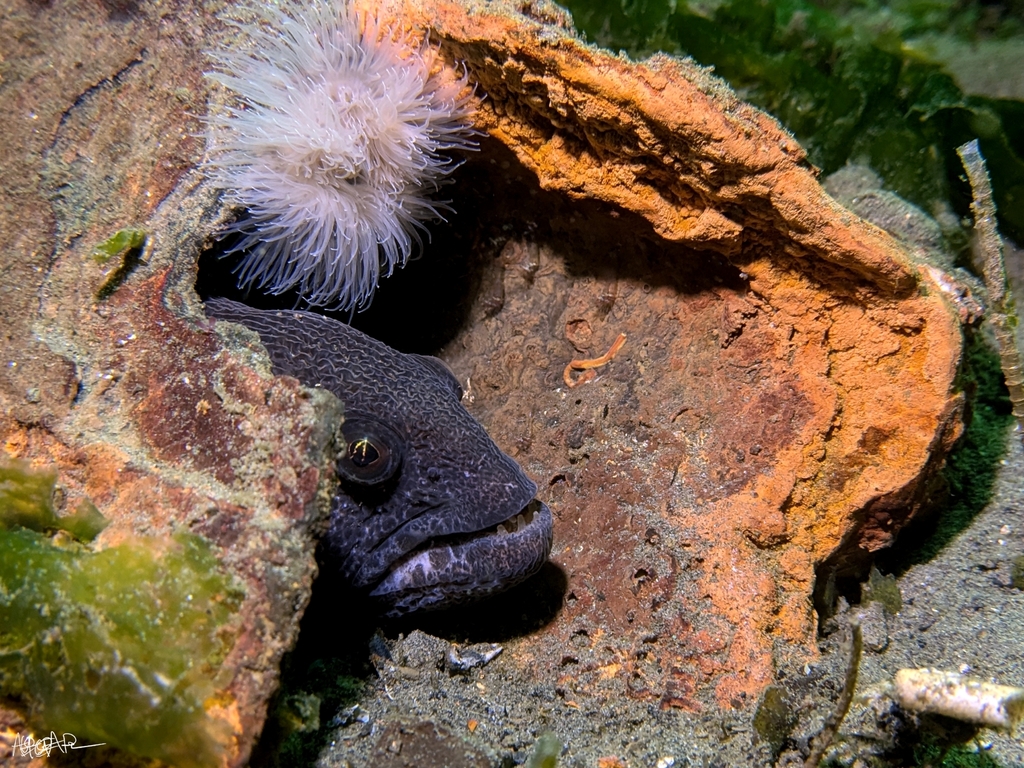
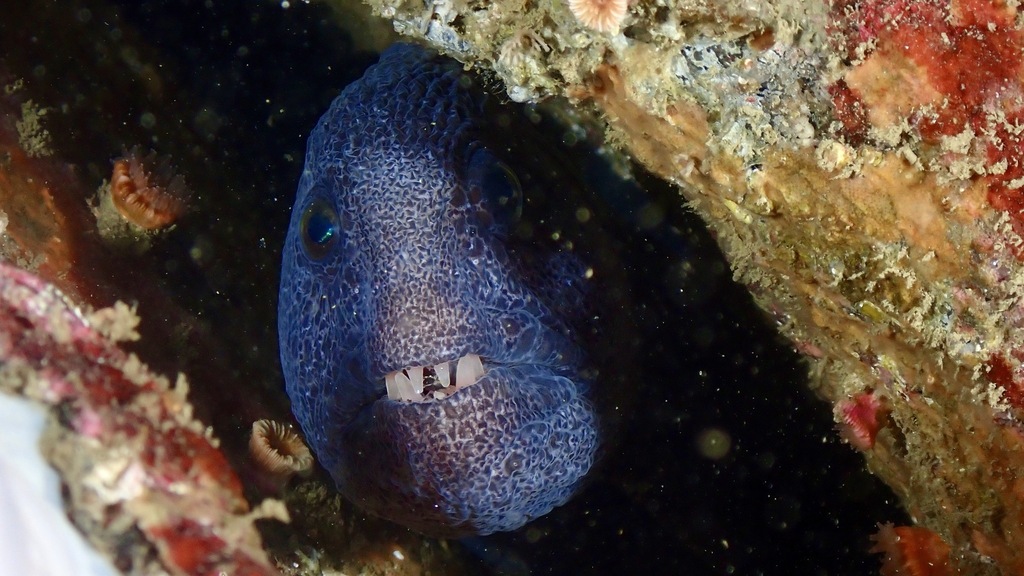
Photos show the species, not always the places on this page.
Length
Up to about 2.4 m (7.9 ft) total length. Divers Alert Network describes adults as typically about 1.8 m (6 ft).
Weight
Up to 18.4 kg (40.6 lb) in FishBase and Washington state records. Divers Alert Network describes adults of nearly 14 kg (30 lb).
Next to a person
A big adult can be longer than most people are tall, but much lighter, closer to a child in weight.
What it eats
Crabs, sand dollars, sea urchins, snails, abalone, mussels, clams and fish. Strong jaws with canine teeth and molars crush the shells. In Puget Sound sea urchins and crabs are favoured, and in northern waters hairy triton snails. One aquarium source reports young adults eating as many as 24 Dungeness crabs in a day.
Around people
Calm, give space
How it lives
Despite the name it is not a true eel. It is a wolffish, with paired gill slits and pectoral fins. Young wolf eels are orange and spend up to two years in open water. Adults then settle in a rocky den and often keep it, unless a larger wolf eel or a large octopus drives them out. Females mature at about 4 to 7 years and lay up to 10,000 eggs in winter. Both parents guard the egg mass, and the eggs hatch after about 3 to 4 months. Pairs are often described as lifelong. Wild lifespan is unknown, though one wild fish was followed for about twenty years and aquarium fish live about 25. Depth goes to 226 m (740 ft).
Where it goes
Adults are mostly sedentary. They stay in one rocky den unless a larger wolf eel or octopus pushes them out. The young drift in open water for up to two years before settling on the reef. The range runs from the Sea of Okhotsk and Sea of Japan across the Aleutians to southern California.
We only draw a journey on the map when scientists have tracked it or clearly documented it. For this animal we have not found one yet.
Populations
Listed as Least Concern by the IUCN (assessed 2020). Recreational harvest in Puget Sound is closed in Washington, and wolf eels are rarely caught in the commercial fishery off the Washington coast. One aquarium source says occasional fishing has not harmed global populations. A global population figure is not available in the sources read.
Meet it respectfully
Wolf eels sometimes look out from the den toward divers, but that is the animal's choice. Keep your distance, stay out of the den entrance, and never reach in, touch, feed or bait a wolf eel to draw it out. Large specimens can give a painful bite. A pair may be guarding eggs in winter, so leave dens undisturbed. Follow local rules and your guide.
Fun fact
Tap the bulb to light it up.
A wolf eel is not a true eel. It is a wolffish, with paired gill slits and pectoral fins.
Young wolf eels are bright orange. Adults turn grey or brown.
Both parents guard the eggs, and the female coils around them and massages them from time to time to keep water moving.
Wolf eel in the Ocean Atlas
Places we have researched where this animal is recorded. It is never guaranteed, and some places are for watching from the boat only.
Travel with usComing soonTrusted referralExploringOn pause, story onlyEthics pass
Country colour: pink where we travel, blue where we are exploring or refer, grey for story only.
 Canada
 United States
Sources for this page
- Wikipedia, Wolf eel
- FishBase, 2026
- Monterey Bay Aquarium, Wolf-eel
- Washington Department of Fish and Wildlife, Wolf eel
- Aquarium of the Pacific, Wolf eel
- Robbins, 2023, Alert Diver, Divers Alert Network
- GBIF, IUCN Red List category
Facts checked 5 October 2026. Photos: Unsplash licence, or Creative Commons as shown on each photo.
Work in ocean travel?
We are always happy to hear from exceptional local operators, accommodation, conservation organisations and destination experts. If your work fits responsible, small-group ocean travel, we would love to learn more.
Partner with Ocean Calling5-day freediving course in Bali
CHF 1,180