
A Day on a Small Group Red Sea Trip in Egypt
The wind is still asleep, the boat is quiet, and first light is turning the desert mountains pink behind you. This is the best hour on Egypt's Red Sea. A small group day here, done well, is built around hours like this: few people, slow dives or snorkels on protected reefs, no chasing animals, and evenings for the science of a sea that may help coral survive a warmer world.
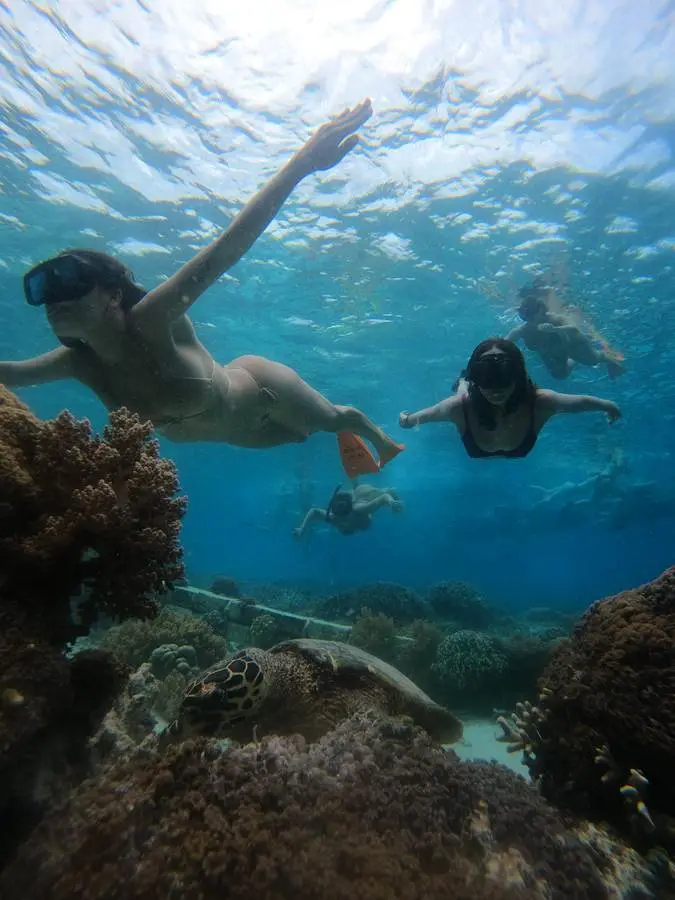
First, an honest note. Egypt is not an Ocean Calling trip, and we do not want to pretend otherwise. This article is how we would shape a day there, using the same rules as our hosted retreats: small groups, vetted local operators, unhurried days, and every guest free to skip anything. If you plan your own small group trip to the Red Sea, I hope it helps you choose well.
The Red Sea is often sold as a wreck-diving destination or a package-holiday reef. It is both. But it is also one of the most interesting seas on the planet for reef science, and a small group gives you the time to notice why.
Morning: Ras Mohammed, a reef protected for decades
From the Sharm El-Sheikh side, many days start toward Ras Mohammed National Park, at the southern tip of the Sinai. Sources disagree a little on the founding year, some say 1983 and IUCN says 1986, but either way it is one of Egypt's oldest protected areas, and it shows.
According to IUCN, monitoring in the park shows live coral cover of up to 90 percent in some areas and an average of over 65 percent, compared with typically 20 to 30 percent outside the reserve. The park is home to more than 210 coral species. In November 2018, during the UN Biodiversity Conference in Sharm El-Sheikh, Ras Mohammed received the IUCN Green List certificate, which recognises protected areas that are well governed and effectively managed. An expert group assessed the site against 50 indicators.
There is a nice piece of history here for divers. One of the first studies on how briefings change diver behaviour, by Medio and colleagues in 1997, was done in Ras Mohammed. A short environmental briefing cut divers' contacts with the reef from about 1.4 to 0.4 per diver in seven minutes. A good briefing is still the start of every good morning there.
Why Red Sea coral may outlast others
This is the part that excites scientists. Corals in the northern Red Sea, and especially in the Gulf of Aqaba, can tolerate much more heat than many reefs elsewhere. In 2013 the marine biologist Maoz Fine and colleagues proposed that the Gulf of Aqaba may be a coral refuge. Their idea: over a long history, only heat-tolerant corals made it north through the warm southern Red Sea, and settled in water several degrees cooler than their bleaching limit.
A more recent study by Kochman and Fine followed tagged corals at the northern tip of the Gulf of Aqaba over four summers. In 2024 a marine heatwave lasted 113 days, with sea surface temperatures reaching 32.6 °C, about 3.4 °C above the long-term average. The two main species they followed, Stylophora pistillata and Pocillopora damicornis, came through without bleaching. That is unusual, and hopeful.
Egypt's long coastline of fringing reefs has also been recognised internationally. In 2022 the Great Fringing Reef of Egypt became the first Mission Blue "Hope Spot" in the Red Sea, after a campaign by the Egyptian NGO HEPCA and The Ocean Agency. At COP27 in Sharm El-Sheikh, Egypt's environment minister announced protection for the reef along more than 2,000 km of coastline. At the time, reports noted that the level of protection was still unclear, so check the current status before you rely on it.
Resilient is not invulnerable
I do not want to oversell the hope. Heat-tolerant does not mean heat-proof. HEPCA's Bleach Watch Egypt network, working with the Red Sea Protectorates, documented a coral bleaching event on the Egyptian coast in 2023. In September 2024, a HEPCA report described bleaching reaching, for the first time, beyond the southern regions to the northern sectors, including Hurghada and the Gulf of Aqaba, with an overall average bleaching rate of 28 percent. These figures come from HEPCA's own surveys, and the full impact of the latest global bleaching event is still being assessed.
So the honest picture holds two things at once. The northern Red Sea may be one of the best long-term hopes for coral. And it is already under pressure. Both are true, and a good guide will tell you both.
Midday: can you swim with dugongs in Egypt?
Turtles, reef sharks, dolphins and, much more rarely, dugongs live along this coast. Dugongs are the animal people hope for most, and the one that needs the most care. A study based on interviews with fishermen in 2015 and 2016 estimated a minimum population of only about 73 to 97 dugongs in the north-western Red Sea, and the authors could not say for certain whether that showed a decline. Dugongs have been retreating from parts of the coast in the face of tourism development, habitat loss and disturbance from boats, and in 2019 a dead dugong near Marsa Alam had a head wound from a boat propeller. HEPCA has also warned about too many snorkellers and divers in Abu Dabbab Bay, a well-known dugong spot.
We could not find an official, current Egyptian rule on swimming distance from dugongs, so we will not invent one. What we would do is simple: follow the park rangers and the certified local guides, never chase, never block an animal's way to the surface, never touch, and leave when it moves away. A dugong is never guaranteed, and that is part of the respect. Wildlife encounters are unpredictable. Snorkelling near dugongs should always follow local regulations and experienced professional guidance. We wrote more about this in why a dugong sighting is luck, not a guarantee.
Afternoon: why a small group moves slowly
After a morning in the water, afternoons should be quiet: a surface interval in the shade, a light lunch, sometimes a second, shorter snorkel or dive when the light softens. With six people or fewer, nobody has to keep pace with the group average. That matters on the Red Sea, where currents and depth changes reward people who move at their own speed.
The sun is strong here, even in the cooler months. A long-sleeved rash guard means less sunscreen in the water, and a roll-top dry bag keeps your phone, passport copy and a dry layer safe from spray on deck. Our Red Sea packing list covers the rest, and a refillable bottle from a tropical travel kit helps cut plastic on hot days.
The conservation layer: how to visit without adding pressure
Popular reefs carry many visitors, and that is part of what reefs here have to survive, on top of heat. As a guest you can lower your share of that pressure. Choose operators that use mooring buoys, keep groups small and correct divers kindly underwater. Keep your fins off the reef. Do not touch, feed or follow animals. Ask how the operator works with the protected-area rules, and check the current park fees and rules before you travel, because they change.
There is also the cost of getting there. Flights to Egypt have a real carbon footprint, and that same carbon dioxide is warming the sea these corals are trying to survive. We think the fairest answer is to travel less often and stay longer, and to make each trip count for the reef and for the local people who protect it.
Evening: what the reef teaches, off the water
Evenings are for talking about what we saw and what it means: why a reef this resilient still bleached in recent years, what a Hope Spot can and cannot change, and what it means to visit a place scientists are watching as a possible refuge for coral. There is something quietly moving about floating over coral that might still be here when many other reefs are not.
If you want to go further, our guide to what ethical diving looks like on Egypt's Red Sea reefs now covers the ethics in more depth, and the Egypt page of our Ocean Atlas collects the places and animals. If this made you curious about travelling this way, you can explore our retreats.
Questions people ask
Does Ocean Calling run a retreat in Egypt?
No. This article shows how we would shape a small group day on the Red Sea, using the same principles as our hosted retreats: small groups, vetted local operators and no wildlife interference.
Why is Ras Mohammed special?
It is one of Egypt's oldest protected areas (sources give 1983 or 1986). IUCN reports average live coral cover over 65 percent inside, against 20 to 30 percent outside, and in 2018 it received the IUCN Green List certificate for effective management.
Are Red Sea corals really heat-resistant?
Corals in the northern Red Sea and Gulf of Aqaba tolerate unusually high temperatures. In a 2024 heatwave of 113 days, two main coral species studied at the northern Gulf of Aqaba came through without bleaching. But HEPCA still recorded bleaching on Egypt's coast in 2023 and 2024.
Can I swim with dugongs in Egypt?
Sightings are rare and never guaranteed. A study estimated only about 73 to 97 dugongs in the north-western Red Sea. If you meet one, keep your distance, do not chase or block it, and follow the local guides and rangers. Check the current local rules before you go.
What is the Great Fringing Reef Hope Spot?
In 2022, Egypt's Great Fringing Reef became the first Mission Blue Hope Spot in the Red Sea. At COP27, Egypt announced protection along more than 2,000 km of coast, though the exact level of protection was unclear at the time.
Wildlife encounters are never guaranteed and never forced. Ocean Calling works only with vetted, ethical local operators, and every animal is free to approach, or not, entirely on its own terms.
Sources & further reading
- IUCN, 2018. Ras Mohammed National Park: Egypt's underwater paradise among the best protected marine reserves on the planet.
- HEPCA, 2024. Bleach Watch report 2024 update.
- HEPCA. Bleach Watch Egypt.
- HEPCA, 2022. The Great Fringing Reef is a Hope Spot.
- The Ocean Agency, 2022. Protection for one of the world's most important reefs (COP27).
- Fine, M. et al., 2013. A coral reef refuge in the Red Sea. Global Change Biology (Hebrew University research record).
- Kochman, N.R. and Fine, M. Gulf of Aqaba as a thermal refuge: insights from four years of monitoring (Hebrew University research record).
- Medio, D. et al., 1997. Effect of briefings on rates of damage to corals by SCUBA divers. Biological Conservation 79: 91-95.
- Egyptian Journal of Aquatic Biology and Fisheries. Study on dugongs in the north-western Red Sea based on fishermen interviews.
- Egypt Independent. Endangered species: Egypt's dugong.
- Al-Masry Al-Youm, 2019 (via Mideast Environment archive). Report on a dugong killed by a boat propeller near Marsa Alam.
- HEPCA. Disappearing dugongs (report on Abu Dabbab and tourism pressure).
Further reading on Ocean Calling: More from the journal · Egypt's Red Sea reefs and ethical diving · What to pack for the Red Sea · Egypt in the Ocean Atlas · Wildlife & the law · See the retreats
Find the retreat that fits you
Small groups of up to six guests, unhurried days and local experts. Tell us how you feel in the water and we will point you to the right trip.
Explore in the Ocean Atlas
Places in this article