
Why Small Group Travel Reduces Environmental Impact
Keeping a trip small is not only cosier. It eases real pressure on reefs, wildlife and the island communities that host us, and one dive study shows exactly why the guide matters.
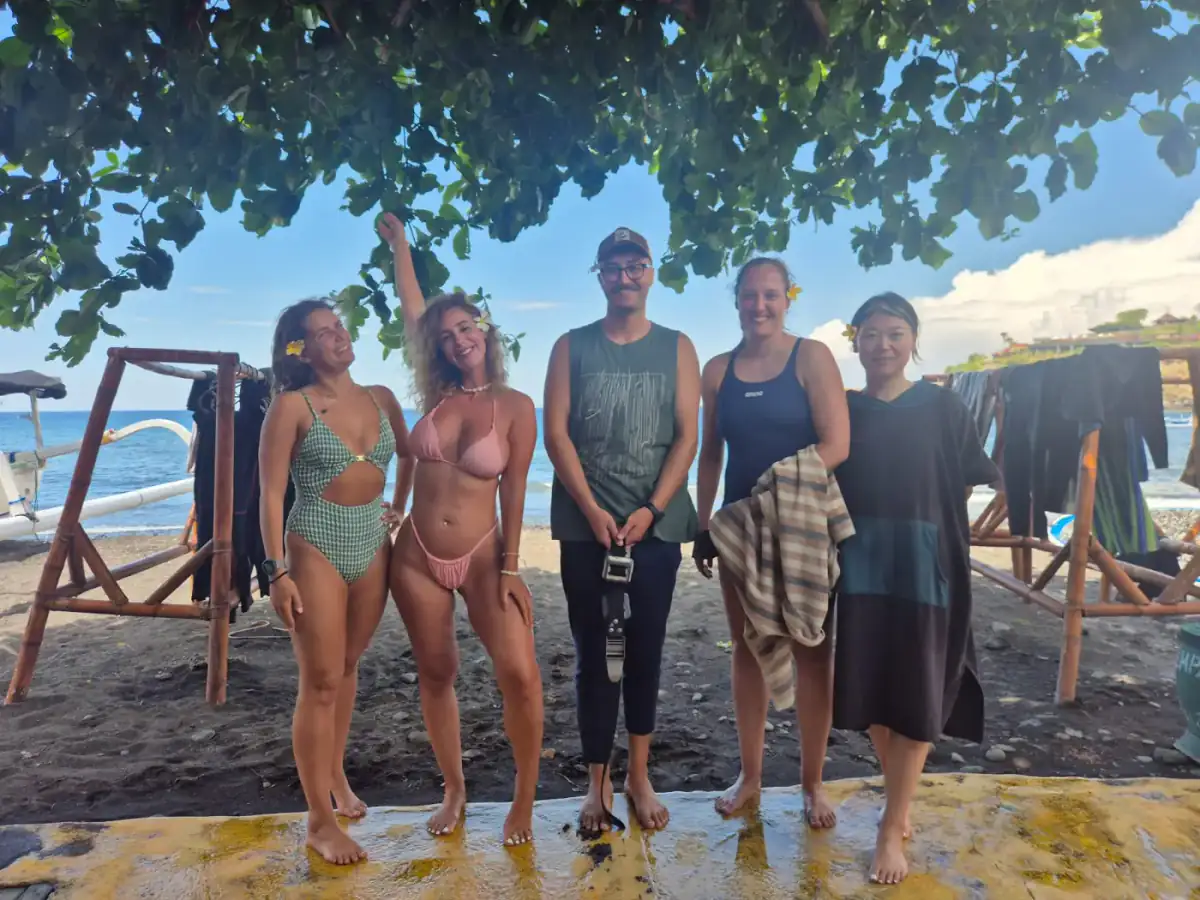
Picture two boats arriving at the same small reef on the same morning. One carries twenty-five snorkellers, the other five. Same reef, same fish, and the guide on each boat may be equally kind. Why would the number matter? Because small group travel reduces environmental impact in very practical ways: fewer fins near the coral, a guide who can actually see and correct everyone, less pressure on wildlife, and less strain on the island's water, food and waste systems.
Tourism isn't the enemy, scale often is
Travel gives us something real: new places, new people, a different rhythm for a while. It can also put real pressure on the places we visit, especially fragile ones: reefs, small islands, communities that were never built for thousands of visitors a week. The difference usually is not whether people travel, but how many arrive at once, and how they move once they are there.
That is the idea behind small group travel. It does not ask anyone to stop exploring. It simply changes the scale, the pace and the amount of care that fits into a day.
What "small" means to us
There is no single official definition of small group travel; different operators use different numbers. On our hosted retreats, the cap depends on what we are doing in the water. Diving and freediving sessions are capped at four guests per instructor, because that is what lets a guide watch everyone's breathing, buoyancy and comfort at once. Other activities, island days, lagoon tours, reef trips by boat, run with up to six. That is not a marketing line. It is a practical limit. A group that size can move through the water quietly, shift plans around the weather or the wildlife, and still get personal attention from a guide who knows everyone's comfort level.
That flexibility matters most in the ocean, where conditions and animal behaviour change every day and a rigid schedule serves nobody.
Conservation: less pressure on fragile reefs
Coral reefs face a long list of threats, warming water, pollution, disease, and recreation is one of the few that travellers can influence directly. NOAA's Coral Reef Information System (CoRIS) lists coastal uses, including tourism overuse and vessel groundings, among the pressures on US reefs, and notes that divers and snorkellers can have a significant negative impact through physical damage. NOAA's Coral Reef Conservation Program also runs anchor-awareness work, because an anchor dropped on a reef can break or dislodge corals for years. The same physical mechanisms apply anywhere people dive, snorkel or anchor near coral: fin contact, careless hands, boat anchors and stirred-up sediment.
Does a dive briefing protect the reef?
Here the research gets interesting. In a well-known study in St Lucia, Barker and Roberts (2004) found that a pre-dive briefing alone did not change how often divers touched the reef. What worked was a dive leader stepping in underwater when someone touched the coral: contact rates fell from about 0.3 to 0.1 contacts per minute. A later study of the Green Fins programme reported that a guide's ability to step in like this decreases as diver groups get larger. In other words, the guide matters, and a guide can only watch so many people.
A smaller group entering the water in a staggered, unhurried way simply gives the reef, and the guide, a better chance. It is not a promise of zero impact, nothing in the ocean works that way, but it makes good behaviour much easier to keep.
Calmer, more respectful wildlife encounters
Wildlife is often the reason people come. It is also the part that deserves the most restraint. Fewer swimmers in the water means less noise, less splashing and less visual pressure on an animal deciding whether it feels safe. We never chase, touch or bait anything we meet; sightings are never guaranteed, and that is the honest trade-off for doing it properly. A good guide reads the animal's behaviour and moves the group's position to match, something that gets harder, fast, once a group grows past a handful of people. Our checklist for responsible wildlife tourism goes through what to look for in an operator.
Lighter use of local resources
Group size shapes resource use in ways that are easy to miss: water, energy, transport, food. Smaller groups need fewer vehicles and less accommodation, and they fit into small, locally run guesthouses instead of needing a large resort.
Food is a good example. Cooking for six people with a local supplier is a different job from catering for a coach tour, and it makes it easier to eat what the island actually produces.
Better habits around waste
Many small islands have limited space and infrastructure for waste, and a high volume of visitors can strain it quickly through packaging and single-use plastic. Small groups make it much easier to build good habits instead: refillable bottles, reusable containers, less packaging brought in at all. A refillable bottle and a few packing cubes from a simple tropical travel kit, and a roll-top dry bag for the boat, replace a surprising number of plastic bags and bottles over a week. Our page on low-plastic travel on islands has more ideas.
People also tend to hold themselves a little more accountable in a small group. It is harder to leave a mess when everyone can see it.
Stronger ties to local communities
Small group travel naturally leans toward locally owned guides, boats and accommodation rather than large international operators. That keeps more of what guests spend inside the destination's own economy, and it brings local knowledge, seasonal patterns, currents, which reef is resting this month, straight into the trip. We work with local experts at our destinations for exactly this reason: they know the water better than anyone flying in ever could, and they are the ones who live with the consequences of how it is treated.
Room to slow down
Small groups tend to move at a slower rhythm almost by default: fewer logistics to coordinate, less pressure to hit every stop on a list. Spending more time in fewer places cuts transport and gives people a real chance to understand where they are, instead of skimming the surface of several destinations in quick succession.
Small groups also leave room for conversations that larger tours rarely have space for: questions about a fish behaviour you just watched, or why one reef is protected and another is not. Guides can offer real context instead of a rehearsed script. We cannot claim these conversations change anyone's habits for life, we could not prove that, but understanding tends to travel home more easily when it was earned in a small, unhurried group.
A balanced, honest way to travel
No form of travel has zero impact, and we will not pretend otherwise. Flights are a large part of the footprint of most long-distance ocean trips, and a small group does not change that. The more honest goal is to reduce pressure where we can, stay longer instead of hopping between places, and keep visitor numbers within what a reef or a village can absorb. Small group travel is not a perfect fix. It is a practical one, and it is the one that lets a place stay worth visiting for the next group too. If this made you curious about travelling this way, you can explore our small-group retreats.
Questions people ask
Does small group travel really reduce environmental impact?
It helps in specific ways. Research on divers found that guide intervention underwater reduced reef contact, and a later study reported that guides can intervene less as groups get larger. Smaller groups also need fewer vehicles and less infrastructure.
What group size does Ocean Calling use?
On our hosted retreats, up to six guests for boat days and other activities, and up to four per instructor for diving and freediving sessions. Trips we refer you to are run by local teams with their own group sizes.
Is a dive briefing enough to protect the reef?
Not on its own, according to a 2004 study in St Lucia. A briefing alone did not change contact rates; a dive leader correcting divers in the water did.
Does small group travel cancel out the flight?
No. Flights are a large part of the footprint of a long-distance trip, whatever the group size. Staying longer in one place and travelling less in between helps more than group size alone.
Are wildlife sightings better in small groups?
Nothing can guarantee a sighting. Fewer swimmers means less noise and splashing, which gives an animal more room to stay calm and choose for itself.
Wildlife encounters are never guaranteed and never forced. Ocean Calling works only with vetted, ethical local operators, and every animal is free to approach, or not, entirely on its own terms.
Sources & further reading
- NOAA Coral Reef Information System (CoRIS). Threats to coral reefs.
- NOAA CoRIS. US Coral Reef Action Strategy, goal on reducing impacts of coastal uses.
- Barker, N. & Roberts, C. Scuba diver behaviour and the management of diving impacts on coral reefs. Biological Conservation 120(4): 481-489, 2004 (UK government research output record).
- Roche et al. Recreational diving impacts on coral reefs and the adoption of environmentally responsible practices within the SCUBA diving industry (Green Fins). Environmental Management, Springer, 2016.
- Coral Reefs, Springer, 2021. Study of diver reef contacts, reviewing how much briefings reduce them.
Further reading on Ocean Calling: More from the journal · Wildlife & the law · See the retreats · Ocean Atlas
Find the retreat that fits you
Small groups of up to six guests, unhurried days and local experts. Tell us how you feel in the water and we will point you to the right trip.