
Why Some Fish Approach Divers (and Others Won't)
One fish swims up to look at your mask. Another disappears at your first bubble. The difference has less to do with you than with what that reef has learned about people.
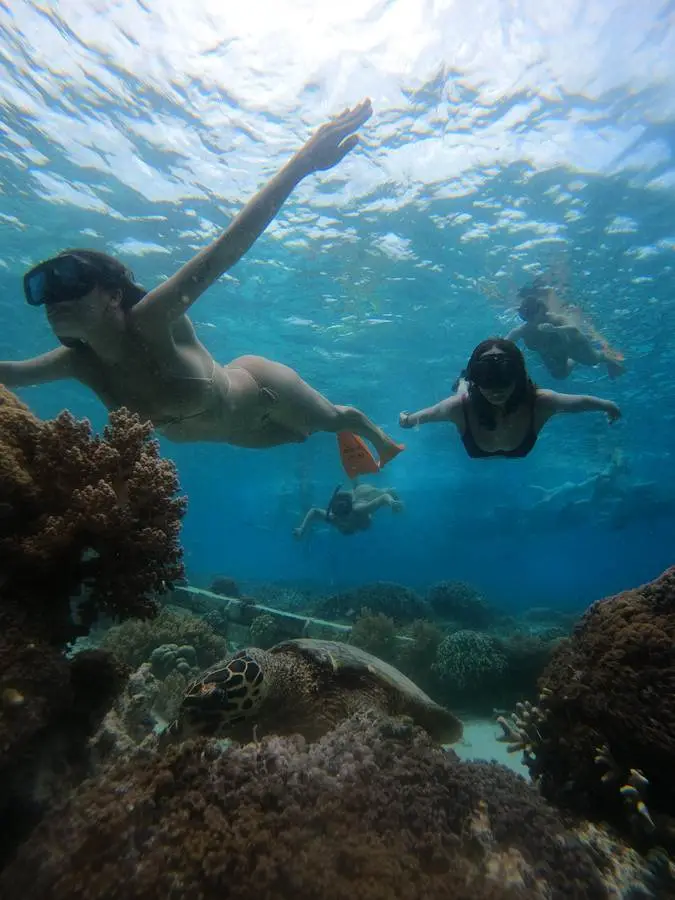
Why do some fish come close to divers while others flee?
Every diver knows both sides of this. A curious batfish that stays next to you for twenty minutes. A wrasse that darts in, checks your mask and darts away again. And two metres further, a grouper that bolts the moment you look at it, or a whole school that scatters at your first breath of bubbles.
It is tempting to think fish have moods, or that some species are simply friendlier. The real answer is more interesting. How a fish behaves around a diver comes from its species, its own personality and, more than anything else, from what people have done to that population in that exact place.
It is rarely about you
The strongest clue to how wary a fish will be is not what the diver does in that moment. It is the fish's history with humans, and especially with people who fish.
A 2018 study in the ICES Journal of Marine Science (Sbragaglia and colleagues) measured flight initiation distance, the distance at which a fish swims away from an approaching person. The team looked at five coastal fish species in three areas of the Mediterranean, inside and outside zones protected from spearfishing. Fish kept a bigger gap from a diver carrying a speargun than from a diver with only fins, and this was clearest in the species that spearfishers target. Outside protected areas, large fish started fleeing a speargun diver from far away. The researchers put it simply: the more dangerous the situation, the stronger the response.
So fish seem able to tell a threat from a non-threat, and they learn which is which from real consequences. Not from how calm or graceful the diver thinks they look.
This is also why the same species can act so differently a few kilometres apart. A grouper that flees on a fished reef and a grouper that hovers near you inside a well-guarded no-take zone may be almost the same genetically. What is different is what each population has learned.
Fish do get used to divers, but only partly
It feels logical that fish would simply get used to divers over time, the way animals in a national park get used to safari cars. Research shows a messier picture.
A 2015 study in PLOS ONE by Titus, Daly and Exton compared a busy dive reef at Utila, in the Bay Islands of Honduras, with a site that sees no divers in the Cayos Cochinos Marine Protected Area. They watched cleaning stations, the small spots where fish line up to have parasites removed. At Utila, cleaning dropped less when people came close and went back to normal faster, a sign of some habituation. But even there, cleaning fell by more than half while divers were present, after decades of diver visits.
Their conclusion: not every fish and not every species has got used to us. On the very same reef, some individuals are just bolder than others.
Curiosity usually has a job attached
When a fish does come close, it is rarely about friendship. Usually it is running an errand.
Cleaner wrasse and cleaner shrimp come up to divers for the same reason they come up to every large animal on the reef. For a cleaner, you are one more possible client who might carry parasites, and checking you costs almost nothing. A 2011 study in Current Biology (Pinto, Oates, Grutter and Bshary) found that cleaner wrasse cooperate better, biting their clients less, when other reef fish are watching. It looks like they want to make a good impression on future clients. That is a lot of social thinking for a fish a few centimetres long.
Damselfish are different. When a damselfish swims at you, it is often defending its small patch of reef. It is checking, and sometimes nipping at, something new that has entered its territory. Not making friends.
Many divers also notice that some fish react differently to scuba bubbles than to a quiet freediver. That makes sense, because bubbles are noisy and new. But we did not find good research that measures it, so take it as an observation, not a finding.
What this means for how you dive
None of this is a reason to try to make an encounter happen. Feeding fish to bring them closer teaches a population to link humans with food. It changes their natural behaviour, and it is not good for the fish or for the next diver who arrives without a snack.
It is a reason to stay still, breathe evenly and let curiosity come to you, instead of swimming towards it. Most of what decides whether a fish comes close was settled long before you got in the water: by whether that reef is protected, and by what that fish has already learned to expect from people.
If you like taking photos, a small underwater camera lets you stay still and let the fish decide. A well-fitting low-volume mask that does not leak makes it easier to stay calm and breathe slowly.
Reef fish behaviour changes by species, site and individual, and no sighting is ever guaranteed. The kindest and most rewarding way is simple: never feed, chase or touch wild fish to get a closer look, and always follow your operator and the local marine park rules.
Curious how the same idea works with a much bigger and more careful animal? Our guide to where manta rays choose to approach divers looks at exactly that. And to see what real protection changes on a reef over time, read what happens to a reef when anchors drop in the wrong spot.
The fish that swims straight past you and the fish that stays at your shoulder are both telling you something true about that reef's history. Neither of them is judging your technique.
Questions people ask
Why do some fish swim away from divers?
Often because of their history with people. A 2018 Mediterranean study found fish fled sooner from divers carrying spearguns, especially species targeted by spearfishing and especially outside protected areas.
Do reef fish get used to divers?
Partly. A 2015 study in Honduras found cleaning stations at a busy dive reef recovered faster after diver contact, but cleaning still dropped by more than half while divers were there.
Why do cleaner wrasse come up to divers?
To a cleaner, a diver looks like one more large animal that might carry parasites. Research also shows cleaner wrasse behave better when other fish are watching, which hints at how social these small fish are.
Should I feed fish to get closer?
No. Feeding changes natural behaviour and teaches fish to link people with food. Stay still, breathe evenly and let curiosity come to you.
Are fish calmer inside marine protected areas?
The spearfishing study suggests fish react less strongly where they are protected, because fewer meetings with people end badly. It still varies by species and by individual.
If this made you curious about meeting the ocean this way, you can explore our upcoming retreats.
Wildlife encounters are never guaranteed and never forced. Ocean Calling works only with vetted, ethical local operators, and every animal is free to approach, or not, entirely on its own terms.
Sources & further reading
- Sbragaglia V. et al., 2018. Spearfishing modulates flight initiation distance of fishes: the effects of protection, individual size, and bearing a speargun. ICES Journal of Marine Science.
- Leibniz-Institute of Freshwater Ecology and Inland Fisheries (IGB), 2018. Spearfishing makes fishes more timid (press release).
- Titus B.M., Daly M., Exton D.A., 2015. Do reef fish habituate to diver presence? Evidence from two reef sites in the Bay Islands, Honduras. PLOS ONE 10(3): e0119645.
- Scientific American blog, 2011. Good cleaners: cleaner fish behave differently depending on who's watching (on Pinto et al., Current Biology).
Further reading on Ocean Calling: More from the journal · Wildlife & the law · See the retreats · Ocean Atlas
Find the retreat that fits you
Small groups of up to six guests, unhurried days and local experts. Tell us how you feel in the water and we will point you to the right trip.