
Freediving for Mental Health: What the Breathing Research Says
Can freediving help with how we feel? Not as a treatment. But slow breathing, the habit at its heart, has some real research behind it. Here is what that research says, what it does not say, and where to be careful.
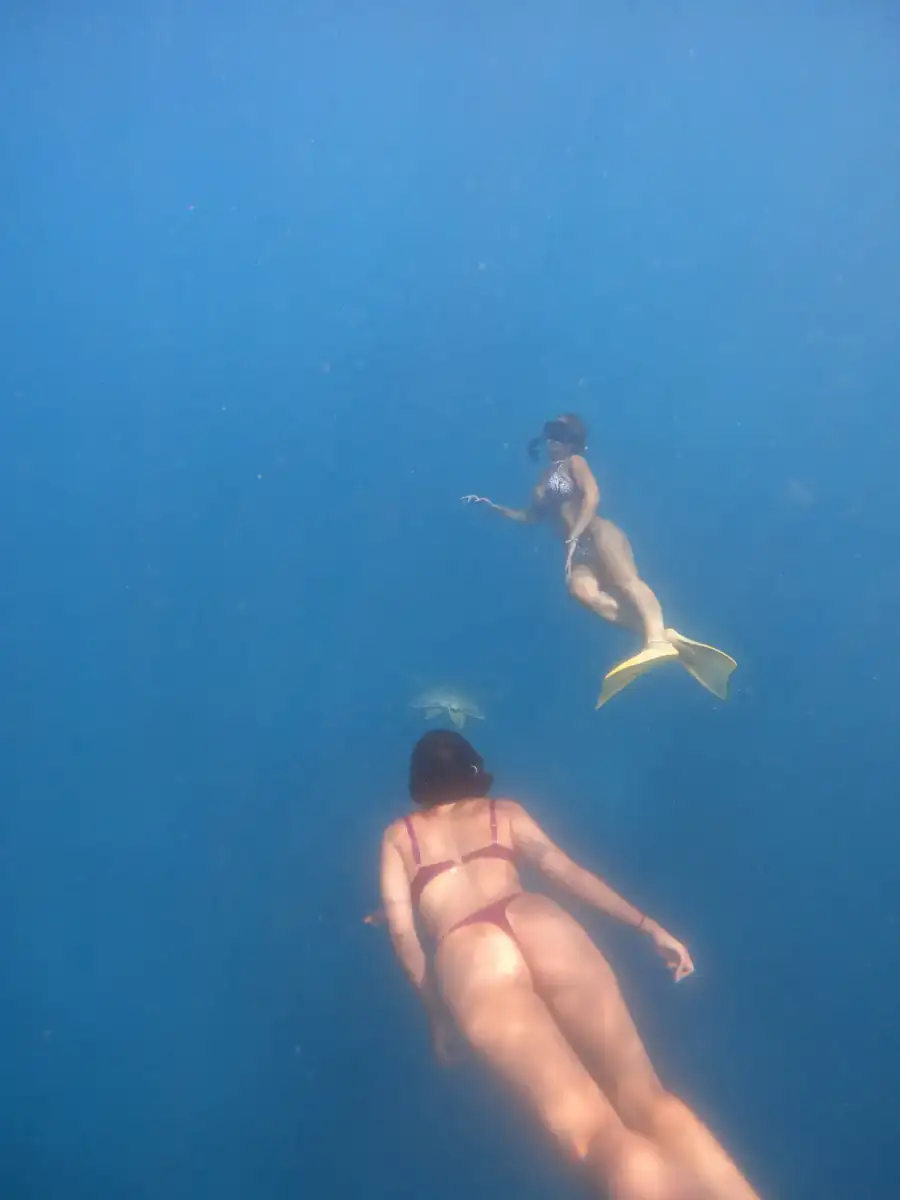
Breathing through the depth: freediving as a space for reflection.
Some weeks the body feels it before the mind finds the words. The chest is heavy, sleep is thin, and the same thought keeps going round. Many people tell me the sea is where this loosens a little. So it is a fair question: can freediving help with how we feel?
My honest answer: freediving is not a treatment for grief, anxiety, depression or any diagnosed condition, and I know of no study I could verify that shows it is. What does have some support is slow, deliberate breathing, which freediving uses a lot, and which you can try on dry land first. Nothing here replaces a therapist, a doctor, or the people who know your story.
What does the research on breathing actually say?
The best evidence I could verify is a randomised trial by Stanford researchers, led by Melis Balban and published in Cell Reports Medicine in 2023, called “Brief structured respiration practices enhance mood and reduce physiological arousal”. Participants were given one of three breathing exercises or mindfulness meditation, and practised for five minutes a day for one month, from home.
The three breathing methods were cyclic sighing, which focuses on long out-breaths, box breathing, and a type of cyclic hyperventilation with breath retention. The authors report that breathwork, and especially exhale-focused cyclic sighing, improved mood and lowered the breathing rate more than mindfulness meditation did. Both approaches reduced negative emotion, including state anxiety. Stanford’s own summary adds that heart rate did not change in any group, and that the cyclic sighing group had the biggest daily rise in positive feeling.
I want to be careful about what this means. The study looked at short breathing exercises at home, not at freediving or the sea. It ran remotely, and the authors call the cyclic sighing result promising, not final. I did not go through every figure in the full paper, so I am not quoting effect sizes. To me it is a modest, useful finding: a few minutes of slow breathing with a longer out-breath may help some people feel calmer, and it costs nothing to try.
Why the water might feel different
Here I move from evidence to experience, and I want you to see the line. Under water, many everyday inputs disappear. No phone, no conversation, sound turns soft. Attention often settles on simple things: the breath, the weight of the body, the feeling of being held by the water. Many people describe it as spacious, not empty.
I cannot prove that this is what helps, and I will not pretend a feeling of relief in the water is a clinical result. Beaches, pools and quiet walks can feel calming too. If you want to read about the idea that being near water settles us, we have a piece on why being near the ocean feels calming, and one on breathwork, ocean anxiety and confidence.
Breath as an anchor, not a fix
If you want to try the idea without getting wet, keep it small. Sit comfortably, breathe in through the nose, and let the out-breath be longer than the in-breath. Five minutes, at the same time each day, for a few weeks, and notice what changes. That is a simple version of what the Stanford trial tested, and the same kind of breathing that freediving training builds on.
Breathing exercises are not right for everyone in every moment. If breath-holds or fast breathing make you dizzy or panicky, stop, and ask a doctor or a qualified teacher. I would never practise any breath-hold or fast-breathing technique in or near water without a qualified instructor.
If you later move into the water, small comforts help you relax and keep your attention on the breath: a mask that does not leak, from a low-volume mask list, and fins you can kick without cramping, like those on a freediving fins list. They do not make anyone calmer on their own, but they remove two small sources of stress.
Learning slowly, and with support
Freediving is a breath-hold sport with real risks, so it must be learned from a qualified instructor and practised with a buddy, never alone. Most people start with breath awareness on land, then easy floating, then short supervised dives. Progress is slow, and that is fine. The goal was never depth. It is feeling at ease with your own breath and with the quiet that comes after. Our pages on freediving safety basics and the buddy system explain the rules we follow.
Wellness without taking from the sea
There is a risk in telling people that the ocean will heal them. It can turn a living place into a tool for our mood, and some of the worst habits in wildlife tourism start right there: moving closer to an animal because the moment feels meaningful, or flying across the world for one good week. I try to keep two rules. First, calm comes from slowing down, not from getting something from an animal. We never chase, touch, bait or manipulate wildlife, and any animal that appears is a gift it is free to withdraw. Second, flying has an environmental cost, and I would rather you stay longer and travel less than collect trips.
If you already live near a coast, a quiet swim, a walk or a bench by the water may give you part of what you are looking for, with no flight at all.
If you are struggling
If you are in a very dark place, please talk to a doctor, a therapist or a crisis line where you live before you think about any retreat. Freediving cannot hold what a trained person can hold. If you are doing reasonably well and want a gentle, unhurried way to meet your own breath, our small groups are made for that: six people at most, no pressure to join any activity, and the freedom to skip anything.
If this made you curious to try it yourself, you can explore our retreats.
Questions people ask
Can freediving treat anxiety, depression or grief?
No. Freediving is not a treatment for any diagnosed condition, and I did not find a study showing that it is. Please talk to a doctor or therapist about treatment.
What does research say about breathing exercises and mood?
A 2023 randomised trial by Stanford researchers in Cell Reports Medicine had people practise five minutes a day for one month. Breathwork, especially exhale-focused cyclic sighing, improved mood and lowered breathing rate more than mindfulness meditation. It was a remote study of exercises done at home, not of freediving.
Do I need to freedive to try these breathing patterns?
No. A slow breath with a longer out-breath can be practised sitting at home. Freediving training uses similar patterns, but you do not need the water to begin.
Is freediving safe for beginners?
It is a breath-hold sport with real risks, so it should be learned from a qualified instructor and practised with a buddy, never alone. Ask a doctor first if you have heart, lung or ear problems.
What if breath-holding makes me panicky?
Stop, breathe normally, and tell your instructor or doctor. Panic is a signal to slow down, and a good teacher will let you skip any exercise.
Does Ocean Calling promise that a retreat will help my mental health?
No. We cannot promise any outcome and we never claim that the ocean treats a condition. We offer small groups, unhurried plans and the freedom to skip anything.
Wildlife encounters are never guaranteed and never forced. Ocean Calling works only with vetted, ethical local operators, and every animal is free to approach, or not, entirely on its own terms.
Sources & further reading
- Balban, M.Y. et al., 2023. Brief structured respiration practices enhance mood and reduce physiological arousal. Cell Reports Medicine (full text, PubMed Central).
- Stanford Medicine, 2023. News coverage of the Balban et al. breathwork trial.
- Stanford University, Huberman Lab. Publication page: Brief structured respiration practices enhance mood and reduce physiological arousal.
Further reading on Ocean Calling: Breathwork, ocean anxiety and confidence · Freediving safety basics · Why being near the ocean feels calming · More from the journal
Freediving certification in Bali: Amed, USAT Liberty wreck and Ubud
Freediving certification · Amed & Ubud, Bali, Indonesia
A referral trip with a local team Rocío trusts. If this made you want to learn to freedive, this is a beginner-friendly course with a local team Rocío trusts.