
Why Every Woman Should Try Freediving at Least Once
Freediving and women, told honestly: what the physiology really shows, the all-female diving traditions behind the sport, and why one calm breath is worth trying.
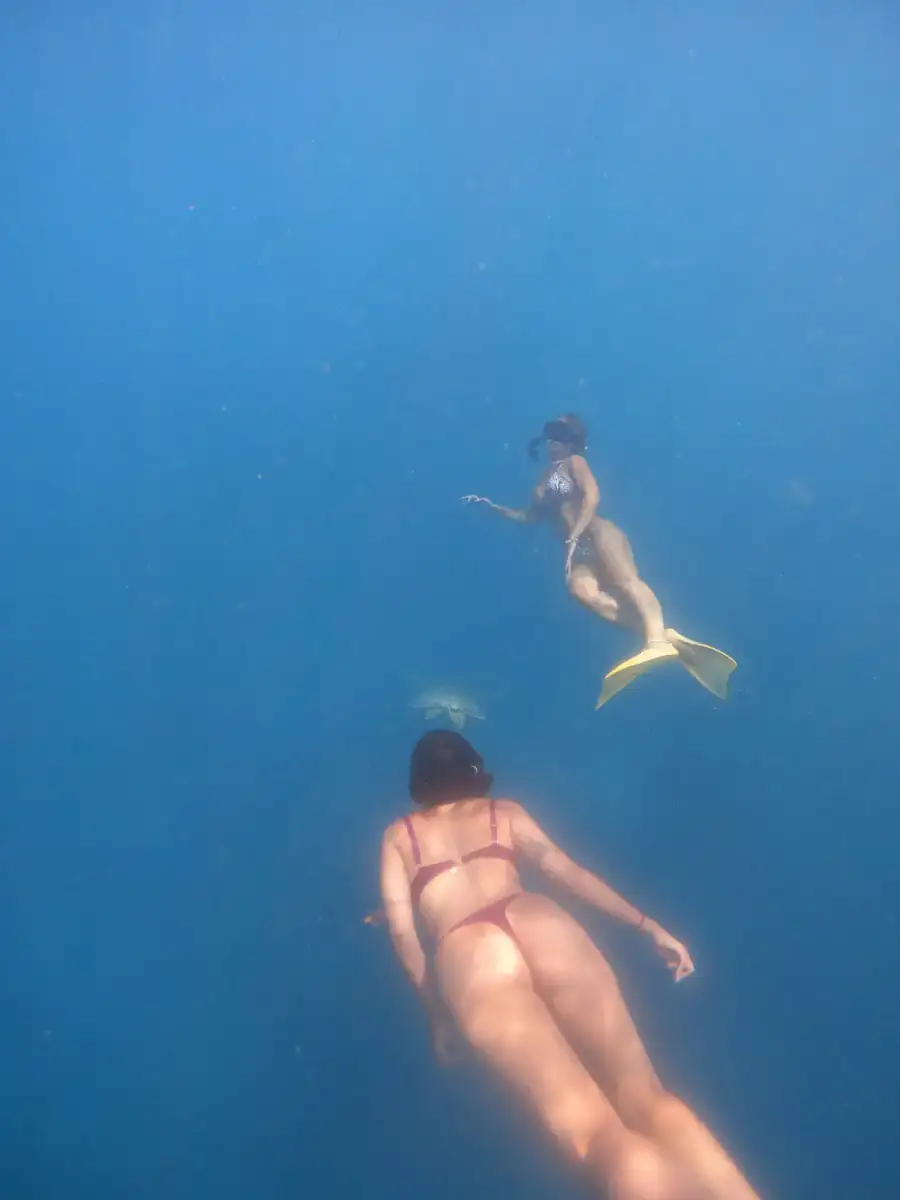
Somewhere around ten metres down, there is a moment when everything goes quiet in a way that is hard to find anywhere else. Your lungs are still. Your movements slow down. The usual noise of the day, the notifications, the lists, the small performances of being seen, is simply not there. Only your own pulse, and the water holding you.
So why should every woman try freediving at least once? Not because women have a secret biological advantage. Research says the diving reflex is much the same in men and women. The reason is that one calm, guided breath-hold shows you how your body handles stillness and the urge to breathe. Freediving, diving on a single breath without tanks, gets called an "extreme sport" more often than it deserves. For most people who try it, especially the first time, in calm water with a good instructor, it feels closer to a moving meditation than a test of endurance.
We chose this title because a first real breath-hold, done calmly and safely, can change how you feel about your own body in the water. But we want to be honest about why, instead of repeating the old idea that women are somehow "made for" the water in a mystical way. The true story is more interesting than that.
What does the research say about women and breath-holding?
A claim travels around freediving circles: that women have a built-in edge underwater, with more body fat, a stronger dive reflex and an easier time holding their breath. It is a neat story, but in its simple form it does not hold up.
A study published in January 2025 in Frontiers in Physiology, by Frank Pernett, Erika Schagatay and Pontus Holmström, tested breath-holds in 37 men and 44 women, all with no breath-hold experience. On average, the men held their breath longer: 78 seconds against 61 seconds. The men also had larger lungs and larger spleens, with a larger absolute spleen contraction. (The spleen releases extra oxygen-carrying red blood cells during a breath-hold.) The authors suggest the longer holds may partly come from this greater oxygen storage. But the diving response of the heart itself, the drop in heart rate, did not differ significantly between the sexes, and relative spleen contraction was similar too.
Put simply: in this group of beginners, the reflex that makes freediving possible looked much the same in everyone. What differed, on average, was body size and oxygen storage. The study did not test how training changes that gap, so I will not promise anything about it. Still, anyone who has taken a course knows that relaxation, technique and coaching change a beginner's breath-hold a lot. Our piece on what happens in your body when you hold your breath underwater explains the basics.
A tradition that never needed a "women's advantage"
If you want proof that women need no biological head start to become remarkable breath-hold divers, look at the haenyeo of Jeju Island, South Korea. They are a community of women who have freedived for seafood without breathing equipment for generations, many of them well into older age.
A 2025 study in Cell Reports, with Melissa Ilardo among the authors, compared haenyeo with non-diving women from Jeju. The divers showed pronounced bradycardia, a stronger drop in heart rate while diving, which the researchers see as a likely effect of training. They also found genetic variation, shared by Jeju people in general, that may lower diastolic blood pressure and so ease the effects of diving during pregnancy, and selected variation in a gene earlier linked to cold-water tolerance. The groups were small, around 30 women each, so the genetic findings are early. But the heart-rate result is a clear reminder of what years of practice can do.
The same is true at the top of the sport. AIDA International, founded in 1992 in Nice, France, keeps freediving rules and world records, and it keeps separate women's world records in each discipline. Freediving never needed women to have a hidden advantage in order to belong. They already belong.
What it gives you, one breath at a time
None of this is meant to talk you out of trying. Quite the opposite. What freediving offers has nothing to do with records. It lives in a small, repeatable experience: staying still while your body asks for air, and learning, as every freediving course teaches, that the first urge to breathe comes mainly from rising carbon dioxide, not from running out of oxygen. Learning to feel that difference calmly, with a trained instructor beside you, turns out to travel well into the rest of life. Some people say they notice it later, in how they meet a stressful day.
There is also very little to perform down there. No audience, no comparison, no right way to look while you do it. For many women, especially those travelling solo, that missing audience is the real gift. Not the depth, but the quiet.
That is part of why we built Ocean Calling the way we did. Our trips are designed for solo travellers, highly sensitive people and neurodivergent guests who want unhurried time in the water without competing with anyone, including themselves. If a first breath-hold feels scary, meeting our local experts and reading the honest words in our guest reviews is a gentler start than a records page. And if you are not sure which course to take, our guide to PADI, SSI, AIDA or Molchanovs certification compares them.
Staying calm about safety
Freediving has real risks, including blackout, and it becomes much safer when you follow the basics that good courses teach: never dive alone, always have a trained buddy watching you from the surface, and build depth slowly instead of chasing a number. Nobody should push you past what feels calm and controlled. That is not the point of any of this.
Gear matters less than calm, but a few basics help. A low-volume mask needs less air to equalise as you go down, and long freediving fins let you move with slow, easy kicks. On a boat day, a roll-top dry bag keeps your phone, passport and a dry layer safe.
The ethical layer: freediving as a quiet guest
Part of why freediving suits respectful ocean travel is that it is quiet: no bubbles, no engine, just one body moving slowly. That is a privilege, not permission to get close. On our trips nobody chases, touches or baits wildlife, and animals are free to come closer or to leave.
It also means respecting the people whose waters you dive in. The haenyeo are a living community, not a show. If you visit Jeju, or any fishing village, follow the local rules about where you may swim, and remember that what is a hobby for you may be someone else's work. Travel to the ocean also has a real carbon cost. Staying longer and diving slowly in one place is one honest way to make the trip count.
Before you go under
Freediving does not ask you to be strong in the usual sense of the word. It asks you to slow down, to trust a process that feels a little strange at first, and to notice what happens when nothing is fighting for your attention. Whether or not you end up loving it the way the haenyeo do, most people come up from their first real breath-hold a little different from how they went down.
If this made you curious to feel it yourself, you can explore our upcoming retreats.
FAQ
Do women have a natural advantage in freediving?
Not in a simple way. A 2025 study of 81 beginners found the heart-rate diving response was similar in men and women. Men held their breath longer on average (78 against 61 seconds), probably helped by larger lungs and spleens.
What is the diving reflex?
It is the body's automatic response to holding the breath, especially with the face in water: the heart rate slows (bradycardia), and the spleen can contract to release extra red blood cells. In the 2025 Frontiers in Physiology study, the heart-rate drop did not differ significantly between the sexes.
Who are the haenyeo?
The women freedivers of Jeju Island, South Korea, who have gathered seafood on a single breath for generations. A 2025 Cell Reports study found they show a pronounced drop in heart rate while diving, likely from training.
Is freediving safe for beginners?
It has real risks such as blackout, so learn with a qualified instructor, never dive alone, always have a trained buddy watching from the surface, and build depth slowly.
Who sets freediving world records?
AIDA International, founded in 1992 in Nice, France, is one of the main federations that sets rules and recognises world records. It keeps separate women's world records in each discipline.
Wildlife encounters are never guaranteed and never forced. Ocean Calling works only with vetted, ethical local operators, and every animal is free to approach, or not, entirely on its own terms.
Sources & further reading
- Sex-based variations in breath-holding: oxygen storage and diving response among non-divers, Pernett F., Schagatay E., Holmström P., Frontiers in Physiology, 2025.
- Study of the Haenyeo divers of Jeju: diving bradycardia and genetic adaptation, Aguilar-Gómez D. et al., Cell Reports 44(5), 2025 (PubMed Central).
- The all-female free divers of Jeju Island have a superpower in their genes, NPR (via KPBS), 2025.
- AIDA International (history and role), Wikipedia.
- AIDA championship event page with women's record listings, AIDA International.
Further reading on Ocean Calling: More from the journal · Wildlife & the law · See the retreats · Ocean Atlas
Freediving certification in Bali: Amed, USAT Liberty wreck and Ubud
Freediving certification · Amed & Ubud, Bali, Indonesia
Ocean breath first, sacred water after. If this made you want to learn to freedive, this is our beginner-friendly course.