
Diving and Burnout Recovery: Why the Quiet Helps
You let the air out of your jacket and sink a little. The phone is in a bag on the boat. All you can hear is your own breath, slow and loud. For some people, that is the first quiet minute in months.
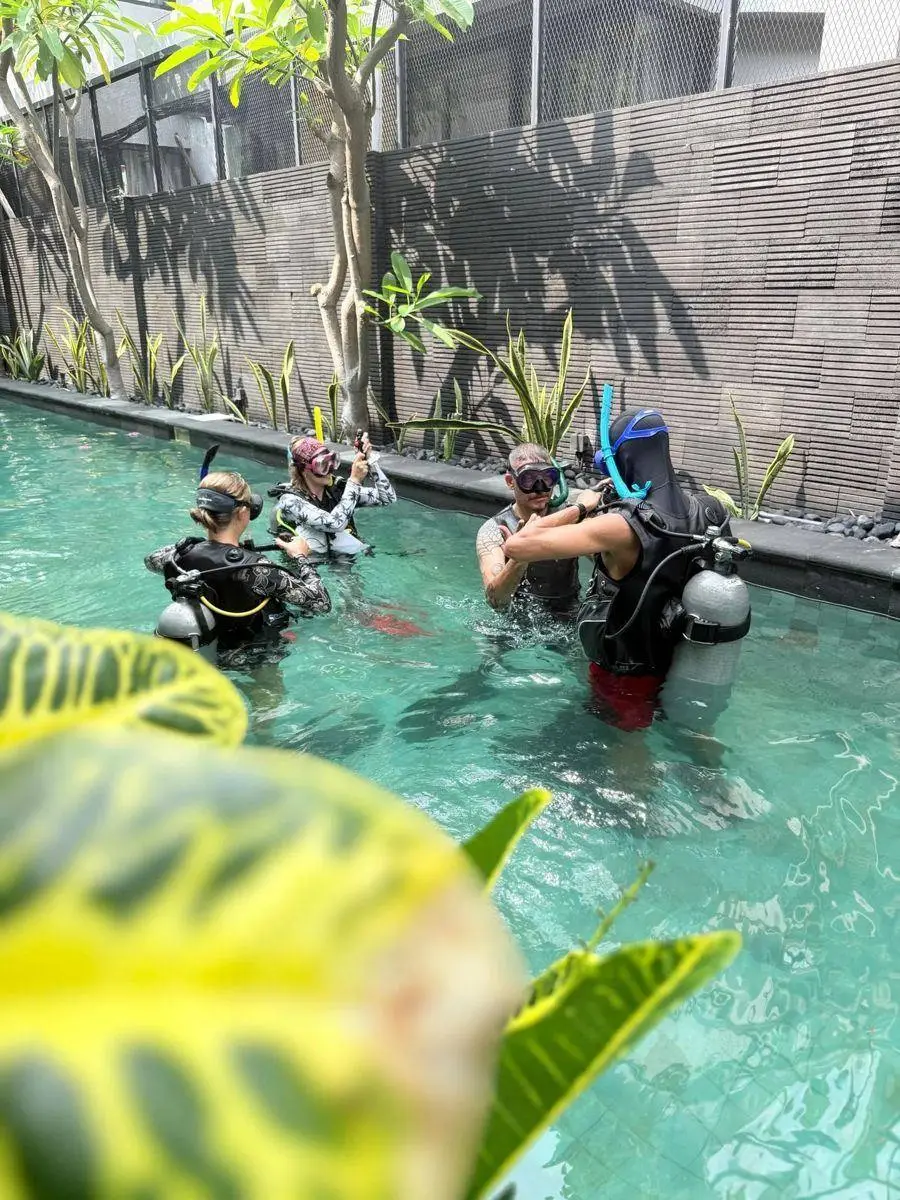
Why does diving help some people recover from burnout, when it is, technically, one more activity in a full life? Mostly because of what it takes away. Underwater there are no notifications, very little noise, and your attention narrows to breath and movement. That pause can feel deeply restful. It is one part of a bigger picture, though, and never a replacement for rest, support or professional care.
Modern life rarely lets the nervous system fully rest. Messages keep arriving, responsibilities overlap, and even the moments meant for recovery are full of background noise. The World Health Organization describes burn-out in its International Classification of Diseases (ICD-11) as an occupational phenomenon, "a syndrome conceptualized as resulting from chronic workplace stress that has not been successfully managed", with three dimensions: exhaustion, mental distance or cynicism about one's job, and reduced professional efficacy. The WHO is clear that it is not classified as a medical condition, and that the term refers only to work. But the everyday experience of it is very real.
A pause, not a treatment
I want to be honest about something before we go further. Diving is not a treatment for burnout, and it does not replace therapy, medical care or rest. If what you are carrying feels bigger than tiredness, please talk to a professional. That matters more than any trip. What diving can offer is smaller and more specific: a few hours, or a few days, where the usual sources of stimulation are simply not there.
Underwater, the signals that normally demand a quick reaction are gone. Phones do not work. The surface world goes quiet. Movement slows down. Instead of adding more input, the environment takes a lot of it away, and for a mind used to constant switching, that alone can feel like relief.
Why can diving support burnout recovery?
Diving is often sold as adventure, and it can be. But many divers describe something closer to stillness. Without messages to answer or a schedule to follow, attention narrows to what is right in front of you: your breath, your movement, the water around you.
In scuba diving, the regulator makes every inhale and exhale audible. It is hard to ignore your own breathing when it is the loudest thing you hear. Freedivers find something similar in the quiet before and after a breath-hold.
Two lines of research fit with this, carefully. A systematic review by Gascon and colleagues in 2017, covering 35 studies on outdoor "blue spaces" such as coasts, lakes and rivers, found that the balance of evidence suggested a positive link between more time near blue space and better mental health and well-being. The authors also said the studies were few and very different, and that cause and effect is not proven. And reviews of breathing research, including a 2018 systematic review by Zaccaro and colleagues and a 2022 meta-analysis of 223 studies by Laborde and colleagues, found that slow breathing increases heart rate variability, a marker linked with the calming branch of the nervous system.
Neither line of research was about diving or burnout. But the direction matches what many divers already feel: fewer things competing for attention, and a mind that settles more easily. Our article on why being near the ocean feels calming looks at the blue space research a little more.
Buoyancy and the weight we carry
Burnout is often described in physical words: weighed down, overloaded, running on empty. Those words are not an accident. Body and mood are connected.
Neutral buoyancy gives you an unusual physical experience. Properly weighted, you hang in the water without constant muscle effort to hold yourself up. Muscles that are half-braced against gravity all day get to let go, and breathing often slows with everything else. It is a different body state from the one most of us carry around, and that difference alone is often enough to notice. A mask that fits and does not leak sounds like a small detail, but it removes one more thing to manage, which is the whole point.
Diving during times of change
Big transitions, a career change, a move, the end of something, often come with a lot of worrying ahead of time. Underwater, that kind of thinking has less room. Your attention has to stay with your breathing, your depth and where you are in the water, and there is not much space left for rehearsing the worst.
Many divers describe the descent as a small, symbolic way of putting surface worries down for a while. Not avoiding them, just pausing the loop. There is also something grounding about being inside a world that carries on without caring about your inbox. The reef does not know about your deadline.
What divers often bring back up
The value of a dive is less in the time underwater than in what comes back up with you. Many divers describe surfacing with a bit more clarity about what matters that day. There is also a slow kind of confidence that grows over repeated dives: managing your buoyancy, your air, your pace. None of it dramatic, all of it asking for calm, step-by-step problem-solving. These are descriptions from divers, not research findings, and we share them as such.
Practical calm helps too. Arriving with a simple, organised bag, a tropical travel kit with packing cubes and a refillable bottle, and a roll-top dry bag for the boat, means fewer small decisions on days when decisions already feel heavy.
The ethical layer: rest that does not cost the ocean
If the ocean is helping us rest, it seems fair to ask what our rest costs the ocean. A recovery trip is still a trip. Flights have a real carbon footprint, and busy dive sites put pressure on reefs and animals. So the same slowness that helps the nervous system can also help the place. Fewer dives done calmly instead of many done quickly. No touching, no chasing, no feeding of wildlife. Small groups, local operators who are paid fairly, and staying longer in one place instead of rushing between many.
It is also why "do nothing" is a real option on our retreats. Anyone can skip any dive or activity, without explaining why. With a maximum of six guests, nobody gets swept along by the group, and there is room for a quiet day on the boat or the beach. If you are curious about the breathing side, our piece on freediving, breathwork and mental health goes further, with the same caution about what science can and cannot say.
What a dive can and cannot do
Burnout often comes from a long stretch where what is asked of you is more than you can recover from. Diving does not fix that imbalance, and no single trip can. What it offers is a real, structured pause: a few hours where the usual noise drops away and your attention settles somewhere simple. Silence becomes something to lean into, not something to fill. That is not nothing.
If this made you curious about experiencing it yourself, you can explore our upcoming retreats, designed to be unhurried and low in stimulation.
Questions people ask
Is burnout a medical diagnosis?
No. In ICD-11 the WHO lists burn-out as an occupational phenomenon resulting from chronic workplace stress that has not been successfully managed. It is not classified as a medical condition, but people can still seek health services for it.
Can diving cure burnout?
No. Diving can offer a restful pause with less stimulation, but it is not a treatment. If you are struggling, please speak with a doctor or therapist.
Is there evidence that being near water helps mental health?
A 2017 systematic review of 35 studies found the balance of evidence suggests a positive link between blue space exposure and mental well-being, but the authors said more research is needed to prove cause and effect.
Why does slow breathing feel calming?
Reviews of slow-breathing studies (Zaccaro 2018, Laborde 2022) found it increases heart rate variability, which is linked with the calming, parasympathetic side of the nervous system.
Do I have to dive every day on a retreat?
No. On our retreats anyone can skip any activity, and groups are capped at six guests, so a quiet day is always possible.
Wildlife encounters are never guaranteed and never forced. Ocean Calling works only with vetted, ethical local operators, and every animal is free to approach, or not, entirely on its own terms.
Sources & further reading
- WHO classifies burn-out as an occupational phenomenon in ICD-11. AIHA Synergist, 2019.
- Gascon et al. Outdoor blue spaces, human health and well-being: A systematic review of quantitative studies. International Journal of Hygiene and Environmental Health / University of Exeter repository, 2017.
- Zaccaro et al. How Breath-Control Can Change Your Life: A Systematic Review on Psycho-Physiological Correlates of Slow Breathing. Frontiers in Human Neuroscience, 2018.
- Laborde et al. Effects of voluntary slow breathing on heart rate and heart rate variability: A systematic review and a meta-analysis. Neuroscience & Biobehavioral Reviews, 2022.
Further reading on Ocean Calling: More from the journal · Wildlife & the law · See the retreats · Ocean Atlas
Find the retreat that fits you
Small groups of up to six guests, unhurried days and local experts. Tell us how you feel in the water and we will point you to the right trip.