
Freediving Duck Dive Physiology: What Your Body Does
In the seconds before a duck-dive, your heart slows down, the blood vessels in your arms and legs tighten and, in some people, the spleen squeezes out a small reserve of red blood cells. Here is what science knows about freediving duck-dive physiology, what is still open, and why calm matters more than depth.
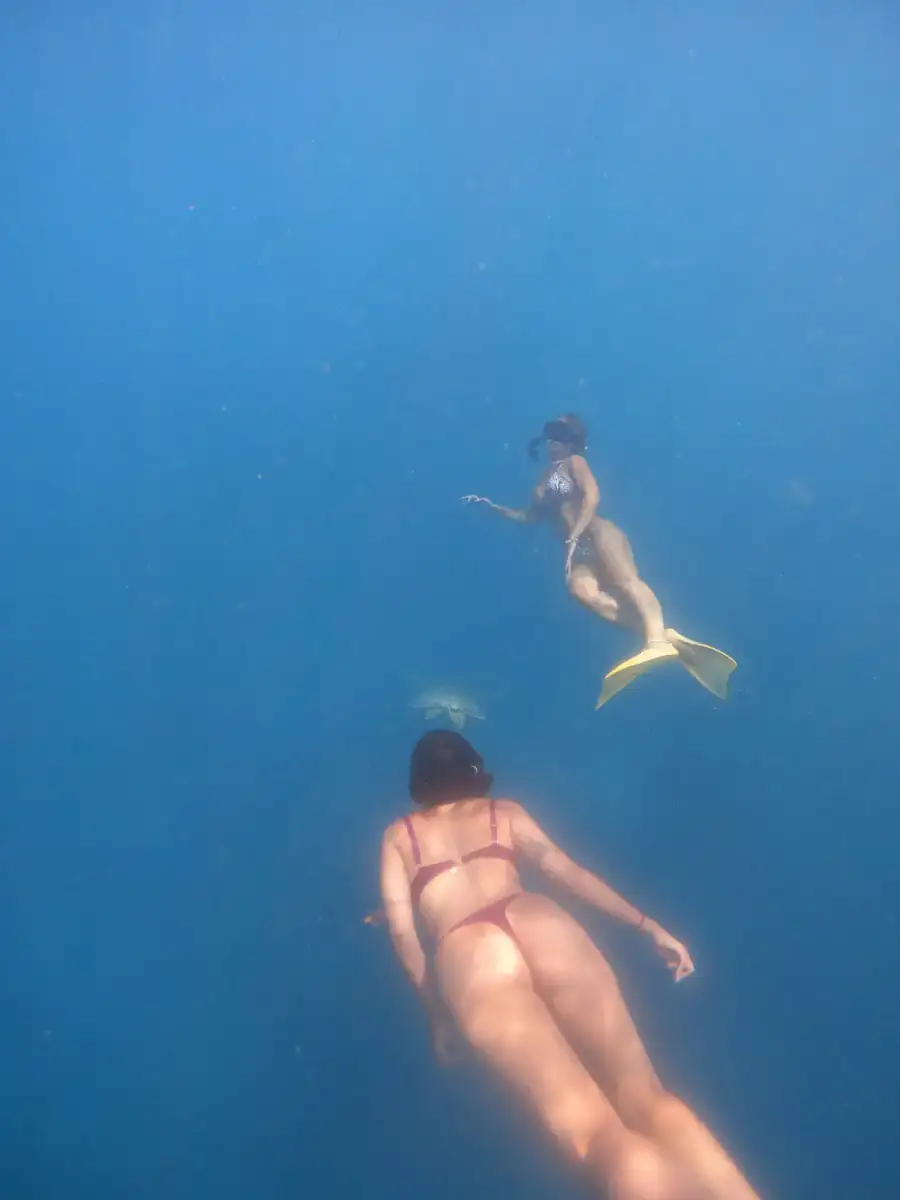
What happens in your body in the thirty seconds before you duck-dive
There is a special kind of stillness just before a duck-dive. You float face down, snorkel in, watching the light dance on the sand a few metres below. You take the last breath. For a moment nothing seems to happen at all. Except that a lot is already happening, quietly, inside you.
This is the physiology of the duck-dive, and much of it begins before your head is even under. I am not a physiologist, so here I stay close to published research, and I tell you clearly where it stops.
The breath that is not really the start
We imagine a dive begins when we fold at the waist and the fins leave the surface. For the body, it can start earlier. Humans, like other diving mammals, have a protective response often called the diving reflex. The StatPearls entry, published through the US National Library of Medicine, describes it as a response to being under water with three main parts: a slower heart rate (bradycardia), a pause in breathing (apnea) and tighter blood vessels in the limbs (peripheral vasoconstriction).
What turns it on? Mostly the breath-hold, together with cold receptors on the face. A review in the Scandinavian Journal of Medicine & Science in Sports (2005) says cold on the face is not strictly needed, but it makes the response stronger. In trained breath-hold divers, a 2002 study in the Journal of Applied Physiology found that during 30-second breath-holds while exercising, putting the face in cold water (10°C) deepened the drop in heart rate from about 21 percent to about 33 percent, compared with holding the breath in air.
That detail matters for warm-water freediving. Most of our dives happen in tropical water, nowhere near 10°C. The reflex is still there, but the cold-water numbers should not be carried over to a warm lagoon. I do not know how strong the effect is for a beginner in 28°C water, and I have not found a source that does.
Bradycardia: a slower heart on purpose
The first change most people can feel is the heartbeat. It slows. This is not panic. It is closer to the opposite: the body resets so the heart itself uses less oxygen, leaving more for the rest of you. If your pulse feels slower and heavier in the first seconds after your face goes in and your breath stops, you are not imagining it.
The response is not the same in everyone. In a 1980 experiment, Ross and Steptoe found that doing mental arithmetic weakened the slowing of the heart, both in air and in water, while listening to prose did not. They concluded that higher brain activity can change the reflex. This does not prove meditation makes the reflex stronger, but it fits what most instructors see: a busy mind and a tense body make the dive harder.
Blood shift and the spleen
At the same time, the blood vessels in your arms and legs narrow. StatPearls says this is thought to send blood toward the vital organs and limit oxygen use in muscles that are not essential right now. Your body is choosing priorities: a resting arm can wait, a brain cannot.
The third piece is less famous: the spleen. Research from Erika Schagatay’s group on breath-hold divers shows that the spleen contracts during breath-holds and releases stored red blood cells into the blood. In one study, ten people did three maximal breath-holds with two-minute rests. Their spleens shrank by about 18 percent, haemoglobin and haematocrit rose by roughly 2 percent, and their breath-hold times got longer. A later article in Frontiers in Physiology (2012) says this spleen response seems to help prolong breath-holds done one after another. Put simply, the body tops up its oxygen-carrying capacity a little, right when you ask more of it. The effect is small and was studied in specific groups, so I would not promise it will keep you down longer.
Why does calm matter more than depth?
Anxiety and breath-holding fight over the same nervous system. A racing mind tends to keep the heart rate up and the breathing shallow, and a tense body burns oxygen faster. This is not a new finding about the reflex itself, but it is the thinking behind how freediving is taught. I write more about it in freediving safety basics, and about the feelings of a held breath in what breath-holding does to the body.
A 2022 systematic review and meta-analysis by Ackermann and colleagues, in Psychophysiology, looked at the diving response and cardiac vagal activity. I did not read its detailed results, so I list it only as further reading and quote no numbers from it. What I can say is that the field is busy, and that the figures you see online for “the dive reflex” often come from particular lab conditions that may look nothing like your dive.
Safety: the part the physiology does not fix
A calm reflex is not a safety system. Divers Alert Network (DAN) explains that breathing too hard before a breath-hold delays the urge to breathe, while oxygen can still drop low enough to cause unconsciousness. The risk is highest near the surface on the way up, when pressure falls, which is why it is called shallow-water blackout. DAN’s two most repeated rules: never breath-hold dive alone, and do not hyperventilate before a dive. A buddy may be the only person who can see a blackout and bring you up in time.
On our retreats we keep this very plain. Qualified local instructors teach the freediving, groups are six guests at most, and nobody ever freedives alone. You never need to go deeper than you want, and you can skip any session. If you are learning, equalisation and relaxation are the skills worth your time first. Reading is not a course, so please learn with a certified instructor.
A quick word on gear: a low-volume mask is easier to equalise and clear, and freediving fins let you move slowly without wasting energy, which is the whole idea. A rash guard keeps the sun off your back while you float and wait for your turn.
The ocean is simply waiting
There is something comforting in all this. When you duck-dive, you are not fighting your body. For those thirty seconds it does something humans have done for as long as we have put our faces in water. The heart slows, the blood moves inward, the spleen gives up a small reserve. If this made you curious to feel it yourself, have a look at our Bali freediving page, where we can match you with a careful local school that teaches slowly and honestly.
Questions people ask
What is the mammalian dive reflex?
According to StatPearls, it is a protective response to being under water in mammals, humans included, that slows the heart (bradycardia), pauses breathing (apnea) and tightens blood vessels in the limbs (peripheral vasoconstriction).
Does cold water make the dive reflex stronger?
The evidence says it can. A 2002 study of trained breath-hold divers found that cold (10°C) face immersion deepened the drop in heart rate during 30-second breath-holds from about 21 to 33 percent, compared with holding the breath in air. How much of this applies to warm tropical water, I do not know.
What does the spleen do when you freedive?
Research on breath-hold divers shows the spleen contracts during breath-holds and releases red blood cells. In one study of ten people, repeated maximal breath-holds shrank the spleen by about 18 percent and raised haemoglobin by roughly 2 percent. The effect is small.
Can I train the dive reflex by being relaxed?
The reflex is automatic, but it can be changed. An older experiment found that mental arithmetic weakened the slowing of the heart, which suggests the mind plays a part. That is not proof that relaxation makes it stronger, so I would say calm helps you use oxygen well and stay safe, not that it guarantees a stronger reflex.
Is freediving dangerous?
It can be, if done without training, alone or after hyperventilating. DAN advises never to breath-hold dive alone and to avoid hyperventilation, because a blackout can come without warning near the surface. Please learn with a certified instructor and always dive with a buddy.
Do you need to be fit or a strong swimmer to start?
You need to be at ease in the water and happy to go slowly. A good course works on breathing, relaxation and safety before depth. If you are unsure, tell your instructor and choose a shallower, calmer start.
Wildlife encounters are never guaranteed and never forced. Ocean Calling works only with vetted, ethical local operators, and every animal is free to approach, or not, entirely on its own terms.
Sources & further reading
- Physiology, Diving Reflex StatPearls, NCBI Bookshelf, last updated 2022.
- Hypoxia in Breath-Hold Diving Divers Alert Network.
- Freediving Safety Awareness Divers Alert Network.
- Diving response review (breath-hold, facial cold receptors and autonomic responses) Scandinavian Journal of Medicine & Science in Sports, 2005.
- Heart rate and face immersion during apnea in trained divers Journal of Applied Physiology, 2002 (record at Lund University).
- Ross & Steptoe, autonomic responses to diving and mental arithmetic Journal of Physiology, 1980.
- Spleen volume changes and serial apneas (research article) Frontiers in Physiology, 2012.
- Speed of spleen volume changes evoked by serial apneas Schagatay and colleagues.
- The diving response and cardiac vagal activity: a systematic review and meta-analysis Ackermann et al., Psychophysiology, 2022 (further reading only).
Further reading on Ocean Calling: Freediving safety basics · What breath-holding does to the body · The single breath · More from the journal · Ocean Atlas
Freediving certification in Bali: Amed, USAT Liberty wreck and Ubud
Freediving certification · Amed & Ubud, Bali, Indonesia
Ocean breath first, sacred water after. If this made you want to learn to freedive, this is our beginner-friendly course.