
Shell Jewellery and Ethical Diving: Responsible Ocean Travel
What a shell necklace really costs the ocean, and how small, thoughtful choices on the beach and in the water add up to responsible ocean travel.
The first quiet beach of a trip. Warm sun, salty air, water slowly reaching for your feet. Then you see it: a perfect shell in the sand, or a pretty shell necklace at the stall behind you. Is it simply a memory of your trip, or is there a cost hiding behind it? The honest answer: one shell is rarely the problem. But shells taken in large numbers, or from protected animals collected alive, do affect the ocean. Ethical diving and responsible ocean travel start with small questions like this one.
The way we talk about responsible ocean travel has grown up a lot in the last few years. It is no longer only "take photos, leave footprints". It is about the story behind the things we buy, and the way we behave once we are in the water. Here is what I have learned, with the parts that are well documented and the parts that are still uncertain.
Why an empty shell still matters
An empty shell on the sand looks like a small piece of art waiting for a home. But on a real shoreline, shells keep working after the animal that made them is gone. Hermit crabs move into empty snail shells, for example, and other small organisms live on or among them.
One of the few long-term studies on this comes from a beach in Catalonia, Spain. Researchers led by Michał Kowalewski compared shell surveys from 1978 to 1981 with surveys from 2008 to 2010, and published the results in PLOS ONE in 2014. Shells on the beach fell by more than 60 percent while tourist numbers roughly tripled. The authors found no new fisheries, urban development or changes in weather and currents that would explain it. Kowalewski called it a case study and said it was too early to know what wider environmental effects would follow. So a handful of shells from one holiday is not the issue. The same beach, visited by many people, year after year, is.
The story behind shell jewellery
This does not mean all shell jewellery is something to avoid. Ethical travel, for me, is not about being perfect. It is about staying curious and asking a few honest questions.
One part of the shell trade does deserve real caution. Some of the most striking pieces in shops, like jewellery made from the spiral shell of the chambered nautilus, may come from animals caught alive for their shells. In 2016, the parties to CITES, the global treaty on wildlife trade, agreed to list the whole nautilus family on Appendix II. The listing took effect in January 2017. Appendix II regulates international trade; it does not ban it. In 2018, the United States listed the chambered nautilus as threatened under the Endangered Species Act, and NOAA describes harvest for the international shell trade as the most significant threat to the species.
None of that means every nautilus item is illegal. But it is a species worth asking about before you buy, and carrying such items across borders can need permits. Please check the current rules for your own country before you travel.
Questions to ask before buying shell jewellery
A good seller should be able to answer simple questions. Where did this shell come from? Was the animal alive when it was collected? Is it a protected species? If the answer is vague, or the price seems too low for something rare, that is worth noticing.
Some shell products are made from shells that are a by-product of food, or from shells collected already empty. Others are not. I cannot tell you which is which for a specific market, and often neither can the tourist. When you are not sure, choosing not to buy is always an option, and so is choosing a local craft that uses other materials.
Being a quiet guest in the water
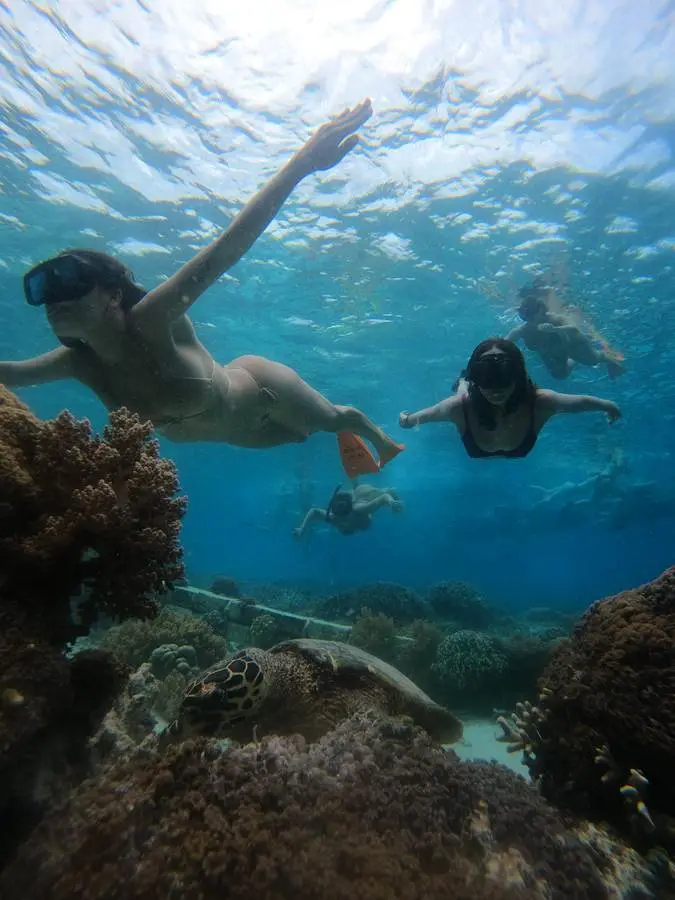
Being thoughtful does not stop at the souvenir stand. It also shapes how we behave once we are actually in the water. Certified diver or just starting with snorkeling without damaging coral, the goal is the same: disturb as little as possible. A close-up photo is never worth stressing an animal for.
If you are lucky enough to share space with wildlife, let the animal decide what happens next. NOAA's marine life viewing guidelines recommend staying at least 100 yards from whales, and about 50 yards from dolphins, seals and sea turtles in US waters, with some stricter federal rules in particular places. It is a useful rule of thumb elsewhere too, but always follow the local rules where you are. Sightings are never guaranteed, and that is exactly the point. The animal never owes us a performance.
Slower, smaller, more local
More people I meet are choosing smaller groups, slower schedules and trips built around learning something (freediving, marine ecology, or simply how to be still in the water) instead of ticking off a list of sights. I cannot point to a statistic for how widespread this is, so please take it as my impression, not a trend report.
What I can say with more confidence is that choosing operators who work with local experts keeps more of what you spend with people who live there. Small habits help too. A reusable water bottle and simple travel kit instead of plastic bottles on every boat. A rash guard that reduces how much sunscreen you need, and, when you do use some, a mineral sunscreen of the kind the US National Park Service suggests for reefs. And honesty matters here too: flights to the ocean have a real environmental cost, and taking fewer, longer trips is one of the more meaningful choices we can make.
Three questions worth asking before you book
You do not need to be a marine biologist to spot a good operator. A few honest questions usually tell you enough:
- "How do you interact with wildlife?" If the answer includes touching, feeding or guaranteeing an encounter, pause there. Look for operators who talk about distance, patience and letting the animal choose.
- "Where does the money go?" A good operator can tell you, in plain words, how they support the local community or conservation work in the area.
- "What is your group size?" Smaller groups usually mean less disturbance and a calmer day. On our hosted retreats we keep groups to a maximum of six. You can read more about how we run things on our planning and FAQ page.
What we hold ourselves to
- Small groups, so the experience stays calm and safe.
- Respectful wildlife encounters, where the animal's comfort always comes first.
- Working alongside local professionals, so the communities we visit benefit too.
- Staying curious and learning, so our practices keep getting better.
- Keeping our footprint as small as we can, wherever we travel.
Mostly memories
Ethical ocean travel is not a strict checklist, and it was never about being perfect. It is about staying curious about the shell necklace, the boat tour and all the choices in between, and asking what is really behind them. When we take mostly memories home, and support the people who treat the ocean's health as part of the deal, these places have a better chance of staying wild for whoever comes after us. If you are looking for presents instead of souvenirs, our guide to gifts for ocean lovers that respect the ocean has some ideas.
If this made you curious about travelling the ocean this way, you can explore our upcoming retreats.
Questions people ask
What exactly is ethical diving?
At its simplest, it is "look, don't touch": good buoyancy so you do not hit coral, a respectful distance from wildlife, and choices like mineral sunscreen or covering up that add less to the water. It means being a guest in someone else's home.
Does collecting shells harm the beach?
In large numbers, it can. A 2014 PLOS ONE study of a beach in Spain found more than 60 percent fewer shells between 1978 to 1981 and 2008 to 2010, while tourism roughly tripled. The authors called it a case study and could not yet say what wider effects would follow.
Is it okay to buy shell jewellery?
It depends on the story behind it. Ask where the shell came from, whether the animal was alive when collected, and whether it is a protected species. When the seller cannot answer, not buying is a fine choice.
Is nautilus shell jewellery legal?
Trade is regulated, not banned. The whole nautilus family has been on CITES Appendix II since January 2017, and the US listed the chambered nautilus as threatened in 2018. Importing items can require permits, so check the current rules for your country before you travel.
How close should I get to marine wildlife?
NOAA recommends at least 100 yards from whales and about 50 yards from dolphins, seals and sea turtles in US waters, with stricter rules in some places. Elsewhere, follow local rules and let the animal choose.
Why do some retreats limit group size to six people?
Smaller groups are easier to keep safe and low-impact. For you, it means more time with your guides and a calmer pace. For wildlife, it means less noise and crowding. Ocean Calling's hosted retreats keep groups to a maximum of six.
Wildlife encounters are never guaranteed and never forced. Ocean Calling works only with vetted, ethical local operators, and every animal is free to approach, or not, entirely on its own terms.
Sources & further reading
- NOAA Fisheries. Chambered nautilus: species page and Endangered Species Act status.
- Federal Register, 2020. Notice on the chambered nautilus (threats and trade under the ESA listing).
- CITES, 2016. CoP17 Inf. 37 (nautilus family, Appendix II).
- NOAA Fisheries. Marine life viewing guidelines: guidelines and distances.
- Florida Museum of Natural History, 2014. Seashell loss due to tourism may have global impact (on Kowalewski, Domènech and Martinell, PLOS ONE).
- University of Florida News, 2014. Study: seashell loss due to tourism increase may have global impact.
- Smithsonian Magazine, 2014. Beach tourists who collect shells may be harming the environment.
- US National Park Service. Sunscreen and ocean protection.
- Scientific American, Extinction Countdown. Nautilus finally moves toward endangered species protection.
Further reading on Ocean Calling: More from the journal · Wildlife & the law · See the retreats · Ocean Atlas
Find the retreat that fits you
Small groups of up to six guests, unhurried days and local experts. Tell us how you feel in the water and we will point you to the right trip.