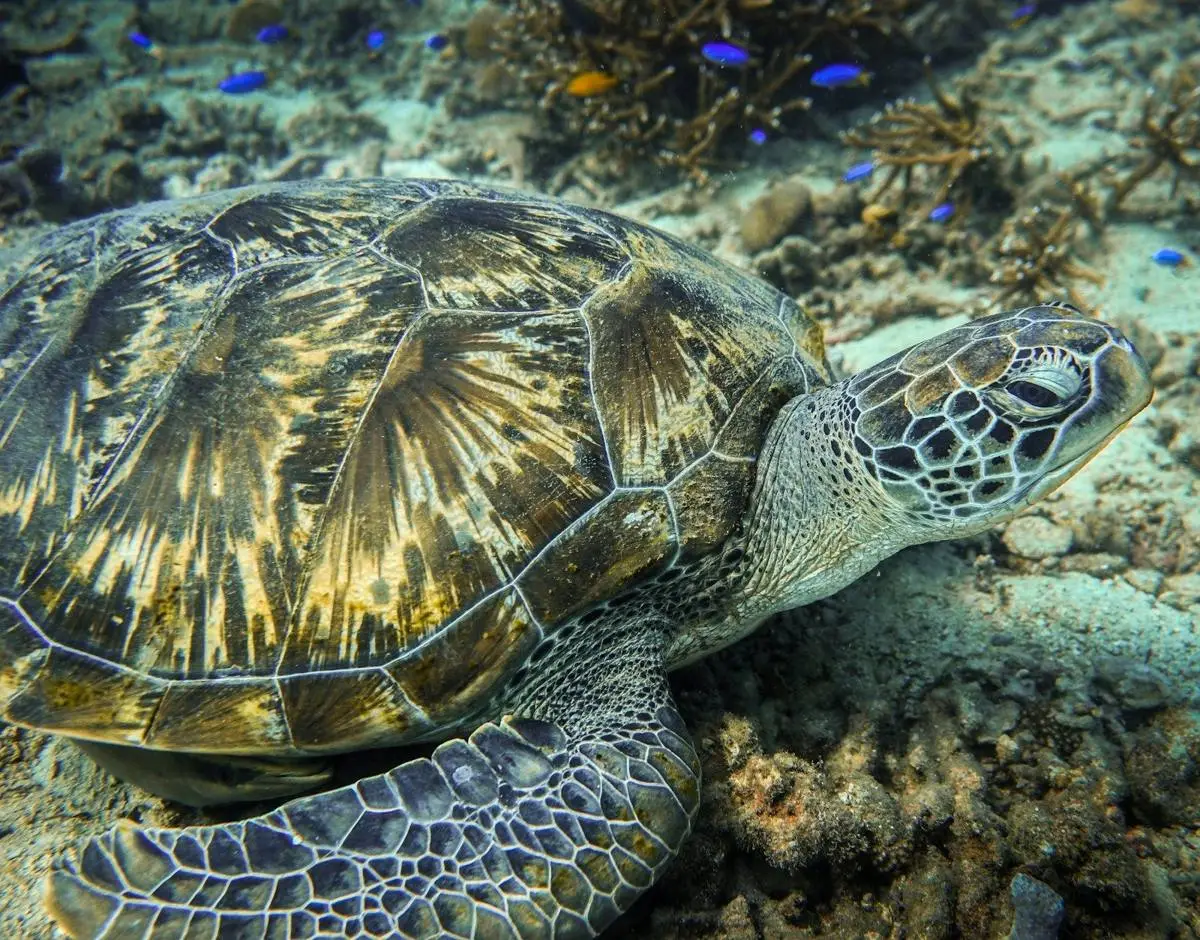
Let Them Crawl: How Baby Turtles Should Reach the Sea, and Why We Do Not Carry Them
A hatchling on the sand at night is one of nature’s most moving sights, and one of the easiest to spoil with kindness. So should you carry a baby turtle to the sea? No. The best help we can give is to step back.

Picture a dark beach, a little after nightfall. The sand moves, and a small turtle, no bigger than your palm, pushes out and starts to shuffle towards the sound of the waves. Your first instinct might be to pick it up and carry it the last few metres. It is a loving instinct. It is also, in almost every case, the wrong one. Baby turtles should reach the sea by crawling there on their own, and our job is to stay out of the way.
Below I explain why that short crawl matters, what light and handling do to a hatchling, why release events are more complicated than they look, and what you can do if you are lucky enough to see it happen. I have used the guidance of turtle specialists and published studies, and I say where something is uncertain.
Why should baby turtles crawl to the sea by themselves?
The IOSEA Marine Turtle MoU, an agreement under the UN Convention on Migratory Species, advises that hatchlings should be able to crawl across the beach and enter the ocean by themselves. It is not only about tradition. A scientific review of natal homing suggests this short crawl helps young turtles learn the beach they came from, so they can find their way back years later. It is thought they learn the magnetic signature of the beach, not the exact nest. Scientists are still working out the details, so I would call this a well-supported idea rather than a closed question.
It is a lot to learn in a few minutes. A turtle that is carried may miss part of that information. We cannot be sure how much, and nobody can run a perfect experiment on one hatchling. But the precaution is simple and costs nothing. Let it walk.
The frenzy: a first swim that sets the course
The crawl is also the start of a workout. Once in the water, hatchlings go into a “frenzy”, swimming almost non-stop for about a day. A study in the Journal of Experimental Biology describes this first swim as the most important step in how far and where young turtles disperse. In plain words, the first day decides a lot about where the journey goes.
The Indian Ocean Turtle Newsletter notes that hatchlings held in cool, dark and calm conditions save energy, and that the frenzy is set off by light, heat or movement. This is why a flash, a phone torch or being carried in warm hands can matter. The sprint can begin before the turtle even reaches the sea, and the energy it spends there is energy it needs for the swim.
Why not carry them to the water?
It can feel kind to give a hatchling a shortcut. But carrying one skips the crawl, and any detour or handling costs it energy and time it needs for the swim. Wildlife agencies also warn that light from people, cameras and buildings can pull hatchlings away from the sea. The Florida Fish and Wildlife Conservation Commission, for example, explains that hatchlings use brightness to find the ocean, and artificial lights can confuse them. That is why we never use flash near a nesting beach, and why our piece on photography without flash is worth a read before you travel.
Time of day matters too. A conservationist from Yayasan Penyu Indonesia says hatchlings should ideally be released at night until early morning, when predators are less active. In reality, releases are often held in the afternoon, timed for events, so visitors can take part and donate. That is the part that makes me uneasy. The schedule follows the visitors, not the turtles.
Release events: conservation or marketing?
Many people first meet this question through a release event, where visitors hold a hatchling and place it on the sand or in the water, often for a donation. Holding and headstarting hatchlings is a recognised welfare question in its own right, and the IOSEA advice on it is listed in the sources if you want the detail. I am not a turtle biologist, and I do not want to be unfair to people who run these projects with good intentions. Some are run by caring teams. But the sources I used all point the same way. A hatchling that crawls and swims on its own, at night, has the best start I know of. Where a project has a clear conservation reason to do otherwise, it should be able to explain it to you.
If you want to look at this more closely, we wrote about turtle release events in Bali and about turtle tanks. A good rule of thumb: if an experience promises you will hold a baby turtle, ask who benefits.
Are there times when people should step in?
Yes, sometimes. If a nest is in danger, or hatchlings are lost or hurt, trained and permitted people may need to move or hold them, using science-based methods. That is a job for local rangers and permit holders, not for visitors. Sea turtles are protected animals in many countries, and handling them without a permit can be illegal, so check the current local rule before you travel. If you find hatchlings that seem lost, keep your distance, keep lights off and call the local rangers.
What to do if you are lucky enough to see it
Stay well back and stay quiet. Keep your hands in your pockets and your torch and flash off. Do not block the path to the sea, and do not let children pick them up. If other people are crowding the hatchlings, step away. Watching a hatchling make its own way down the sand, with no help, is the real gift. Wildlife encounters are unpredictable. Turtle watching should always follow local regulations and experienced professional guidance.
If you want to keep a memory from a distance, a small action camera on a wrist strap lets you film without stepping close, with the light switched off and the screen dimmed. And if the evening is breezy, a roll-top dry bag keeps your phone and a spare layer dry while your hands stay free and empty.
Where Ocean Calling stands
We do not offer or join hatchling releases. In places like Derawan, which we are still getting to know in our Ocean Atlas, our rule is hands off and watch from a distance. You can read the full story in Baby turtles are not props, and learn more about the green turtle in the Atlas. Our groups are small, up to six guests, and everyone is free to skip any activity. If this made you curious, you can explore our upcoming retreats. Travel has an environmental cost, and I would rather say that plainly than hide it.
Questions people ask
Should I help a hatchling get to the sea?
No, not unless local rangers ask you to. Hatchlings should crawl to the sea on their own. If they seem lost, keep your distance and call the local rangers.
Is it better to release hatchlings at night?
Yes. A conservationist from Yayasan Penyu Indonesia says night or early morning is best, when predators are less active. Releases in the afternoon are often timed for visitors.
Why is a flash a problem?
Light can lead hatchlings away from the sea and can switch on their swimming frenzy too early. Keep flash and torches off near a nesting beach.
Can I hold a hatchling for a photo?
No. Holding a hatchling costs it energy and can disturb its journey. Ocean Calling does not offer this.
Why does the crawl matter?
A review of natal homing suggests the crawl helps hatchlings learn the beach they came from, possibly through its magnetic signature, so they can return years later. Researchers are still studying the details.
Are all hatchling release programmes bad?
Not necessarily. Some are run with care for real conservation reasons. The sources above suggest hatchlings do best when they crawl and swim unaided, so ask who runs it, why, and whether visitors are involved for donations.
Wildlife encounters are never guaranteed and never forced. Ocean Calling works only with vetted, ethical local operators, and every animal is free to approach, or not, entirely on its own terms.
Sources & further reading
- IOSEA Marine Turtle MoU. Holding and headstarting sea turtle hatchlings: advice
- Indian Ocean Turtle Newsletter. Holding and headstarting sea turtle hatchlings (IOTN 38)
- Journal of Experimental Biology. Locomotor activity during the frenzy swim: analysing early swimming behaviour in hatchling sea turtles, 2011
- Natal homing and imprinting in sea turtles (review)
- Florida Fish and Wildlife Conservation Commission. Artificial lighting and sea turtle hatchling behavior
- Institut Hijau Indonesia. Penangkaran penyu: konservasi atau eksploitasi? (interview with Yayasan Penyu Indonesia)
Further reading on Ocean Calling: Baby turtles are not props · Green turtle in the Ocean Atlas · Turtle release events in Bali · Turtle tanks
Find the retreat that fits you
Small groups of up to six guests, unhurried days and local experts. Tell us how you feel in the water and we will point you to the right trip.
Explore in the Ocean Atlas
Animals in this article