
Moʻorea’s Lagoon: Rays, Blacktips and Turtles Without Touching
You can meet a blacktip shark in water that barely covers your knees. A pink ray glides straight towards you, close enough to touch. That is the magic of the Moʻorea lagoon, and also the risk. Shallow water makes touching look harmless. It is not.
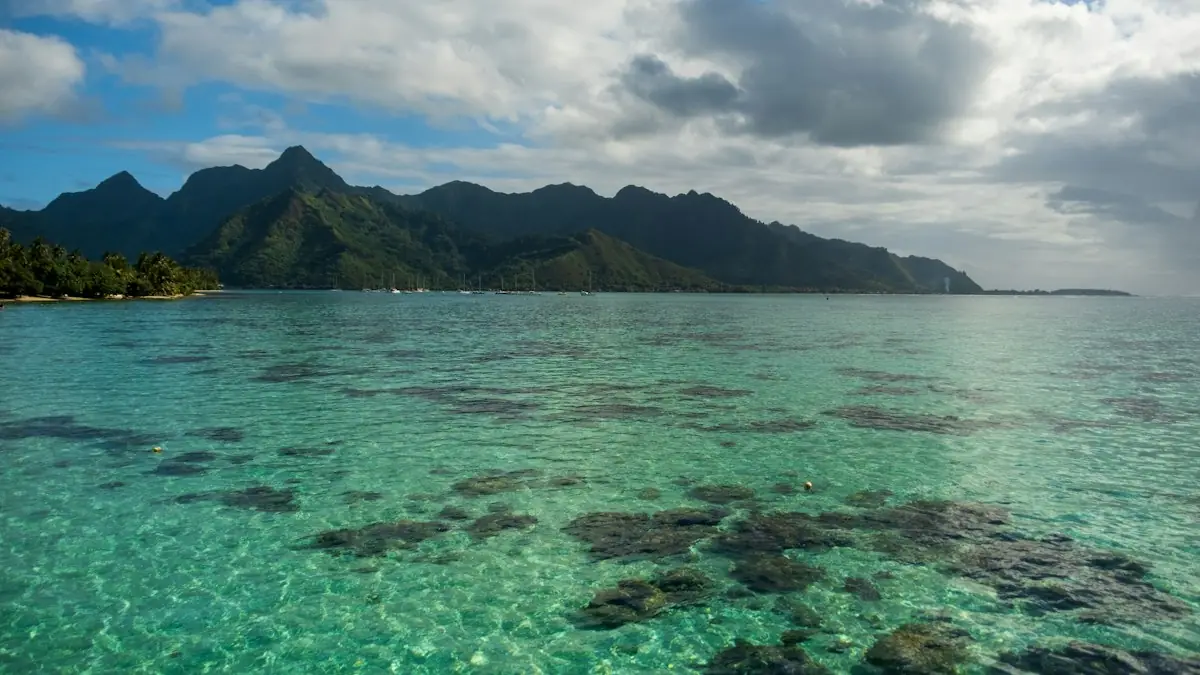
Can you meet rays, blacktip sharks and turtles in the Moʻorea lagoon without touching them? Yes, and it is the best way. You float, you look, you leave them a path, and you let them decide. Inside the reef, the lagoon is pale and busy. Rays rest on sand. Blacktips cut through the channels. Turtles rise to breathe and sink back down. Guests can snorkel from a quiet beach and meet all three in one hour.
The wrong hour looks like a queue. People stand on coral. Someone reaches for a tail. A turtle is turned for a camera. This article is about the difference between those two hours, and about the story behind the rays that swim so close.
Moʻorea lagoon: turtles, rays and sharks in one hour
The lagoon is a shallow world between the island and the barrier reef, usually calm, which is why it is such a good place to learn. You do not need to be a strong swimmer to see a lot. The rays most visitors meet are pink whiprays. You would think a ray this famous had been studied for a long time. Not really. Te mana o te moana, the marine conservation foundation based on Moʻorea, notes that very few studies had looked at these rays before its own research in the 2000s. Blacktip reef sharks are the other famous residents, small sharks of the reef and lagoon that scientists in Moʻorea have followed for years.
But shallow water makes everything feel close and safe, and that feeling is what leads people to reach out. A blacktip reef shark in knee-deep water is still a wild predator, and a ray resting on sand is still an animal that wants to be left alone.
Why do the rays come so close?
At a popular lagoon stop, rays may swim straight up to people and sharks may circle nearby. It is easy to think the animals are relaxed and happy to be touched. The history of the place tells a more complicated story. According to Te mana o te moana, ray feeding began on the north-west coast of Moʻorea in 1994. Since then it has become one of the island's favourite visitor activities, with operators setting up regular feeding areas where the rays gather during lagoon tours.
Between 2004 and 2007, a researcher studied these rays, including how feeding changes their behaviour. That work fed into a stingray feeding guideline inside Moʻorea's Marine Space Management Plan, the planning code that decides how the lagoon may be used. So when a ray comes very close, it may not be curiosity. It may be the memory of food.
I understand why some tours feed sharks and rays: the animals are easy to see. But scientists have been studying what feeding does, and the results are worth knowing before you choose.
How to move here
Float. Do not wade across living coral, because standing on it can break it, and coral grows slowly. Stand only on sand, if you must stand at all. Give every turtle a full body-length of water. Let a ray leave before you pass. Blacktips are not asking to be fed or framed at arm’s length. Keep your hands close to your body, even when an animal comes near, and keep your fins high and slow. Even a gentle touch can do more than you think, and we explain why in why touching marine animals harms them.
A long-sleeve rash guard protects your back from the sun while you float, and a mineral sunscreen covers the rest. A low-volume mask and snorkel makes it easy to stay still and look, instead of standing up to fix a leak. The lagoon is small, so every swimmer counts.
What science says about feeding and touching
French Polynesia closed its waters to shark and ray fishing in 2006, creating a shark sanctuary of about 5.5 million square kilometres. That protects the animals from the net. It does not automatically protect them from being fed for tourism, and a local 2017 environmental code is described as restricting the attraction of wild animals with food. I read this in secondary sources, so please check the current rule before you travel. Our article on why shark feeding in French Polynesia is complicated goes deeper.
The research in Moʻorea is careful, and it points one way. A 2021 study found that feeding changed where blacktip reef sharks stay and how they use their habitat, even when no food was being offered. A 2025 study by Mills, Planes and Mourier, covering 117 sharks at 17 locations sampled between 2008 and 2011, linked shark feeding to changes in the health and female reproductive investment of blacktip reef sharks. I read press coverage and abstract excerpts of that paper, not the full text, so I describe it in general terms only. Earlier work, from 2010, found more parasites in a local grouper species around shark-feeding sites.
Then a natural experiment happened. In 2020, a six-week COVID-19 lockdown suddenly stopped all feeding tourism at a ray and shark site in French Polynesia. Blacktip reef sharks and pink whiprays almost completely left the site. Yet one day before reopening, some of them reacted to nothing more than the sound of a boat engine. Normal numbers, around 15 sharks and 10 rays, came back one and two months after feeding started again. The researchers concluded that this conditioning lasts for weeks, so short pauses in feeding would not really reduce its impact. The details differ between studies, but the direction is the same: food from tourism leaves traces in the animals.
This lagoon is one reason we keep Moʻorea groups small. The whale days get the headlines. The lagoon is where guests learn the house style: look, do not grab.
Turtles: better news, with a limit
In October 2025 the IUCN moved the green turtle from Endangered to Least Concern worldwide. The decision rests on a global increase of more than 28 percent since the 1970s. It is real good news for people who work with turtles. But it comes with two cautions. Four of the eleven regional populations are still declining, and the assessment says regional populations in the Central South Pacific, where French Polynesia lies, remain vulnerable or endangered. Experts also call the species conservation dependent, meaning that if protection stops, the status could slip back.
In French Polynesia, turtles are protected. Te mana o te moana has run a sea turtle care centre on Moʻorea since February 2004. It has taken in more than 400 green and hawksbill turtles, and returned more than 190 to the ocean.
I did not verify the exact local rule on approaching turtles, so I will not state one. Our own rule is simple: a full body-length of water, no touching, no turning a turtle for a photo, and a clear path to the surface and to open water. A turtle resting on the bottom will need to rise and breathe, and if people crowd above it, it has to find another way, or wait. Wildlife encounters are unpredictable. Snorkelling with turtles, rays and reef sharks should always follow local regulations and experienced professional guidance.
A whale permit is not a lagoon permit
Moʻorea is known for its strict whale rules, and any boat offering whale encounters there needs the right authorisation for that activity. That permission is about whales. It tells you nothing about how a lagoon stop with rays or sharks is run. The lagoon has its own management plan, so the rules should be checked for the exact site and the exact activity. We ask, and we do not assume.
Before we get in the water, we ask the guide two things. Does this stop involve feeding? And what is the plan if a ray comes close? A good lagoon guide gives a short briefing, keeps the group small and quiet, and moves on if the place feels crowded.
The ethical layer: why small is kinder
The lagoon feels endless, but it is a small living room for many animals, and many visitors. A small group moves more quietly, makes fewer waves and is easier to guide. That is why we cap our groups at six guests, work with vetted local operators and never add an activity just because it photographs well. Guests can skip any activity, and an empty-handed hour in the water is a good hour. The most beautiful photo is often the one with more water between you and the animal.
Travel has a cost, too. Getting to French Polynesia means a long flight with real emissions. We try to make that trip worth it by keeping the days unhurried, so one long stay replaces several short ones, and by spending locally. If this made you curious, you can explore our Moʻorea retreat in September 2027: the animal chooses, and we watch. You can also read more about the blacktip mothers and in the French Polynesia Atlas.
Questions people ask
Is the lagoon safe?
It is shallow and usually calm, and it still has boats, sun and living animals. Wear a rash layer, watch your fins and keep away from boats. Always follow your guide's briefing.
Can children snorkel here?
Yes, with an adult who is willing to skip the crowded corner and stay within easy reach.
Do you touch rays on your trips?
No. We do not touch, feed or chase rays, sharks or turtles. The rays at popular stops gather after years of feeding that began in 1994, so we prefer to let rays behave as rays, and to watch.
Is it a problem to feed sharks and rays?
Research in Moʻorea links shark feeding to changes in blacktip reef shark behaviour, habitat use and health, and a 2020 lockdown study showed the conditioning lasts for weeks. We do not feed wildlife on our trips.
Are green turtles still endangered?
Globally the IUCN moved them to Least Concern in October 2025, but some regional populations, including in the Central South Pacific, remain vulnerable or endangered. Categories change, so check the current listing.
Will I definitely see turtles?
No. Turtles may appear around the reef, but they come and go on their own terms. A lagoon morning without a turtle can still be full of life.
Is feeding sharks legal in French Polynesia?
French Polynesia has had a shark sanctuary since 2006, and rules on attracting wildlife with food exist. I could not confirm the current wording, so check the current rule before you travel and ask your operator.
Wildlife encounters are never guaranteed and never forced. Ocean Calling works only with vetted, ethical local operators, and every animal is free to approach, or not, entirely on its own terms.
Sources & further reading
- 18 years on, how are sharks faring in French Polynesia’s shark sanctuary? Mongabay, 2024.
- World’s first shark sanctuary MarineBio Conservation Society, n.d..
- Feeding sharks ‘junk food’ takes a toll on their health (on Mills, Planes and Mourier, Animal Conservation 28(4)) Science News, 2025.
- Impact of shark-feeding tourism on surrounding fish populations off Moorea Island (French Polynesia) (Vignon et al.) Marine and Freshwater Research, 2010.
- Green turtle rebounds, moving from Endangered to Least Concern Mongabay (reporting the IUCN Red List update), 2025.
- The conservation status of green turtle populations worldwide SWOT / State of the World’s Sea Turtles, n.d..
- Séguigne, C. et al., 2022. Effects of a COVID-19 lockdown-induced pause and resumption of artificial provisioning on blacktip reef sharks and pink whiprays in French Polynesia. Ethology.
- Te mana o te moana. Fishes and rays research.
- Te mana o te moana. The Sea Turtles Clinic.
- RESCCUE, Pacific Community. Revision of the Moorea Maritime Area Management Plan (PGEM).
Further reading on Ocean Calling: Blacktip mothers · Shark feeding in French Polynesia · French Polynesia Atlas
Swim with humpback whales in Moʻorea: an ethical whale retreat
Whale encounter retreat · Moʻorea, French Polynesia
Time in the blue, on the whales’ terms. This story is about French Polynesia, where we run our whale trip.
Explore in the Ocean Atlas
Places in this article
Animals in this article

