
Coral Reefs and Their Rules: Moʻorea and Sri Lanka
You put your face in the water and see a reef full of pale, standing branches. Is it alive? Is it dead? And who, if anyone, is protecting it? In Moʻorea and Sri Lanka, the honest answer depends on which reef, which depth and which year.
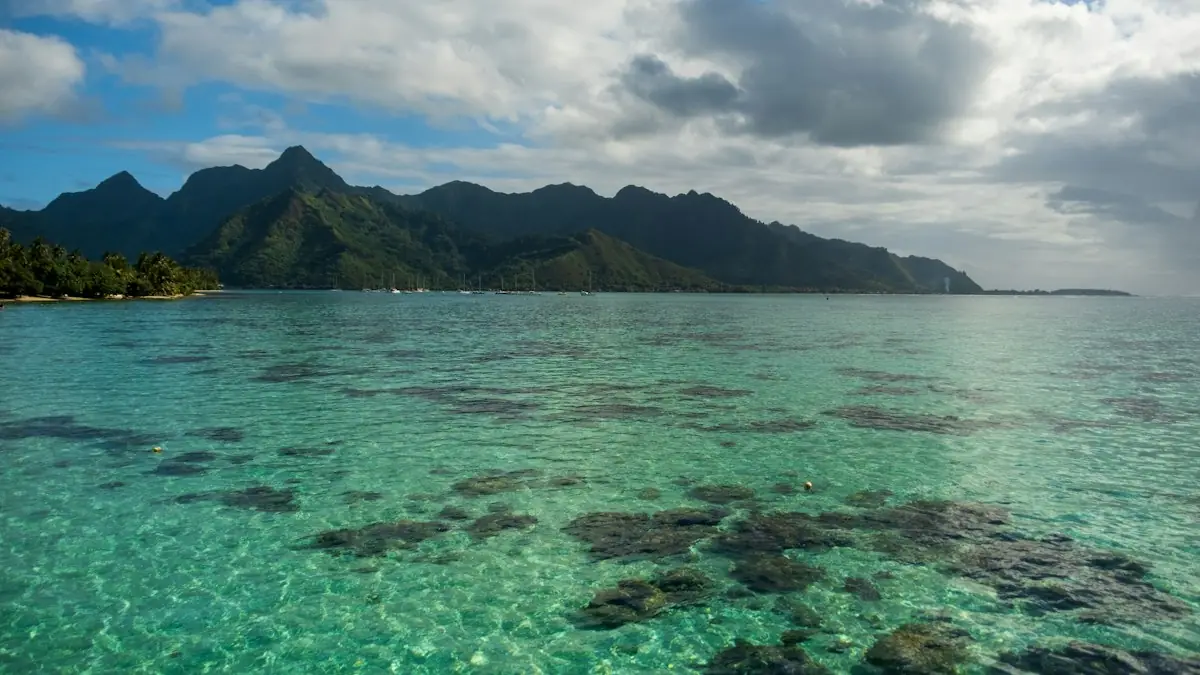
Two warm oceans, two very different reef stories. In Moʻorea, French Polynesia, the reef is among the most studied on Earth, and the rules around it are wide and national. In Sri Lanka, reefs are smaller and scattered, and protection is built site by site.
Neither way is automatically better. What matters is how the rules live on the water, day after day.
Is the coral in Moʻorea dead? A reef watched for decades
Few reefs are measured as carefully as Moʻorea’s. The French research station CRIOBE has worked on the island for decades, and a long-term ecological research site funded by the US National Science Foundation began there in September 2004. All this watching lets us tell the reef’s story honestly.
It is a story of big falls and big returns. An outbreak of crown-of-thorns starfish from 2006 to 2010, and then Cyclone Oli in February 2010, left coral cover below 1% at monitored sites on the outer reef.
And then the reef came back. On the north shore, at 10 metres deep, live coral covered about 75% of the reef early in 2019. We tell more of that comeback in what Moʻorea is teaching scientists about resilient reefs.
The year the heat came
Then came the heat. Bleaching is what happens when heat stress turns corals white. At that same north shore site, bleaching in 2019 left only 17% coral cover by August 2020.
Normally, dead branching coral breaks down and is cleared away, and young corals settle on the fresh surface. This time, many kilometres of reef stayed covered by dead Pocillopora colonies that did not fall. Seaweed grew on them. By 2025, recovery at this site had not started.
Heat also does not hit every coral in the same way. During the 2018 to 2019 heatwave, researchers surveyed more than 5,000 colonies on the outer reef. About 79.9% of Acropora colonies bleached severely, compared with 18.1% of Pocillopora, and Acropora at 10 metres bleached more than Acropora at 17 metres.
So two honest snorkellers can come home with two very different reports, and both can be right.
Sri Lanka: smaller reefs, many pressures
Sri Lanka has about 680 km² of coral reefs. An older review for FAO described reefs close to shore along only about 2% of the coastline, and recorded live coral cover at Hikkaduwa falling from 21.7% in 1985 to 13.2% in 1994. Old numbers, but the pressure is clearly not new.
Bleaching hit in 1998 and 2016, and some reefs in the Gulf of Mannar had almost 80 to 90% live coral cover before 1998. The list of threats is long: overfishing and blast fishing, abandoned fishing gear, unsustainable tourism, pollution, nutrients and sediment.
The sea is warming too. Across shallow reef areas, surface temperatures rose by about 0.03 to 0.04 °C a year between 2005 and 2021, with April the hottest month.
At Kayankerni, on the east coast, a 2025 report gives live coral cover of 35.8% in 2023 and records bleaching in 2016 and in 2019 to 2020. For Pigeon Island, near Trincomalee, and Bar Reef, baseline data was still being collected. So we do not quote a coral cover figure for Pigeon Island. We would rather wait for the survey.
Two ways of writing rules for the sea
French Polynesia thinks big. Since 2006, all sharks and rays are protected across its whole ocean area, with the mako added in 2012. Since 2002, its waters have been a marine mammal sanctuary of about 4.9 million km². And its environment code of October 2017 forbids attracting wild animals with gestures, noise or food where this risks disturbing them.
Sri Lanka chooses species and places. Named sharks are protected, including three threshers, the oceanic whitetip and the whale shark, and fins must stay attached when sharks are landed. The national scuba guideline says sharks should not be fed under any circumstances.
With whales, both places keep boats at least 100 metres away. In French Polynesia, the whale season runs from 20 July to 20 November, with a 100 metre safety zone for boats. Sri Lanka’s Sea Mammals Regulations of 2012 say vessels must stay no closer than 100 metres, and people are not allowed in the sea except with the approval of the Director-General.
A rule on paper, a reef in real life
Moʻorea has its own marine space plan, adopted in 2004 and revised in 2021. It began with eight permanent marine protected areas and two regulated fishing zones. The results were real but modest. On the outer reef, fished species rose 19.3% in density and 24.8% in biomass inside protected areas, and the researchers linked the modest gains partly to limited compliance and weak surveillance.
Further offshore, French Polynesia has announced about 520,000 km² more of full protection. Once in place, that would bring about 30% of its waters, around 1.4 million km², under full protection.
And a law does not end a habit by itself. After the 2020 lockdown, researchers documented the feeding of blacktip reef sharks and pink whiprays starting again at one French Polynesian site.
In Sri Lanka, hope looks different. In November 2025, IUCN announced the CORALL Conservation Trust Fund, with the Global Fund for Coral Reefs as first donor, giving about LKR 97 million (USD 321,000) for Bar Reef, Kayankerni and Pigeon Island. The idea is Special Management Areas, where government, communities and partners plan together. A hopeful start, still small next to the pressures.
How to float over a reef kindly
On both islands, float, never stand, and keep your fins high in shallow water. Ask for the sandy entries, and choose boats that use moorings. Never touch, chase or feed any animal, and do not carry food into the water.
If you dive in Sri Lanka, you can check that your group follows the national guideline of no more than five divers per guide, with emergency oxygen on board. With whales there, stay on the boat. In Moʻorea, whale swims happen only in the legal season with licensed boats.
Wildlife encounters are unpredictable. Whale swims should always follow local regulations and experienced professional guidance.
My own small habit on reef days is a long-sleeve rash guard, so I need less cream, and for the rest a mineral sunscreen.
And if you see white or dead coral, do not decide that the whole reef is lost, or that it is fine. Ask which reef, which depth and which year. Slow looking like this is also why our Moʻorea retreat in September 2027 stays a small group, with time for the lagoon.
Questions people ask
Is the coral in Moʻorea dead?
No single answer fits the island. One well-studied north shore site lost most of its coral after 2019 and had not started to recover by 2025, while heat affected different corals and depths in different ways.
Is shark feeding legal in French Polynesia?
The environment code adopted in October 2017 forbids attracting wild species with food, gestures or noise where this risks disturbing them. Always ask an operator directly what they do.
Are sharks protected in Sri Lanka?
Some species are, including the thresher sharks, the oceanic whitetip and the whale shark, and sharks must be landed with fins attached. There is no country-wide shark sanctuary like French Polynesia’s.
How healthy is the reef at Pigeon Island?
We have not found a recent published coral cover figure. Baseline surveys were still underway in the national coral reef programme, so we prefer to wait for the data.
Wildlife encounters are never guaranteed and never forced. Ocean Calling works only with vetted, ethical local operators, and every animal is free to approach, or not, entirely on its own terms.
Sources & further reading
- Scafidi, K.C. et al., 2026. Remnant hollowed out dead coral skeleton branches defer coral community recovery. PLOS One.
- University of Illinois News Bureau, 2026. Still standing but mostly dead: Recovery of dying coral reef in Moorea stalls.
- Adjeroud, M. et al., 2018. Recovery of coral assemblages despite acute and recurrent disturbances on a South Central Pacific reef. Scientific Reports.
- Winslow, E.M. et al., 2024. Corals survive severe bleaching event in refuges related to taxa, colony size, and water depth. Scientific Reports.
- LTER Network. Moorea Coral Reef LTER site profile.
- Mongabay, 2024. 18 years on, how are sharks faring in French Polynesia’s shark sanctuary?
- Te Ora Naho FAPE, 2018. La Polynésie, sanctuaire intégral des requins: le shark feeding y est désormais interdit.
- Séguigne, C. et al., 2021. Effects of a COVID-19 lockdown-induced pause and resumption of artificial provisioning on blacktip reef sharks and pink whiprays in French Polynesia. Ethology.
- Service public de la Polynésie française, 2022. Sanctuaire marin: 20 ans et une fresque (Hiro’a n°172).
- OFB Te Me Um. La révision du plan de gestion de l’espace maritime de Moorea.
- Wencélius, J., Lauer, M. and Bambridge, T., 2022. Ambio.
- Thiault, L. et al., 2019. Ecosphere.
- Pew Bertarelli Ocean Legacy, 2026. French Polynesia strengthens world’s largest network of fully protected marine areas.
- DIREN Polynésie française, 2025. Observation des mammifères marins (leaflet).
- IUCN / Global Fund for Coral Reefs, 2026. Sri Lanka Coral Reef Initiative full programme document (UN MPTF Office).
- IUCN, 2025. Sri Lanka Coral Reef Initiative annual narrative report, July-December 2024 (UN MPTF Office).
- IUCN, 2025. IUCN in Sri Lanka announces CORALL Conservation Trust Fund to protect coral reefs and support coastal communities.
- Rajasuriya, A. Coral reefs of Sri Lanka: current status and resource management. FAO.
- Thilakarathne, E.P.D.N. et al., 2023. Tropical coral reefs in Sri Lanka are threatened due to the fluctuation of seasonal and interannual sea surface temperature. Environmental Monitoring and Assessment.
- Mongabay, 2019. Sri Lanka scales up its domestic campaign to protect sharks with a global push.
- IOTC, 2015. Impact of policies on the shark fisheries of Sri Lanka (IOTC-2015-WPEB11-18 Rev_1).
- IWC Whale Watching Handbook. Sri Lanka country profile.
- Sri Lanka Tourism Development Authority. Guideline for scuba diving and snorkelling, water based adventure tourism.
Further reading on Ocean Calling: French Polynesia in the Ocean Atlas · Sri Lanka in the Ocean Atlas · French Polynesia’s giant marine protected area · Why shark feeding in French Polynesia is complicated · Whales in Sri Lanka: what is legal
Swim with humpback whales in Moʻorea: an ethical whale retreat
Whale encounter retreat · Moʻorea, French Polynesia
Time in the blue, on the whales’ terms. This story is about French Polynesia, where we run our whale trip.
Explore in the Ocean Atlas
Places in this article