
Jul-Oct Whale Season: How to Choose One Place, Not Five
Imagine a map with three pins on it: Moʻorea, Tonga and Réunion. The humpbacks return to all three in the same months, and it is so tempting to try them all in one season. So where is the best place to swim with humpbacks between July and October? My honest answer is simple. Choose one place, stay longer, learn its rules, and let the whales decide the rest.
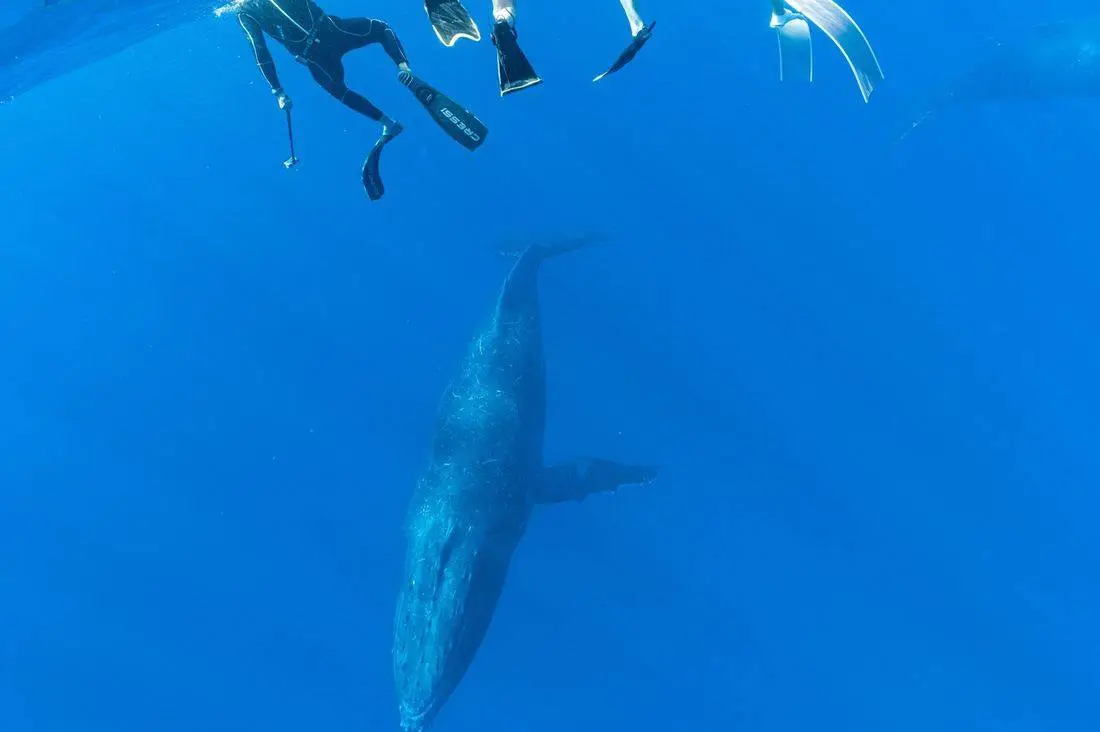
It sounds less exciting than a big tour, I know. But splitting one season across three islands usually means fewer good days in each place, not more.
One season, three islands, one decision
From July to October, humpback whales gather in the warm waters of the South Pacific and the western Indian Ocean to mate, give birth and rest. Moʻorea in French Polynesia, Tonga and Réunion all sit inside this same window, so they compete for the same few weeks of your year.
The calendars overlap closely. In Tonga, humpbacks breed from July to October. In French Polynesia, whale observation is authorised from 20 July to 20 November. In Réunion, the regulated season for close observation and water entry runs from 1 July to 30 September.
These islands are very far apart, and wind and swell can cancel a whale day anywhere. So the real question is which one place deserves your time.
Moʻorea: licensed boats and clear distances
French Polynesia made its whale rules stricter for the 2025 season. Authorised professional boats may not come closer than 100 metres to the animals, and no more than three of them may be in the observation zone at the same time. Private boats must stay beyond 300 metres. Swimmers keep at least 15 metres from the whale, with a maximum of six people in the water and a certified guide present.
In practice, many days are spent watching from the boat. When a whale is resting and the guide decides the moment is right, you slip in quietly, stay where you are, and the whale chooses how close.
Tonga: very small groups, one boat per pod
Tonga has a long history of licensed whale swimming. Under the guidelines ratified in 2013, no more than four clients plus one trained local guide from one licensed vessel may be in the water with a pod, and only one licensed vessel may put swimmers in with the same pod. Swimmers must not come closer than 5 metres, and boats not closer than 10 metres to drop off or pick up swimmers. Once one operator has spent 90 minutes with a mother and calf, all whale watching activities should leave them alone. Ask your operator which version of the rules they follow today.
Tonga also teaches something honest: rules on paper are not the same as behaviour on the water. A study in Vavaʻu over the 2016 and 2017 seasons, based on 56 surveys, saw whales avoid tour vessels in about one third of approaches (33.5%). The resting time whales should get between interactions was often not respected (38.4%), and mother and calf pairs spent more time diving when swimmers were in the water. It is a reason to choose your operator with care.
Réunion: where the shore is the gentle choice
Réunion is a French island in the Indian Ocean, and its rules are different again. During the regulated season, a maximum of three boats may be with the same group of cetaceans. Water entry is limited to seven people including the guide, for 30 minutes at most, and only between 9:00 and 13:00. Boats must slow to 4 knots within 300 metres of the animals.
Here the local research association GLOBICE says something important: the most responsible observation is the one done from the coast, and it offers a free app to help people watch from land. Numbers also vary. In one recent season GLOBICE reported few sightings by the end of July, while reminding people that a low year does not necessarily mean a decline. If Réunion is your place, think of it first as a whale watching island from the cliffs, and only then about the water.
Three small questions to find your place
When people ask me where to go, I ask three small questions back. First, what do you want your days to feel like when the sea says no? Some islands give you a lagoon and easy days on land, others are more remote. Your trip is a whole week, not one hour in the water.
Second, which rules feel right to you? Some people like Tonga’s very small groups in the water. Some prefer French Polynesia’s larger distances. Some, after reading GLOBICE, would rather watch from the shore in Réunion. There is no wrong answer, but read each place by its own rules and never carry a number from one country into another. A 5 metre rule in Tonga does not apply in Moʻorea, and a 15 metre rule in Moʻorea does not apply in Tonga. If you like details side by side, we compare them in Moʻorea vs Tonga vs Réunion.
Third, who will be with you on the water? This matters more than the country. Ask how the captain approaches, what happens when another boat is already with the whale, and when the guide decides to leave. Then pick one place, and give it more nights than you think you need.
Why slow whale travel is kinder to the whales
These breeding grounds are nurseries. In Hawaiʻi, another humpback breeding ground, scientists used drones to measure mothers and calves. They found that nursing mothers lose nearly 214 pounds, about 97 kg, of blubber per day, while their calves grow very fast. This is a Hawaiʻi measurement, but it shows why every forced move away from boats or swimmers costs a mother energy she needs for her calf.
There is also the question of numbers. A photo-identification and DNA study described Oceania as the least abundant humpback breeding population in the Southern Hemisphere, with about 4,329 humpbacks estimated in 2005. It is an old estimate, not a count for today.
Wherever you go, follow the rules of that island exactly as they are written there. Good operators slow down early, never cut in front of a whale, and leave when another boat is already there. In the water, stay together and calm at the surface. Never chase, never touch, never feed, and never swim into the path of a moving whale or between a mother and her calf. Wildlife encounters are unpredictable. Swimming with humpback whales should always follow local regulations and experienced professional guidance.
For the long waiting hours on deck, I keep my phone and a dry layer in a small roll-top dry bag, and my own low-volume mask ready in case the guide says yes.
And if Moʻorea feels like your one place, our Moʻorea retreat in September 2027 is built around exactly this kind of patience: a small group, the lagoon, and whatever the whales decide. It starts from CHF 4,500 per person in a double room shared with your own partner or friend, and you book by simply messaging me.
Questions people ask
What is the best place to swim with humpbacks from July to October?
There is no single best place. Moʻorea, Tonga and Réunion each have legal, regulated frameworks and different rules. The best place is the one whose rules, pace and days on land suit you, with an operator you trust.
Can I combine Moʻorea, Tonga and Réunion in one season?
It is possible on a map, but it means long flights and fewer days in each place. Weather and whale presence change week by week, so more time in one island usually gives you more real chances.
Is watching from a boat or the shore a lesser experience?
No. In Réunion, GLOBICE says the most responsible observation is from the coast. Watching a whale breathe, rest and move on its own terms is often the most memorable part of a trip.
Wildlife encounters are never guaranteed and never forced. Ocean Calling works only with vetted, ethical local operators, and every animal is free to approach, or not, entirely on its own terms.
Sources & further reading
- International Whaling Commission. Whale Watching Handbook: Tonga case study.
- Radio1 Tahiti, 2025. Les règles ont changé pour la saison des baleines 2025.
- Guide Réunion, 2026. Observation des cétacés à La Réunion: rappel des règles 2026 (arrêtés préfectoraux n°944 and n°1098 of 2025).
- GLOBICE. Respecter la réglementation.
- Imaz Press, 2026. Les baleines sont moins nombreuses cette année.
- Garland, E.C. et al., 2011. Dynamic horizontal cultural transmission of humpback whale song at the ocean basin scale. Current Biology 21: 687-691.
- ScienceDaily, 2011. News summary of Garland et al. on humpback song transmission (University of Queensland).
- Fiori, L. et al., 2019. Effects of whale-based tourism in Vavaʻu, Kingdom of Tonga: behavioural responses of humpback whales to vessel and swimming tourism activities. PLOS ONE.
- van Aswegen, M. et al., 2025. Maternal investment, body condition and calf growth in humpback whales. The Journal of Physiology.
- University of Hawaiʻi News, 2024. News summary of the humpback mother and calf drone study.
- Constantine, R. et al., 2012. Abundance of humpback whales in Oceania using photo-identification and microsatellite genotyping. Marine Ecology Progress Series 453: 249-261.
Further reading on Ocean Calling: Why swimming with whales is allowed in some countries and not others · How to choose an ethical whale swim operator · French Polynesia in the Ocean Atlas · Tonga in the Ocean Atlas · Réunion in the Ocean Atlas · Humpback whale in the Ocean Atlas
Swim with humpback whales in Moʻorea: an ethical whale retreat
Whale encounter retreat · Moʻorea, French Polynesia
Time in the blue, on the whales’ terms. This story is about French Polynesia, where we run our whale trip.
Explore in the Ocean Atlas
Places in this article
Animals in this article
