
How to Choose an Ethical Whale Swim Operator: 4 Questions to Ask
Most people ask one question before a whale trip: “Will we see whales?” It is a fair question. But it tells you almost nothing about how the whales will be treated once the boat finds them.
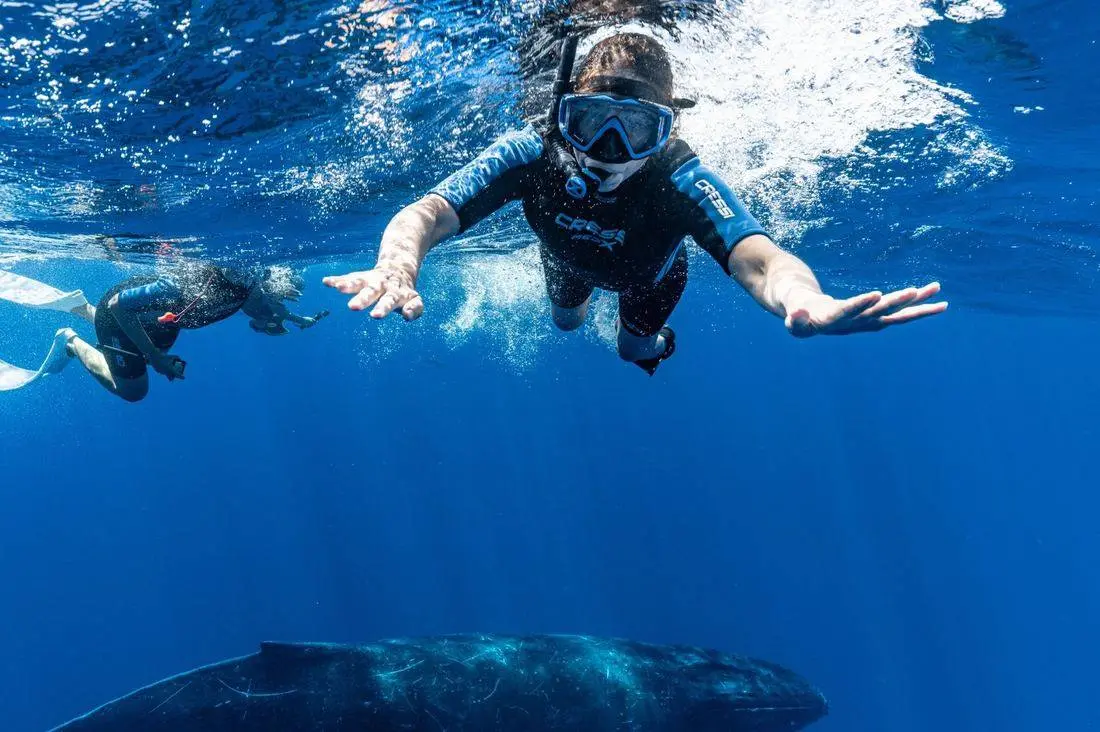
To choose an ethical whale swim operator, ask four things: how the boat approaches, whether drones are flown, whether flash is used, and what the policy is on fins and numbers in the water. Then ask to see one document, a licence, wherever a licence is required. The rest of this story explains why each question matters.
Imagine two boats leaving the same harbour on the same morning. Both have smiling crews, both have beautiful photos online, and both will probably find whales. From the pier, they look exactly the same. The difference shows only when you ask better questions. These are the small questions we ask every whale swim operator, plus the one document we always want to see.
How do you approach the whales?
A fast boat racing to a sighting is exciting for people and stressful for the animals. Good practice in many countries is a slow approach from the side and slightly behind, never head on, with engines slowed or in neutral close to the whales. Ask the crew to describe their approach in their own words. A specific answer that they clearly use every day is a good sign.
Some places write this into numbers, and the numbers change, so please treat what follows as a snapshot. In French Polynesia, a trade report from November 2025 describes a 300 metre observation zone around a cetacean, with no more than three boats inside it at once and a top speed of 3 knots there. An earlier decree, published in April 2024, is reported to set a 100 metre distance for boats and 15 metres for swimmers. In Réunion, a prefectoral order of June 2025 applies to humpbacks from 1 July to 30 September and reduces the number of boats allowed within 300 metres from five to three. Outside that period it asks boats to stay more than 300 metres away. A knot is a measure of speed at sea. These are very slow speeds on purpose.
Do you fly drones?
I do not have one global rule to give you, and that is the honest answer. Drone rules differ by country and by park, and in some places they need special permission. A drone flying low over a mother and her calf is not the same as a photo taken from the deck. In Hawaiʻi, for example, the federal approach rule for humpback whales also bars aircraft within 1,000 feet of a humpback.
A good operator will explain the local rule clearly, instead of just saying "it's fine". If the answer is "we have permission", ask who gave it.
Do guests use flash or strobes?
Rules for whale sharks often say no flash photography. At Ningaloo in Australia, the state's visitor guide lists no flash among the rules for swimming with whale sharks. We apply the same care to whales. A sudden bright light near a large eye is not a small thing, and I see no reason to risk it for a better picture.
A small action camera kit with natural light is plenty. Honestly, most of the time the camera stays down, and I just look.
Can guests use long freediving fins, and how many people are in the water?
Long fins make swimmers fast and powerful. Around whales, and especially around calves, speed is the wrong idea. I do not know of a single worldwide rule on fin length, so this is a question about the operator's own policy. Ask whether they have one, and how they manage swimmers who try to chase. If you are choosing fins yourself, comfort and control matter more than length, and the operator's briefing comes first. Our list of freediving fins is only a starting point, never a reason to swim faster than the guide.
Numbers matter just as much. Small numbers are not a luxury. They are a kindness. In Tonga, sources describe swimmers entering in groups of no more than four with a guide, and only one licensed vessel putting swimmers in the water with a given pod. In Réunion, the 2025 order cut the number of people allowed to swim near cetaceans from ten to seven and limits water entry to between 9:00 and 13:00. In Niue, operators are described as allowing six swimmers at a time, with mother and calf swims kept to five minutes or less, though sources differ on distances. Fewer people in the water leaves more space for the whale to choose.
The one document you should see: a licence
In several places, in-water time with whales is licensed. Tonga licenses its swim operators, and its fleet is described as between 35 and 50 licensed boats, though that is a secondary count. Niue allows swimming only with a licensed operator, and prosecution is possible otherwise. French Polynesia and Réunion require approved providers and set quotas for swimmers. In the United States, the question is different. Federal rules for Hawaiʻi say that no one, including swimmers and divers, may approach a humpback within 100 yards.
A real licence is a document you can see, not a promise. If an operator cannot show one where a licence is required, that is your answer. And because rules change every few years, please check the current rule before you travel. Our guide to what the French Polynesian authority actually allows goes deeper on one example.
Why the rules are strictest around mothers and calves
This is the conservation layer behind every question above. Humpbacks travel to warm water to give birth and nurse. A calf is small and fully dependent on its mother, so many rules set shorter times or tighter limits for pairs. I do not have one study to quote for every rule, but the logic is simple. The youngest animals deserve the most space. We explain the reasoning in why whale rules get stricter around mothers and calves.
When an operator takes these rules seriously, it often means fewer swims and some days with no swim at all. That is a feature, not a flaw. It is also one reason we keep our Moʻorea retreat group small, and why we never promise a whale. Wildlife encounters are unpredictable. Swimming with whales should always follow local regulations and experienced professional guidance.
A last practical note: on a boat day, a rash guard and a dry bag keep you comfortable so you can listen to the briefing. If this made you curious about meeting the ocean yourself, you can explore our retreats.
Questions people ask
Where is swimming with whales licensed?
Among the places in this story: French Polynesia, Tonga, Niue and Réunion all use licences or approved providers. Each has its own season and group size, so always check the rule of the place you visit.
How fast should a whale boat go near whales?
Slowly. For French Polynesia, a November 2025 trade report describes a maximum of 3 knots inside the 300 metre zone around a cetacean. Other places set their own limits, so ask the operator which rule applies.
How many swimmers should be in the water?
Fewer is better. Tonga is described as four swimmers plus a guide per group, Niue as six, and Réunion's 2025 order lowered the maximum from ten to seven. These figures can change.
Are drones allowed near whales?
It depends on the country and the park. Some places need special permission, and some bar low flying near animals. Ask the operator for the local rule and who gave permission.
What if an operator cannot show a licence?
Where a licence is required, that is a reason to choose another boat. Where no licence exists, ask for the written code and how the crew applies it.
Is it rude to ask an operator all these questions?
Not at all. A good operator will be happy to answer, and clear answers are a good sign.
Wildlife encounters are never guaranteed and never forced. Ocean Calling works only with vetted, ethical local operators, and every animal is free to approach, or not, entirely on its own terms.
Sources & further reading
- Préfecture de La Réunion, 2025. Arrêté préfectoral no. 1098 of 27 June 2025 on observation of cetaceans, public notice.
- DEAL Réunion, 2025. Draft prefectoral order on cetacean observation, press kit.
- Figaro Nautisme / Meteoconsult, July 2025. La Réunion encadre davantage l'observation des baleines.
- Figaro Nautisme / Meteoconsult, November 2025. Polynésie française : nouvelle réglementation forte pour l'observation des baleines.
- NOAA Fisheries. Approach regulations for humpback whales in the waters surrounding the islands of Hawaiʻi under the Marine Mammal Protection Act.
- International Whaling Commission, Whale Watching Handbook. Tonga country profile.
- Oceanic Society. Swimming with whales in Tonga: common questions.
- Niue Whale Watching Regulations 2016, via InforMEA.
- Niue Pocket Guide. The guide to swimming with whales in Niue (secondary, tourism guide).
- Department of Biodiversity, Conservation and Attractions (Western Australia). Nyinggulu (Ningaloo) Coast visitor guide, 2024.
Further reading on Ocean Calling: Niue in the Ocean Atlas · Humpback whale in the Ocean Atlas · Why whale rules get stricter around mothers and calves · Tonga in the Ocean Atlas
Swim with humpback whales in Moʻorea: an ethical whale retreat
Whale encounter retreat · Moʻorea, French Polynesia
Time in the blue, on the whales’ terms. This story is about French Polynesia, where we run our whale trip.
Explore in the Ocean Atlas
Places in this article
Animals in this article
