
Moʻorea Coral Reef Resilience: Damaged and Recovering
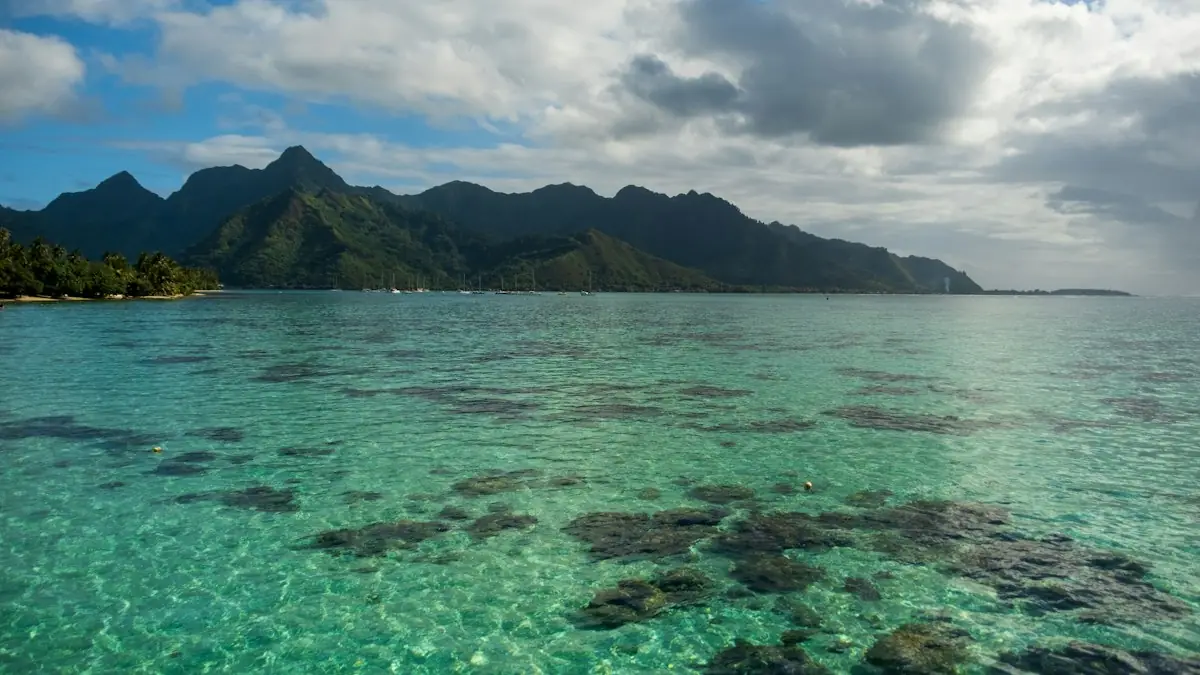
Snorkel the outer reef of Moʻorea, in French Polynesia, and you may see broken coral right next to young, healthy colonies. Both are true at once. This reef has collapsed and come back more than once, and scientists have been watching the whole time.
In short
- Moʻorea's outer reef fell to below 1% coral cover in 2010 after a crown-of-thorns starfish outbreak and Cyclone Oli. Within four years, young and adult coral colonies were back at or above earlier numbers.
- Recovery did not mean the same reef came back. Pocillopora corals led the return, and the mix of species changed.
- Resilience depends on things no single dive can show you: grazing fish, coral larvae arriving from other islands, and how heat affects different corals at different depths.
Can a coral reef be damaged and resilient at the same time? In Moʻorea, yes. Resilience here does not mean the reef never breaks. It means it has, so far, found ways to grow back. This guide is for curious snorkellers, divers and travellers who want to understand what they are looking at.
One of the most watched reefs on Earth
Few reefs have been measured as closely as Moʻorea's. The Moorea Coral Reef Long Term Ecological Research site, funded by the US National Science Foundation, was set up in September 2004. It studies the reef system around the whole island, where shallow lagoons, with a mean depth of about 5 to 7 m and a width of about 0.8 to 1.5 km, run around a 60 km perimeter, and all major coral reef types are within reach by boat. French researchers at CRIOBE, the island's long-standing research station, run their own long-term monitoring too.
All that science matters, because it lets researchers tell a bad year from a long trend. One dataset on the outer reef begins in 1991. In a 2018 study in Scientific Reports, it shows coral cover of about 51% in 1991, a fall to about 22% by 1993 after a cyclone and bleaching, and a recovery to about 49% by 2005. The reef had already been knocked down, and had already come back, once.
The collapse nobody could miss
Then came a much bigger blow. A crown-of-thorns starfish outbreak ran from 2006 to 2010, and Cyclone Oli hit in February 2010. At the monitored outer reef sites, coral cover dropped to below 1% in 2010. A separate team, measuring different sites for a 2011 study in PLoS ONE, recorded a fall of about 90%, from about 40% cover in 2005 to under 5% in 2010.
On many reefs in the world, a loss like that has opened the door to seaweed, and seaweed can make it hard for new corals to settle. Moʻorea did not follow that path, and the reason is one of the most useful lessons it offers.
Why the seaweed never took over
While the coral was dying, the grazers were growing. Between 2008 and 2010, roving plant-eating fishes on the outer reef nearly doubled, and parrotfish grew from about 22% of herbivore biomass in 2006 to about 50% in 2010. The researchers linked this fast increase to the extra algae growing on dead coral: more food, more grazers, and seaweed kept in check.
Where did so many young parrotfish come from? From the lagoon. The researchers found that the parrotfish behind this response first settle in nursery habitat in the lagoons, which the starfish outbreak had not damaged, before moving out to the reef later in life. Their conclusion was clear: the link between the lagoon and the outer reef helped stop seaweed from taking hold after the disturbance. The quiet water where many visitors first snorkel is part of what kept the outer reef open for coral.
It came back, but not as the same reef
Recovery was fast, but uneven. Four years after the 2006 to 2010 disaster, the number of juvenile and adult coral colonies had regained or passed levels from before the disturbance, which the authors describe as a new benchmark for how fast a reef can recover. At one monitored site, Tiahura at 12 m, cover was back to about 17%, with young Pocillopora colonies recolonising the reef. The authors also note that this happened despite steadily low recruitment rates, which suggests that the young corals that did settle survived well. But the mix had changed. Different corals suffered and recovered differently, so the reef that came back was not the same reef.
Place mattered too. Within five years of Cyclone Oli, two north shore sites had passed their earlier coral cover, while others barely moved. In a separate 2018 study, recovery rates ranged from about 1% to 12% a year, and the arrival of new coral recruits explained around 90% of the difference between sites.
Some of those recruits may travel a long way. A modelling study of five warming events around Moʻorea and Tahiti, in 1994, 2002, 2007, 2016 and 2019, notes that reefs recovered by as much as about 76% after each event. The authors of this 2024 study propose that ocean currents link the islands to the Tuamotu atolls, about 250 km to the northeast, which could act as a source of coral larvae that drift for three weeks or longer. It is a model, not a direct count of larvae, but it suggests that part of a reef's resilience may live on other islands.
Why can one snorkel not tell you if the reef is healthy?
Because heat does not hit every coral the same way. During a marine heatwave from November 2018 to July 2019, researchers, in a study published in 2024, surveyed more than 5,000 colonies on Moʻorea's outer reef. About 79.9% of Acropora colonies bleached severely, compared with 18.1% of Pocillopora. Larger Pocillopora colonies, over 30 cm, were more sensitive than smaller ones, and Acropora at 10 m bleached more severely than Acropora at 17 m.
So a visitor who sees white coral on a shallow reef one week, and another who sees colourful Pocillopora on a different reef the next, may both be telling the truth. Neither is seeing the whole island. We look at the wider science in why some reefs bounce back and others don't.
Protection helps, but modestly and unevenly. In a 2019 evaluation, after Moʻorea's marine protected area network was created, harvested fish on the outer reef increased by 19.3% in density and 24.8% in biomass inside protected areas, and harvested fish biomass rose by 31% in fully protected lagoon areas. The authors linked the modest results partly to limited compliance and weak surveillance. You can read more in our guide to French Polynesia's giant marine protected area.
Resilience and the ethics of a visit
Resilience is not a reason to be careless. It depends on young corals settling and surviving, and on young fish growing up safely in the lagoon, so the small choices of visitors count most in the shallows. Float, never stand, on coral. Keep fins high and slow in shallow water. A well-fitting low-volume mask and snorkel makes it easier to stay flat and calm at the surface, and a long-sleeved rash guard means less sunscreen washing into the lagoon. Ask your guide where the sandy entry points are. We explain how to read the water before you get in, in how to read a reef before you get in.
Choose operators who use moorings instead of anchors, keep groups small and give a reef briefing. Respect the rules of Moʻorea's marine protected areas and any closed zones your guide points out. And if you see bleaching, do not assume the whole island is dying, or that it is fine. Ask which reef, which depth and which year. You can explore more of the island on our French Polynesia Atlas page.
If you would like to see Moʻorea's lagoon and outer reef with calm, small-group guidance, you can explore our Moʻorea retreat in September 2027.
Questions people ask
Is the coral in Moʻorea healthy?
It depends where and when you look. Moʻorea's outer reef has collapsed and recovered more than once, and heat affects different corals, sizes and depths in different ways. Scientists avoid a single label, and so do we.
Did coral nurseries bring the reef back after 2010?
The peer-reviewed studies cited here found that natural recruitment of new corals, helped by grazing fish that kept seaweed down, drove the recovery. Coral gardening projects exist on the island, but they are not what these studies measured.
Why didn't seaweed take over after the coral died?
Grazing fish increased quickly. Roving herbivores nearly doubled between 2008 and 2010, and parrotfish, which grow up in the lagoons, came to make up about half of herbivore biomass. They kept the dead coral clear enough for new corals to settle.
Will Moʻorea's reef always bounce back?
No one can promise that. The research shows strong recovery in the past, but also a changed coral mix and repeated heatwaves. Resilience is a capacity, not a guarantee.
Can I see this science as a visitor?
Not directly, but you can notice it: young Pocillopora colonies, schools of grazing parrotfish, and the difference between lagoon and outer reef. A good local guide will help you read what you see.
Which corals bleach most in Moʻorea?
In the 2019 marine heatwave, about 79.9% of Acropora colonies surveyed on the outer reef bleached severely, compared with 18.1% of Pocillopora. Larger Pocillopora colonies and shallower Acropora were more affected.
Wildlife encounters are never guaranteed and never forced. Ocean Calling works only with vetted, ethical local operators, and every animal is free to approach, or not, entirely on its own terms.
Sources & further reading
- LTER Network. Moorea Coral Reef LTER site description.
- Adjeroud, M. et al., 2018. Recovery of coral assemblages despite acute and recurrent disturbances on a South Central Pacific reef. Scientific Reports 8:9680.
- Adam, T. C. et al., 2011. Herbivory, connectivity, and ecosystem resilience: response of a coral reef to a large-scale perturbation. PLoS ONE 6(8): e23717.
- Reef Resilience Network. Summary of Adam et al. 2011, Herbivory, connectivity, and ecosystem resilience.
- Holbrook, S. J. et al., 2018. Recruitment drives spatial variation in recovery rates of resilient coral reefs. Scientific Reports.
- Lama, S. J., Lopera, L. and Bracco, A., 2024. The role of mesoscale-driven connectivity patterns in coral recovery around Moorea and Tahiti, French Polynesia. Scientific Reports.
- Winslow, E. M. et al., 2024. Corals survive severe bleaching event in refuges related to taxa, colony size, and water depth. Scientific Reports.
- Thiault, L. et al., 2019. Ecological evaluation of a marine protected area network: a progressive-change BACIPS approach. Ecosphere.
Further reading on Ocean Calling: Why some reefs bounce back · French Polynesia's marine protected area · More from the Journal · Ocean Atlas
Swim with humpback whales in Moʻorea: an ethical whale retreat
Whale encounter retreat · Moʻorea, French Polynesia
Time in the blue, on the whales’ terms. This story is about French Polynesia, where we run our whale trip.
Explore in the Ocean Atlas
Places in this article