
Gili Meno underwater statues: how art becomes reef habitat
Forty-eight people stand in a circle on the seabed off Gili Meno, and slowly the reef is taking them back. Here is the science behind the statues, how a sculpture turns into habitat, and what it teaches anyone who travels for the ocean.
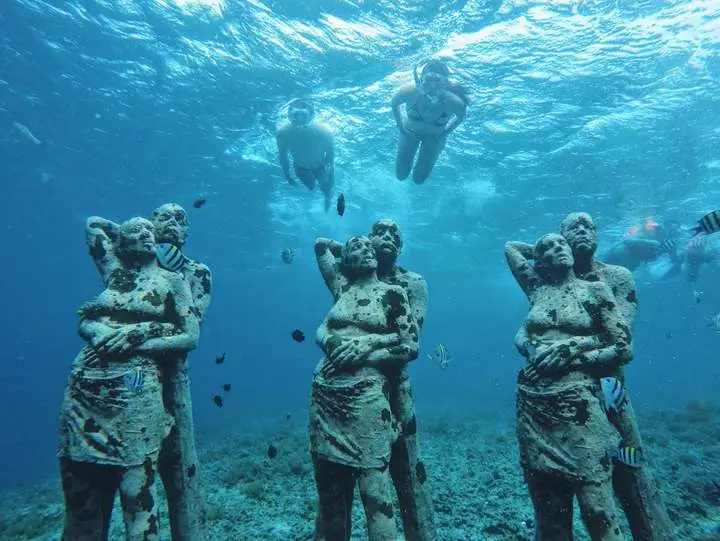
A few metres below the surface near Gili Meno, a circle of human figures stands quietly on the sand. The first time you see it, it feels mysterious, a little surreal. Most people know the site simply as Nest. It is one of the most photographed underwater spots in the Gili Islands, visited by snorkellers, freedivers and scuba divers from all over Indonesia and beyond.
So do the statues actually help the reef? The short answer: they can add real habitat, slowly, as algae, sponges and sometimes coral settle on them. But they do not replace a natural reef, and they only help if visitors treat them with care.
That is what makes Nest interesting for anyone curious about ethical ocean travel. Under the art, it is really a story about materials, habitat, visitor behaviour and the slow, patient work of ecological change.
Why put sculptures underwater at all? Can art really support a reef, or does it just pull more people to a busy coastline? The honest answer sits in between, and that is exactly why the site is worth understanding before you visit.
First, what exactly is Nest?
Nest was created by the British sculptor Jason deCaires Taylor, known worldwide for placing large figurative sculptures on the seabed, from Cancún to the Great Barrier Reef. He completed Nest off Gili Meno in 2017, commissioned by BASK, a resort developer on the island.
The installation is made of 48 life-sized human figures, cast from real people and arranged in a ring, as if holding a silent meeting on the seafloor. Sources give slightly different depths, from about 4 metres to between 3 and 6 metres, which is why snorkellers can enjoy it as well as divers. Nothing moves. There is no show. Just stillness.
That stillness is the point. Most tourist attractions ask you to hurry. Nest asks you to slow down, look closely and notice. The figures still read as human, but they are slowly becoming something else, as marine life settles on their surfaces and blurs them into the seabed around them.
That change is not an accident. It is the whole idea. The figures are made of pH-neutral, environmental-grade concrete, chosen to invite marine life to colonise them over time. They were built to become part of the ecosystem, not to stay apart from it. That is what makes Nest much more than a photo stop.
Why put statues underwater at all?
The easy answer is curiosity. Underwater art gives people something unexpected to find, and it turns an ordinary snorkel into a memory. But in a place like Gili Meno there is a second layer: structures like this can work, at least partly, as an artificial reef.
An artificial reef is a human-made structure placed in the sea to support habitat. It does not replace a natural reef, and it should never be treated as equal to one. Natural reefs are far more complex, in their biology and in their shape. But in the right conditions, artificial structures can offer surfaces where marine organisms settle and grow.
Scientists have argued for decades about one question in particular: does an artificial reef produce new life, or does it mostly attract fish from somewhere else? A classic 1997 review in Fisheries Research concluded that design largely decides which way it goes, and a NOAA report warns that attraction without real habitat value can even become an ecological trap. For most installations the honest answer is somewhere in between, and it is hard to measure. We look at this debate in more detail in do artificial reefs work for conservation.
This is where design matters, not just art. Coral larvae drifting in the water need a stable, suitable surface to attach to before they can become a colony. Algae, sponges and other invertebrates need surfaces with the right chemistry and texture too. If the material is wrong, the surface too smooth or the placement poor, a sculpture stays a sculpture and never really becomes habitat. Nest looks poetic, but the choice of material shows that those practical questions were part of the plan.
How do the Gili Meno statues become part of the reef?
One of the most lovely things about Nest is that it never stops changing.
Once a sculpture goes underwater, the real work only begins. Thin films of bacteria and microorganisms usually form first. Algae follow. Small invertebrates start using the cracks and textures as shelter. In the right conditions, coral itself can settle and slowly spread from there.
Ecologists call this ecological succession: one group of organisms creates the conditions for the next, layer by layer, until a bare surface becomes something alive. It does not happen fast. Reef growth on any structure, natural or artificial, is measured in years, not weeks. The resort itself asks visitors not to touch the figures, because the corals and sponges growing on them are fragile.
That slowness is part of the lesson. A patch of seabed that looks quiet may be in the very first stages of becoming habitat. Installations like Nest make that invisible process visible, which is why they teach so well, even to visitors who will never open a marine biology book.
Why the Gili Islands are a fitting home for this story
The Gili Islands are already known for clear water, healthy reef patches and frequent turtle sightings, and that wider ecosystem gives Nest extra meaning. Around the islands, coral reef areas sit next to sandy seabeds and seagrass meadows, different habitats that together support a rich coastal ecosystem. Seagrass matters a lot here: it is a feeding ground for green turtles and shelter for many young fish, while reef structure adds its own food and hiding places.
That matters because an artificial reef only works well as an addition to a healthy ecosystem, never as a fix on its own. Water movement, nearby species, the seabed and how many people visit a site all shape what grows there over time.
For travellers, the useful idea is that nothing in the water lives alone. A turtle seen near the statues may feed on seagrass somewhere else. A fish hiding in a sculpture's folds may spawn in another habitat entirely. Once you start noticing those connections, instead of hunting for one "highlight", being in the water feels different.
The quieter role the statues play in tourism
There is another reason sites like Nest matter, and it has less to do with coral than with people.
Popular marine destinations often share the same problem: too many visitors drawn to the same fragile places. Even with good intentions, the pressure adds up. Fins brush coral, feet touch shallow reef by accident, boats anchor carelessly, crowds gather around wildlife. In tourism planning, this effect is sometimes called the "honey pot" principle: a striking, easy-to-reach site draws attention to itself and, in doing so, can pull some pressure away from more sensitive coral nearby.
That only works if the site itself is managed with care. If people stand on the statues, kick up sand or crowd the area, the benefit disappears. The sculptures do not solve tourism pressure on their own. They offer one more thoughtful way to guide it, as long as visitors and operators give the site the same respect they would give a living reef.
This is where choosing the right local guide matters in real life, not just in theory. How you enter the water, how close you get, whether you rush or watch: all of it decides whether a beautiful site stays beautiful.
What travellers take away from visiting Nest
Part of what makes Nest valuable is the curiosity it sparks in people who might never think about reef ecology. Someone who came for a photo may leave wondering why some surfaces are covered in life and others are bare, or noticing, for the first time, fish sheltering in the statues' folds.
You do not need to be a marine biologist to get something real from it, only a willingness to look a little longer than usual. That kind of attentive, curious travel is the kind people remember, because it carries meaning, not just a nice photo. A little preparation helps: a low-volume mask and snorkel that fit well let you float still and look longer, and a mineral sunscreen, or simply a long-sleeved top, keeps you protected while you hang quietly above the statues.
A more honest view of ethical ocean travel
Ethical ocean travel is sometimes presented as if there were one perfect way to do everything. In real life it is more modest. It is about awareness, not moral perfection.
The ocean is complex, tourism is complex, and conservation is complex, even when the intentions behind a project are good. Artificial reefs can support habitat, but they do not replace protecting natural reefs. A beautiful site can inspire real care in visitors, and it can also simply attract more of them. Responsible choices help, but they live inside much bigger pressures like pollution, coastal development and a warming ocean, and no sculpture changes that.
That does not make the effort pointless. It makes it real. A grounded view of ethical ocean travel leaves room for nuance. It asks travellers to stay curious, to look for operators who are open about how a site is managed, and to remember that small choices really shape the outcome: a proper briefing before getting in, distance from turtles, never touching a structure or the coral growing on it.
So, are the statues good for the ocean?
They can be, if you see them in context.
Nest creates real habitat surface, draws public curiosity towards reef ecology, and may help concentrate some tourism pressure on a managed site instead of spreading it across fragile natural reef. It also opens conversations about marine design and responsible wildlife encounters that a plain stretch of sand never would.
But it does not fix anything on its own. It does not restore a damaged reef, it does not replace natural habitat, and it does not remove the need for careful visitors and real local stewardship. That is exactly why it matters: it shows what a more thoughtful kind of tourism can look like, inviting enough to draw people in, and rich enough to teach them something once they are there.
What Nest leaves you with
Gili Meno's underwater statues are easy to admire for their beauty alone, but their real meaning lies in everything happening on and around them: art, habitat, and a slow-motion lesson in how the ocean works. They remind us that the sea is not a backdrop for quick experiences. It is a living system that rewards patience and attention.
That is why Nest is worth the visit. Not only for the view, but for the small shift in how you look at the water afterwards.
If a slow, attentive way of exploring reefs sounds like your kind of trip, it is the same pace we look for in our small-group retreats. The Gili Islands are also home to sea turtles, and we explain how to share the water with them in snorkelling responsibly with Gili turtles.
Questions people ask
Who made the Gili Meno statues, and when?
The installation, called Nest, is by the British sculptor Jason deCaires Taylor. It was completed in 2017 and commissioned by BASK, a resort developer on Gili Meno.
How many statues are there, and how deep are they?
There are 48 life-sized figures in a ring. Published depths vary a little, from about 4 metres to between 3 and 6 metres, so snorkellers can see them from the surface.
How do underwater statues help marine life?
When built from suitable materials, such as the pH-neutral concrete used for Nest, sculptures can act as artificial reef structures. Over time, algae, microorganisms, invertebrates and sometimes coral settle on them.
Do artificial reefs replace natural coral reefs?
No. Scientists still debate how much new life artificial reefs produce compared with how much they simply attract. Natural reefs are far more complex, which is why protecting them stays essential.
How can I visit the statues responsibly?
Do not stand on or touch the figures, because the corals and sponges growing on them are fragile. Keep your fins high, give turtles space, and choose an operator who briefs you before you get in. Sightings of turtles or other marine life are never guaranteed.
Our commitment as ethical travellers
We commit to:
- Small groups, to keep our physical and acoustic impact on sensitive habitats low.
- Respectful wildlife encounters, where the animal always has the right of way.
- Science-informed time in the water, learning to read the cues of the animals we meet.
- Continuous learning, as our relationship with the marine world keeps growing.
- A smaller footprint, by choosing reef-friendly products and supporting local, ethical teams.
If this made you curious about the Gili Islands, you can look at our Gili Trawangan referral trip, where we match you with a vetted local team and you book with them directly.
Wildlife encounters are never guaranteed and never forced. Ocean Calling works only with vetted, ethical local operators, and every animal is free to approach, or not, entirely on its own terms.
Sources & further reading
- Dive Photo Guide, 2017. Jason deCaires Taylor sculpture Nest unveiled.
- BASK Gili Meno. BASK Nest: underwater sculpture by Jason deCaires Taylor.
- BASK Gili Meno. Snorkeling the Nest, Gili Meno.
- Lonely Planet. Bali and Gili Meno underwater sculpture.
- Pickering, H. and Whitmarsh, D., 1997. Artificial reefs and fisheries exploitation: a review of the attraction versus production debate. Fisheries Research.
- NOAA Institutional Repository. Report on artificial reefs, attraction, production and ecological traps.
Further reading on Ocean Calling: More from the journal · Gili conservation projects guide · See the retreats · Indonesia Ocean Atlas
Scuba diving certification on Gili Trawangan: turtles, calm days and no cars
Scuba certification · Gili Trawangan, Lombok, Indonesia
Turquoise water, no cars, no stress. This story is about the Gili Islands, where we run a trip.
Explore in the Ocean Atlas
Places in this article