
Arnoux's beaked whale
Berardius arnuxii
A big, social beaked whale of the Southern Ocean that shows itself rarely. No sighting is ever a promise.
Least Concern (IUCN, 2021) means it is not currently judged at high risk of extinction, although its numbers are not known.
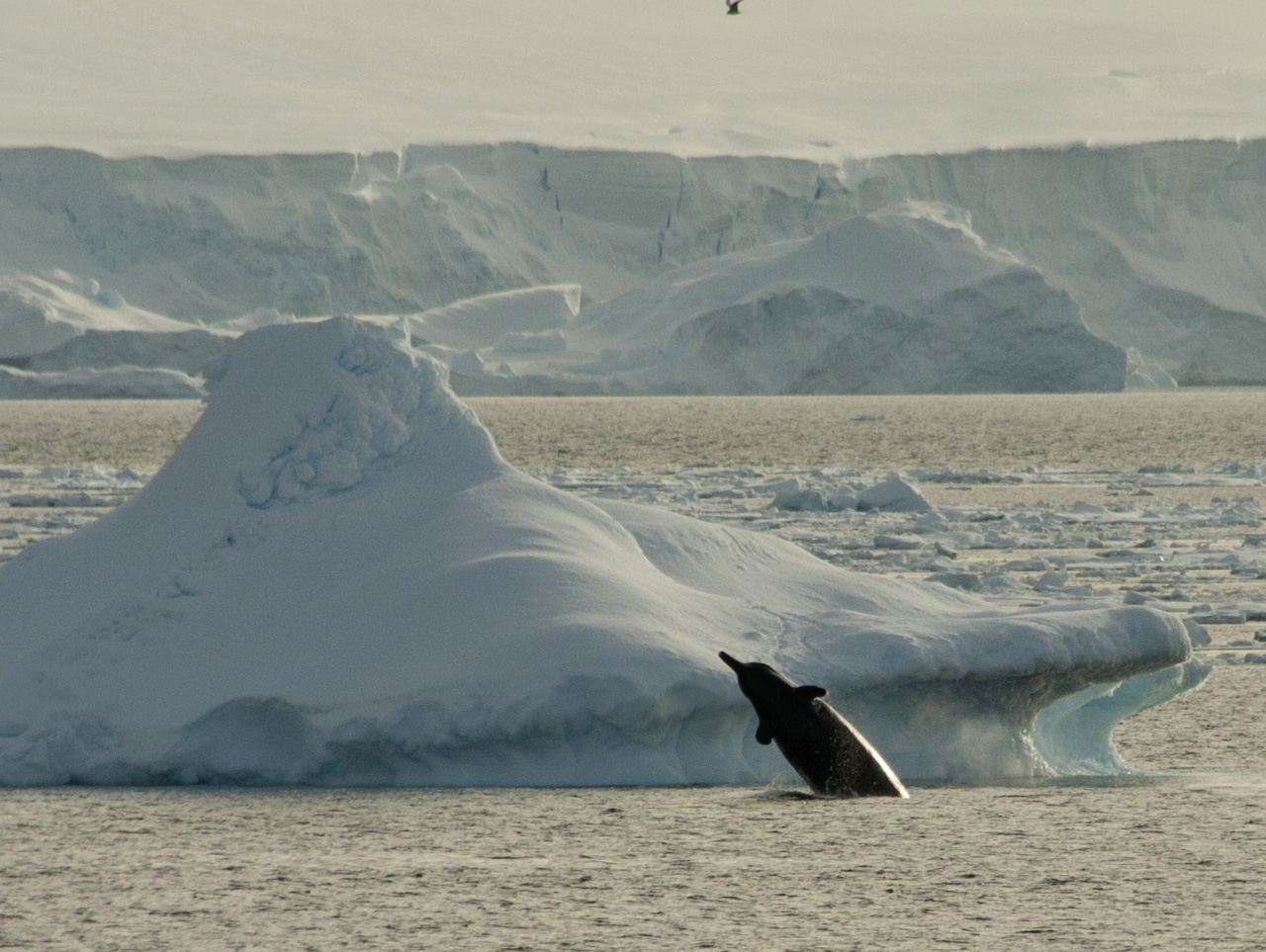


Photos show the species, not always the places on this page.
Length
About 9 to 10 m (30 to 33 ft); another source gives 8 to 12 m (26 to 39 ft). Newborns are about 4 m (13 ft)
Weight
About 9 tonnes (about 20,000 lb), from one source. Other sources give no weight
Next to a person
About five to six times as long as an adult is tall, and as heavy as roughly 100 adults
What it eats
Deep-sea squid and some fish. Prey found include the squid Batoteuthis skolops, Moroteuthopsis longimana and Galiteuthis glacialis. They probably catch prey by suction, since they have no functional gripping teeth.
Around people
Rare, give space
How it lives
Arnoux's beaked whales are social. They are usually in groups of 5 to 10, and larger groups of up to about 50, and temporarily up to 80, have been recorded. They dive as a group for 10 to 45 minutes, occasionally up to 70 minutes, and can stay down for up to an hour. Killer whales are thought to prey on them.
Where it goes
Arnoux's beaked whales live all around the Southern Hemisphere, from the Antarctic ice edge (about 78 degrees south) north to about 34 degrees south. Most sightings are south of 40 degrees south, and strandings are concentrated near New Zealand. Seasonal movements are not described in the sources read.
We only draw a journey on the map when scientists have tracked it or clearly documented it. For this animal we have not found one yet.
Populations
Southern Hemisphere, all around the pole. There are no population numbers, and NOAA has no stock report for it. The IUCN lists it as Least Concern (2021). It is on CITES Appendix I. Sources say it has rarely been hunted, and no specific threats are described.
Meet it respectfully
Arnoux's beaked whales can approach vessels, but let the whale choose the distance. Keep your boat slow, quiet and well back, and never chase, touch, feed or bait one. Rules differ by place and I did not read any specific rules for Antarctica or New Zealand waters, so follow your guide and local rules. A sighting is never guaranteed.
Fun fact
Tap the bulb to light it up.
It is the second-largest beaked whale.
Temporary gatherings of up to 80 whales have been recorded.
It looks almost the same as Baird's beaked whale, but the two live in different oceans.
Arnoux's beaked whale in the Ocean Atlas
Places we have researched where this animal is recorded. It is never guaranteed, and some places are for watching from the boat only.
Travel with usComing soonTrusted referralExploringOn pause, story onlyEthics pass
Country colour: pink where we travel, blue where we are exploring or refer, grey for story only.
 Antarctica
 New Zealand
Sources for this page
Facts checked 5 October 2026. Photos: Unsplash licence, or Creative Commons as shown on each photo.
Work in ocean travel?
We are always happy to hear from exceptional local operators, accommodation, conservation organisations and destination experts. If your work fits responsible, small-group ocean travel, we would love to learn more.
Partner with Ocean Calling5-day freediving course in Bali
CHF 1,180