
False catshark
Pseudotriakis microdon
A large, slow shark of the deep sea, almost never met by people, and no sighting is ever a promise.
Least Concern (IUCN) means it is not currently close to being threatened with extinction; FishBase lists the assessment as March 2023.
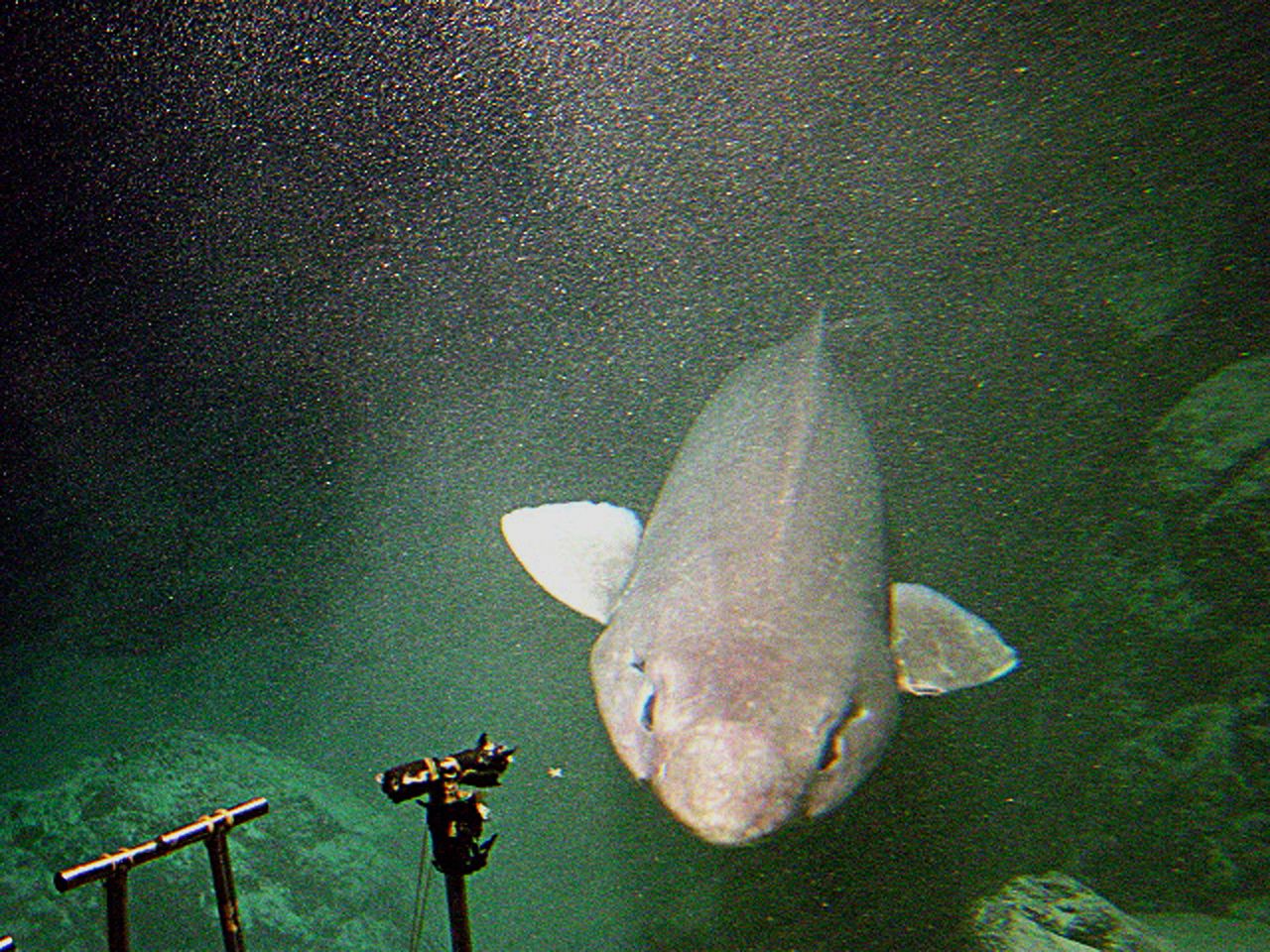

Photos show the species, not always the places on this page.
Length
Females reach about 3 m (9.8 ft) and males about 2.7 m (8.9 ft). The largest recorded is at least 296 cm (9.7 ft)
Weight
Wikipedia reports up to about 330 kg (730 lb); FishBase and Fishes of Australia give no weight
Next to a person
A little shorter than a small car, and at the top of its range as heavy as about four adults
What it eats
Mostly bony fishes, also other sharks, squid, octopus and crustaceans. It may also scavenge.
Around people
Deep, rarely met
How it lives
A slow, sluggish shark. An oil-filled liver of about 18 to 25% of its body weight lets it hover near the seabed with little effort. Females give birth to live young after the embryos feed on yolk, unfertilised eggs and uterine milk. Litters are 2 to 4 pups of about 70 to 140 cm. Pregnancy is probably longer than a year, possibly two to three years. Its lifespan is not known.
Where it goes
Lives near the bottom on deep slopes, seamounts, ridges and deep reefs, from about 100 m to nearly 1,900 m and most often at 500 to 1,400 m. Its day-to-day movements are not well described.
We only draw a journey on the map when scientists have tracked it or clearly documented it. For this animal we have not found one yet.
Populations
IUCN lists it as Least Concern. FishBase gives an assessment date of March 2023, and earlier references cite 2015. It lives in the Atlantic, Indian and Pacific oceans, with most records from the Northern Hemisphere. I found no population estimate. Pitcairn Islands: in 2012, drop cameras at 21 sites between 78 and 1,585 m recorded a false catshark, one of the rare deep species named in the 2014 survey paper. It appeared only in the deepest zone, 800 to 1,600 m.
Meet it respectfully
It lives far below recreational dive depth, so any meeting is most likely to come through research cameras or submersibles. FishBase lists it as harmless. Leave deep-sea sampling, baiting and handling to scientists, and never chase, touch or bait any shark. A sighting is never a promise.
Fun fact
Tap the bulb to light it up.
Its huge, oil-filled liver is about a fifth of its body weight and helps it hover near the seabed.
It has cat-like eyes and a long first dorsal fin, and it is described as a large, sluggish deepwater shark.
Deep drop cameras around the Pitcairn Islands recorded it as one of the rare species among 57 fish seen.
False catshark in the Ocean Atlas
Places we have researched where this animal is recorded. It is never guaranteed, and some places are for watching from the boat only.
Travel with usComing soonTrusted referralExploringOn pause, story onlyEthics pass
Country colour: pink where we travel, blue where we are exploring or refer, grey for story only.
 Ireland
 Japan
Japan Pitcairn Islands
 Portugal
Sources for this page
- Fishes of Australia, False catshark
- FishBase, Pseudotriakis microdon
- Wikipedia, False catshark, 2026
- Friedlander et al., 2014, PLOS ONE, Marine biodiversity in the Pitcairn Islands
- Friedlander et al., 2014, PMC full text
Facts checked 5 October 2026. Photos: Unsplash licence, or Creative Commons as shown on each photo.
Work in ocean travel?
We are always happy to hear from exceptional local operators, accommodation, conservation organisations and destination experts. If your work fits responsible, small-group ocean travel, we would love to learn more.
Partner with Ocean CallingNot sure where to go? Get your Ocean Match
from CHF 19