
Giant Australian cuttlefish
Ascarosepion apama
A cuttlefish that changes colour and pattern as it moves over the reef. Every sighting is a gift of timing and conditions, never a promise.
Near Threatened (IUCN, 2009) means it is close to qualifying as threatened. The Upper Spencer Gulf breeding count fell sharply in 2026, which makes the species a close watch for recovery.
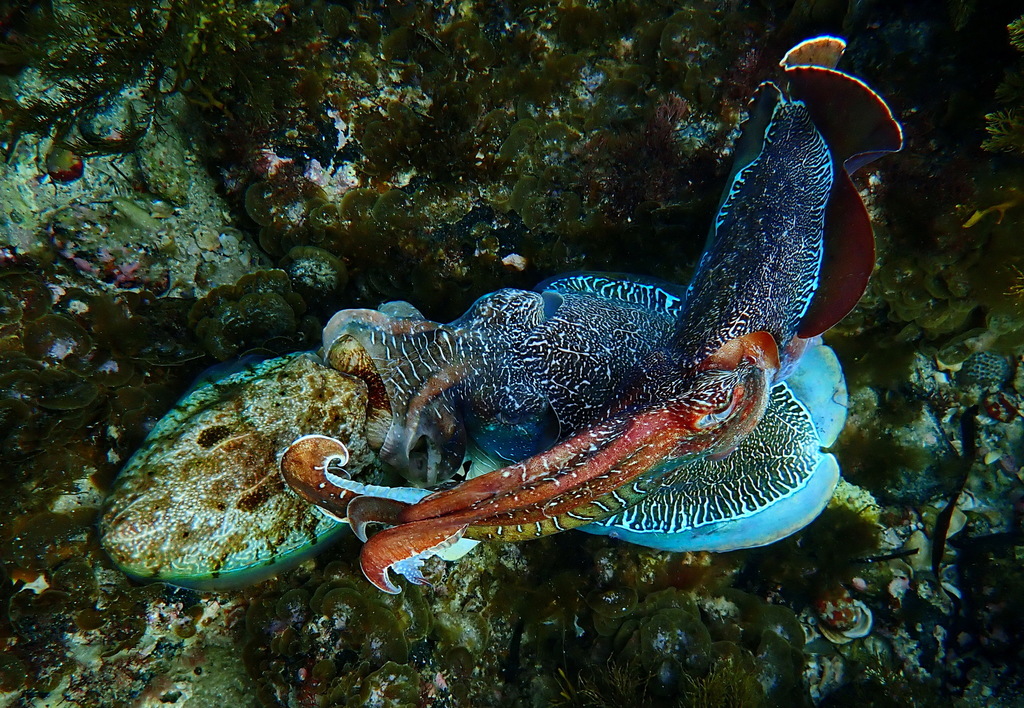
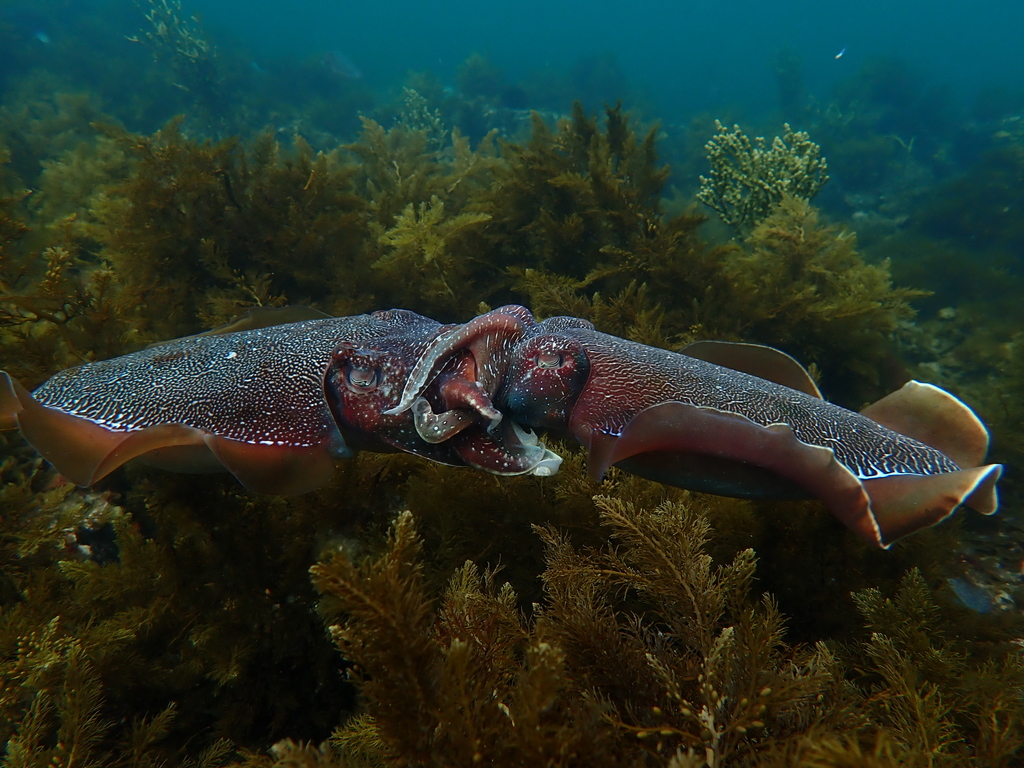
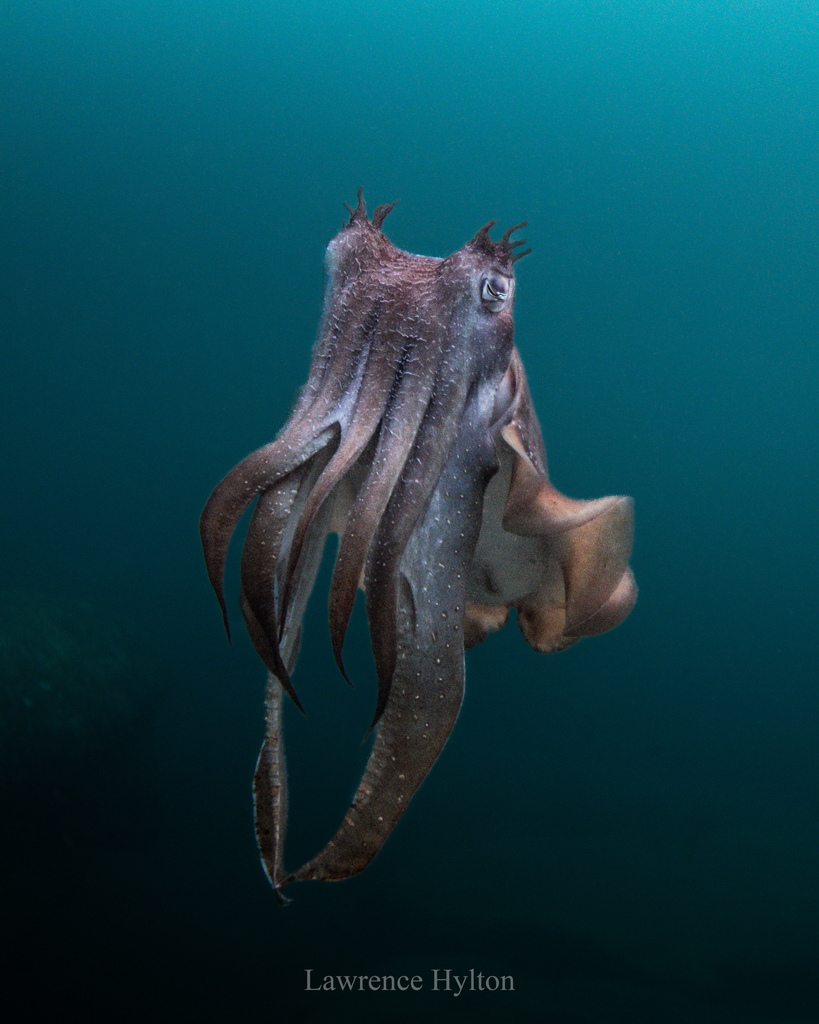
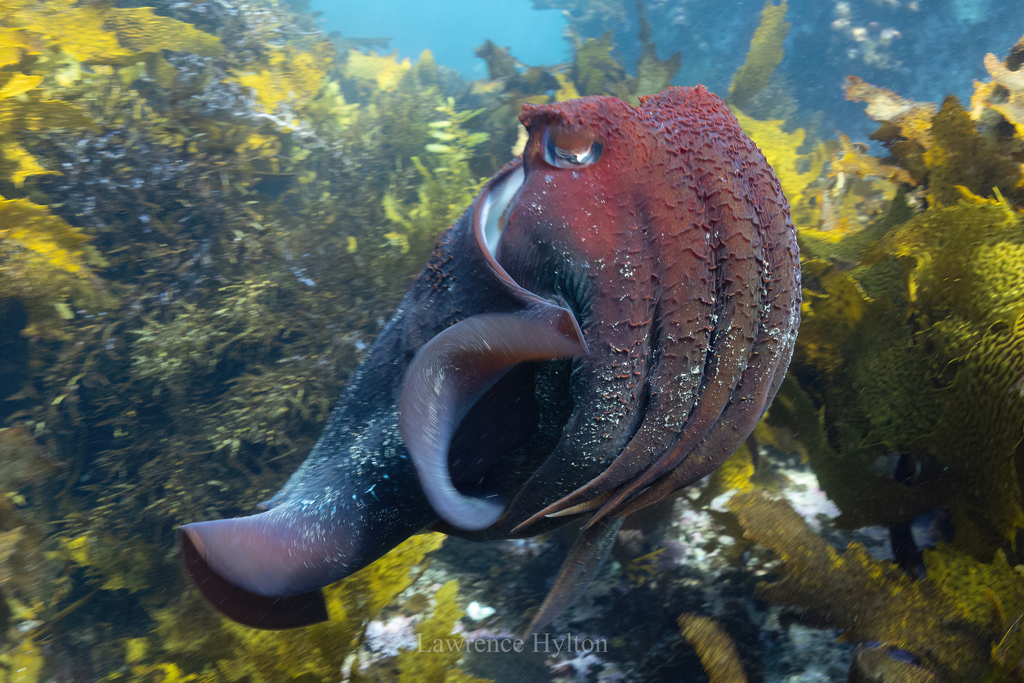
Photos show the species, not always the places on this page.
Length
Up to about 100 cm (39 in) in total length with the arms and tentacles out; mantle up to about 50 cm (20 in)
Weight
More than 10.5 kg (23 lb) in the largest animals
Next to a person
About a metre long with its arms out, and at the top end as heavy as a large dog
What it eats
Live prey. It hunts mainly crustaceans such as crabs and also fish. As an obligate carnivore, it needs live food.
Around people
Calm, give space
How it lives
Giant Australian cuttlefish live about one to two years. They breed once, in the southern winter, and then die. Females lay eggs under rocks and in caves or crevices, and the eggs hatch after about three to five months. Adults usually gather in small groups to mate, but at Point Lowly they form one very large aggregation each winter, from about May to August.
Where it goes
Giant Australian cuttlefish live on rocky reef, seagrass and sand in temperate southern Australian water, to about 100 m deep. They are not known for long migrations, but they gather in winter to breed. At Point Lowly in the Upper Spencer Gulf, adults meet on a shallow reef along about 8 km of coast. After the eggs hatch in spring, the young spend summer and autumn growing in deeper water.
We only draw a journey on the map when scientists have tracked it or clearly documented it. For this animal we have not found one yet.
Populations
In the Upper Spencer Gulf, South Australia, divers count the breeding aggregation each year. Counts ranged from about 13,500 in 2013 to about 247,000 in 2020, and 63,000 in 2025. In 2026 the count was 1,811, the lowest on record and a fall of about 97 percent. Only 440 eggs were found along the 8 km of coast. A harmful algal bloom is the main suspected cause and is being investigated. Scientists note that the population recovered within two years after 2013. The IUCN listed the species as Near Threatened in 2009. I did not read comparable counts for other parts of its range, from Queensland to Western Australia and Tasmania.
Meet it respectfully
Be quiet and slow, keep your distance and never touch the animals or their eggs. Do not chase, feed or crowd cuttlefish while they mate or lay eggs. The South Australian Government introduced a 90-day exclusion zone from 1 July 2026 at the Upper Spencer Gulf breeding site, banning swimming, snorkelling, diving and anchoring. It also bans harvesting cuttlefish in the northern Spencer Gulf, with penalties of up to 20,000 Australian dollars. Rules can change, so check the current status before you plan anything, and follow your guide.
Fun fact
Tap the bulb to light it up.
It is described as the world's largest cuttlefish species and is found only in southern Australia.
At Point Lowly, a single large mating aggregation forms along about 8 km of shallow reef.
All adults die after breeding, so each year's population depends on the success of the previous winter.
Giant Australian cuttlefish in the Ocean Atlas
Places we have researched where this animal is recorded. It is never guaranteed, and some places are for watching from the boat only.
Travel with usComing soonTrusted referralExploringOn pause, story onlyEthics pass
Country colour: pink where we travel, blue where we are exploring or refer, grey for story only.
 Australia
 New Zealand
Sources for this page
- Wikipedia, Australian giant cuttlefish
- GBIF, IUCN Red List category (Near Threatened)
- SeaLifeBase, Sepia apama
- Government of South Australia, Department for Environment and Water, 2026
- ABC News, 2026
- Phys.org, 2026
Facts checked 5 October 2026. Photos: Unsplash licence, or Creative Commons as shown on each photo.
Work in ocean travel?
We are always happy to hear from exceptional local operators, accommodation, conservation organisations and destination experts. If your work fits responsible, small-group ocean travel, we would love to learn more.
Partner with Ocean CallingNot sure where to go? Get your Ocean Match
from CHF 19