
Giant Pacific octopus
Enteroctopus dofleini
A patient animal that lives in its den and shows itself on its own terms. No sighting is ever a promise.
Least Concern (IUCN, 2014) means it is not currently considered at risk of extinction. The size of the North Pacific population is unknown.
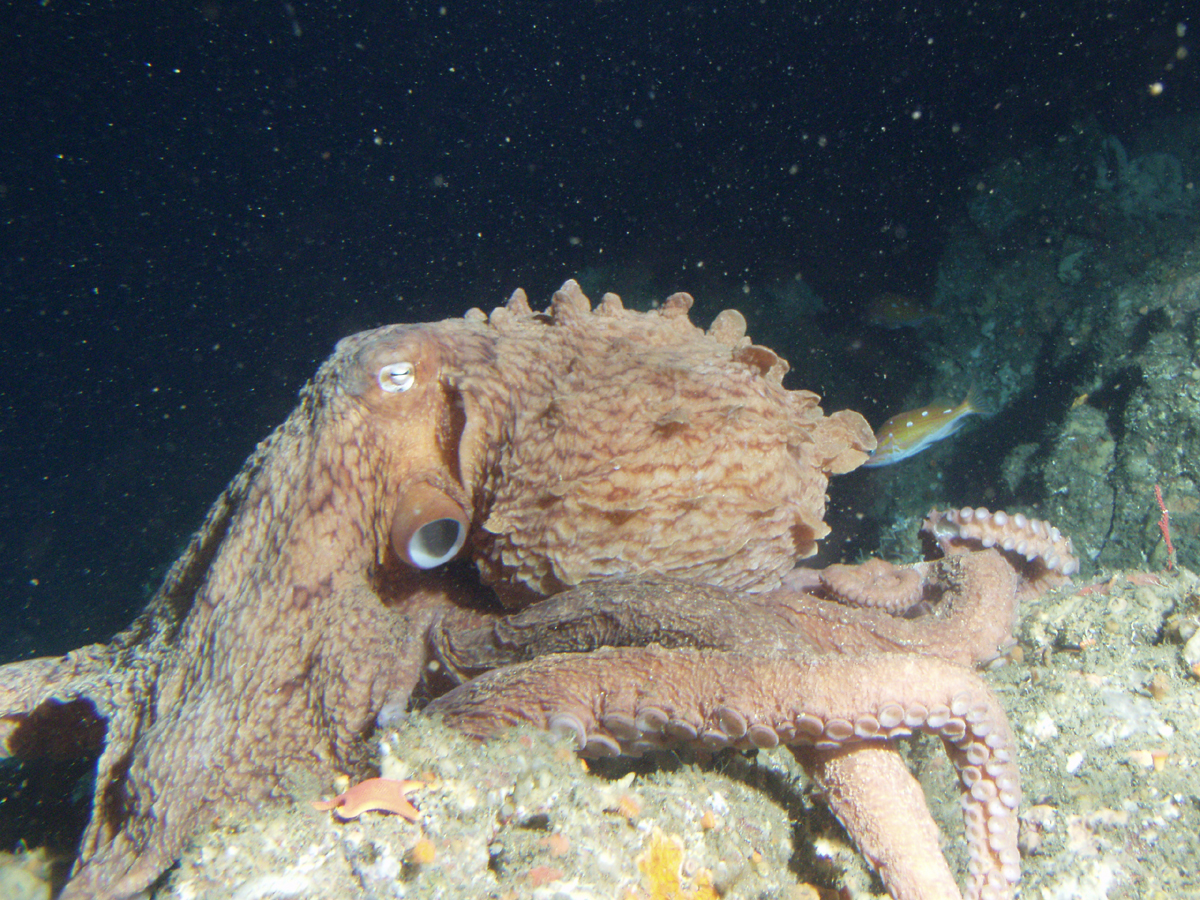


Photos show the species, not always the places on this page.
Length
Arm span usually up to about 4.3 to 4.9 m (14 to 16 ft). Mantle length is about 50 to 60 cm (20 to 24 in). Claims of much larger animals exist but are unverified.
Weight
Sources differ on typical weight, from about 15 kg (33 lb) to about 50 kg (110 lb). A Canadian record of 71 kg (156 lb) is reported. Figures up to 272 kg (600 lb) come from unverified accounts.
Next to a person
The arms can span two to three times the height of an adult, and a typical animal weighs between a child and an adult.
What it eats
Crabs, clams, scallops, snails, shrimp, lobsters, fish and squid, and sometimes other octopuses. It stalks prey, uses camouflage, and can inject venom into prey through its saliva. It carries food back to its den and leaves shell remains at the entrance.
Around people
Calm, give space
How it lives
The giant Pacific octopus lives about 3 to 5 years, long for an octopus. It is solitary and lives in dens in caves, rock crevices or under boulders, from the intertidal zone down to about 1,500 m, with a home range of under 5 square km. Each animal breeds once. The male dies within weeks of mating. The female lays thousands of eggs, with counts that differ widely between sources, guards them for about six months without eating, and dies after they hatch. The larvae drift as plankton before settling on the seabed.
Where it goes
No long migration is described in the sources read. Adults keep to a den and a home range of under 5 square km, and larvae drift with the plankton. One source says adults mate in deeper water, beyond about 50 m (164 ft). The range runs from Baja California to Alaska and across to Japan and Korea.
We only draw a journey on the map when scientists have tracked it or clearly documented it. For this animal we have not found one yet.
Populations
Listed as Least Concern by the IUCN (assessed 2014). Alaska notes that the population size across the North Pacific is unknown and that the species is not listed as threatened, though commercial interest and catch have risen, and about 35,000 lb a year is taken as bycatch in Lower Cook Inlet cod fisheries. It has no special status under the IUCN, CITES or US federal law. No population figure for British Columbia was found in the sources read.
Meet it respectfully
Watch from a distance and never reach into a den or pull an octopus out of its hiding place. Do not touch, handle, feed or bait it. Divers have been bitten when they provoked or tried to photograph an octopus, and its saliva can carry venom. A den may hold a female guarding eggs, so leave it undisturbed. Follow local rules and your guide.
Fun fact
Tap the bulb to light it up.
Most octopus species live about a year. The giant Pacific octopus lives three to five years.
A mother guards her eggs for around six months without eating, and dies after they hatch.
In aquariums, giant Pacific octopuses have learned to open jars and solve puzzles.
Giant Pacific octopus in the Ocean Atlas
Places we have researched where this animal is recorded. It is never guaranteed, and some places are for watching from the boat only.
Travel with usComing soonTrusted referralExploringOn pause, story onlyEthics pass
Country colour: pink where we travel, blue where we are exploring or refer, grey for story only.
 Canada
 Japan
Japan Russia
 South Korea
 United States
Sources for this page
- Wikipedia, Giant Pacific octopus
- SeaLifeBase, 2026
- Monterey Bay Aquarium, Giant Pacific octopus
- Alaska Department of Fish and Game, species profile
- SeaDoc Society, Giant Pacific octopus facts
- Animal Diversity Web, University of Michigan
- GBIF, IUCN Red List category
Facts checked 5 October 2026. Photos: Unsplash licence, or Creative Commons as shown on each photo.
Work in ocean travel?
We are always happy to hear from exceptional local operators, accommodation, conservation organisations and destination experts. If your work fits responsible, small-group ocean travel, we would love to learn more.
Partner with Ocean CallingSwim with humpback whales in Moʻorea, September 2027
from CHF 4,500