
Giant sea bass
Stereolepis gigas
A slow, dark shape in the kelp. Giant sea bass are rare and keep their own schedule, and no sighting is ever a promise.
Critically Endangered means it faces an extremely high risk of extinction in the wild. Wikipedia, Monterey Bay Aquarium and UC Santa Barbara date the listing to 1996, and FishBase to 2004; I could not open the IUCN page itself.
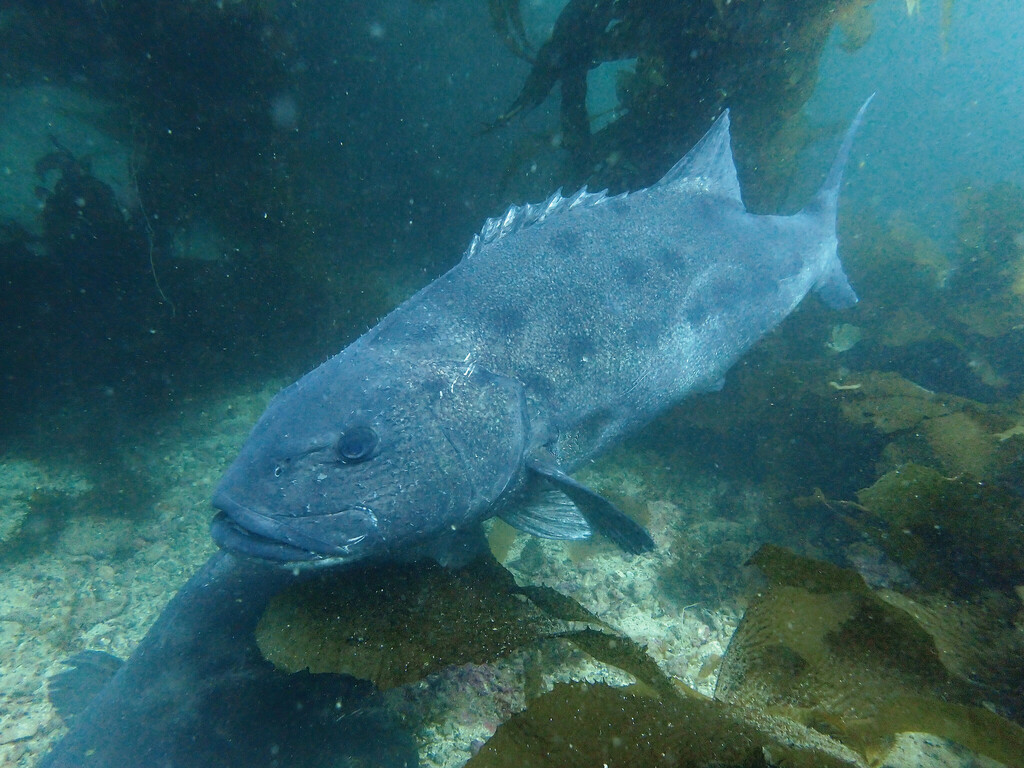
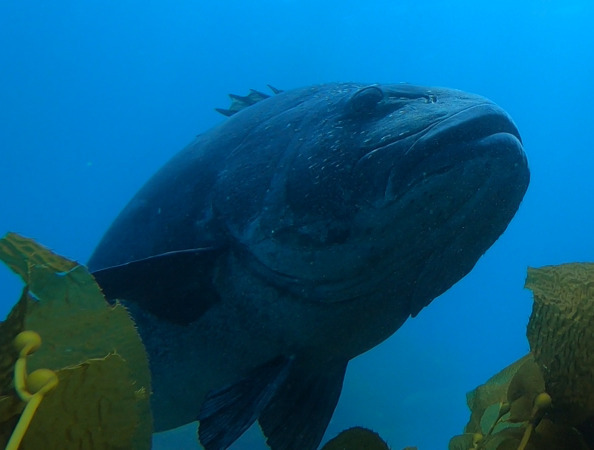
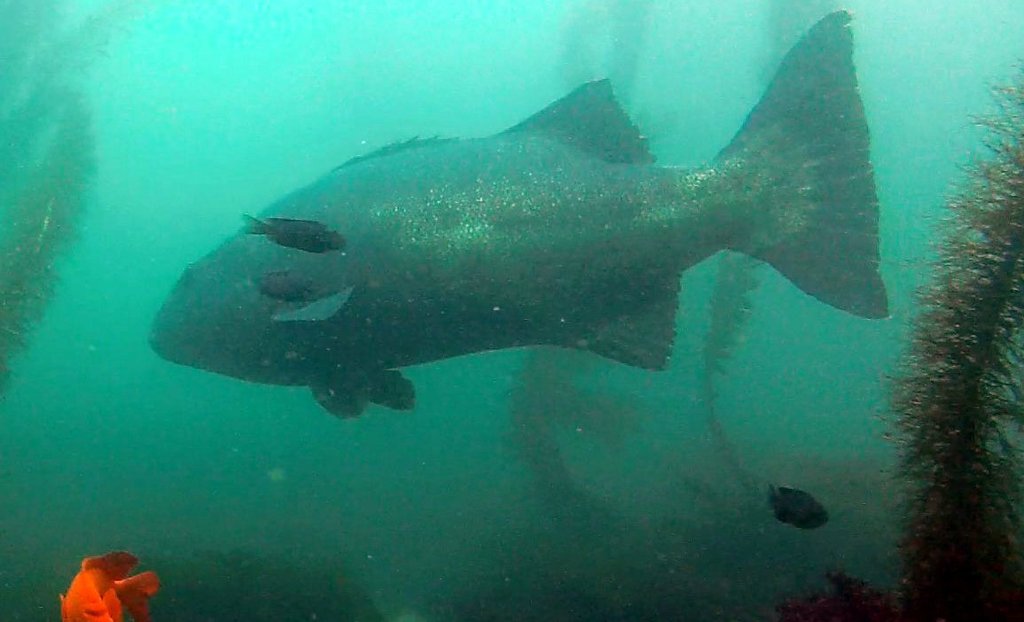
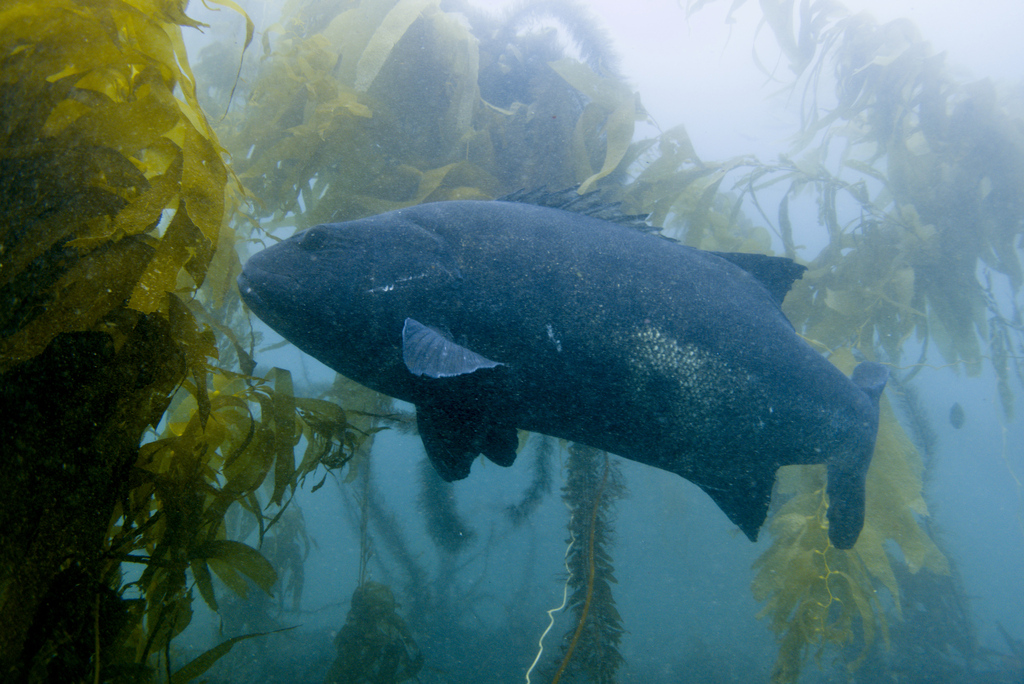
Photos show the species, not always the places on this page.
Length
Maximum reported about 2.3 m (7.5 ft) by Monterey Bay Aquarium; FishBase lists 2.5 m (8.2 ft). Wikipedia notes a measured 2.0 m (6 ft 7 in)
Weight
Up to about 253 to 256 kg (557 to 564 lb) according to Monterey Bay Aquarium and FishBase. Wikipedia says a 435 lb (197 kg) fish was documented in 1971 and that claims of 600 lb are unverified
Next to a person
A large one is about 1.3 times as long as an adult is tall, and can weigh as much as three adults
What it eats
Stingrays, squid, lobster, sardines, white croaker, flatfish and small sharks (Monterey Bay Aquarium). In California, Wikipedia lists anchovies, croaker, mackerel, sheephead and crabs. It is a short-distance sprinter that chases down fast prey.
Around people
Calm, give space
How it lives
Giant sea bass grow slowly. A fish reaches about 30 lb at 6 years and about 100 lb at 10 years, and they mature at about 11 to 13 years (UC Santa Barbara). Scientists have shown they live at least 50 years and some over 70, with the oldest reported around 75 years. They live over rocky reefs, ledges, sand and kelp, often at depths of about 10 to 40 m (35 to 130 ft), with adults usually deeper than about 20 m. In summer, they gather to spawn, and a female can release up to 60 million eggs (Monterey Bay Aquarium).
Where it goes
In a 2023 acoustic tagging study in La Jolla, California, two of five tagged fish stayed in the study area for 2.4 and 3.9 years, while three left after 6 to 9 months, one to a site about 8 km north. Movement was higher in the spawning season (May to October) and in daylight. Fish return to the same spawning sites year after year. Known aggregation sites include Little Harbor and The V's near Santa Catalina Island, plus areas near La Jolla and Anacapa Island.
We only draw a journey on the map when scientists have tracked it or clearly documented it. For this animal we have not found one yet.
Populations
IUCN rates it Critically Endangered. Wikipedia, Monterey Bay Aquarium and UC Santa Barbara all say it has been listed since 1996, while FishBase dates its record to 2004. Between 1932 and 1980, populations fell by roughly 95 to 98 percent (UC Santa Barbara). California banned commercial fishing in the early 1980s and added a gillnet ban in 1994, and Marine Protected Areas now cover some spawning sites. Wikipedia gives an estimate of about 500 individuals in California in 2018, and Monterey Bay Aquarium says breeding females may total only several hundred. Whether the species is recovering remains uncertain. More than half of the range is in Mexican waters, where incidental catch is still allowed (one fish per trip).
Meet it respectfully
Move slowly, keep your distance and let the fish decide whether to stay. Never chase, touch, feed, bait or crowd a giant sea bass, and give extra room at spawning sites in summer, when the fish are most exposed. The sources I read say California bans targeted fishing, and a research paper warns that fish remain at risk of incidental catch during the spawning season. Follow local rules and your guide.
Fun fact
Tap the bulb to light it up.
A female can release up to 60 million eggs in a spawning season.
It grows slowly, taking about 11 to 13 years to mature.
A photo-identification project called Spotting Giant Sea Bass helps researchers recognise individual fish.
Giant sea bass in the Ocean Atlas
Places we have researched where this animal is recorded. It is never guaranteed, and some places are for watching from the boat only.
Travel with usComing soonTrusted referralExploringOn pause, story onlyEthics pass
Country colour: pink where we travel, blue where we are exploring or refer, grey for story only.
 Japan
 Mexico
 United States
Sources for this page
- Wikipedia, 2026
- FishBase, 2026
- Monterey Bay Aquarium, 2026
- UC Santa Barbara, Imagine, 2023
- Blincow et al., PeerJ, 2023
- GBIF, IUCN Red List category, 2026
Facts checked 5 October 2026. Photos: Unsplash licence, or Creative Commons as shown on each photo.
Work in ocean travel?
We are always happy to hear from exceptional local operators, accommodation, conservation organisations and destination experts. If your work fits responsible, small-group ocean travel, we would love to learn more.
Partner with Ocean CallingShop with Ocean Calling
Visit the Ocean Calling storefront on Amazon.
As an Amazon Associate I earn from qualifying purchases. You are not only choosing products that respect the ocean, you are also helping us keep going: paying our local partners fairly and keeping our retreats ethical, sustainable and honestly priced for you. 💗