
Gray's beaked whale
Mesoplodon grayi
A deep-diving whale that spends almost its whole life out of sight. It is rarely seen alive, and no sighting is ever a promise.
Least Concern (IUCN, 2020) means the species is not close to being threatened with extinction. There is no population count, so the assessment rests on limited information.
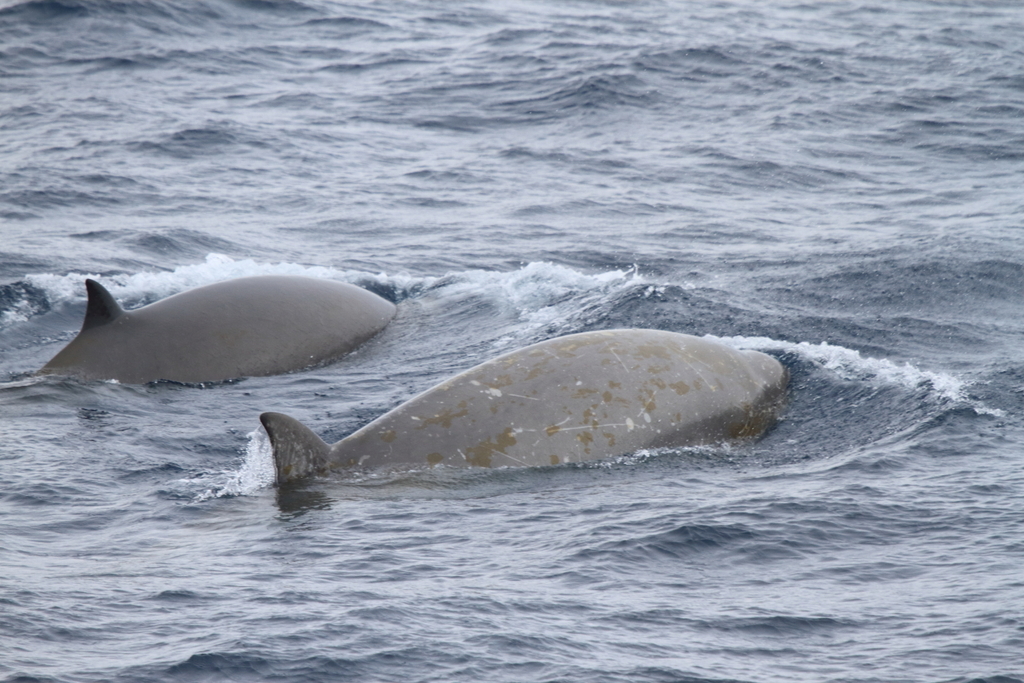
Photos show the species, not always the places on this page.
Length
About 5 to 6 m (16 to 20 ft). One source gives a maximum of 5.6 m (18 ft). Calves are thought to be about 2.1 to 2.2 m (7 ft) at birth.
Weight
About 1,100 kg (2,400 lb). One source gives a much higher figure, so treat weights as approximate.
Next to a person
About three times as long as an adult is tall, and as heavy as about 15 adults
What it eats
Probably a deep-diving suction feeder. Recorded prey include hake-family fish, silver lightfish and lanternfish, and it likely eats some squid. Both sexes have small teeth towards the back of the mouth. Adult males also have two small triangular teeth midway along the mouth.
Around people
Rare, give space
How it lives
Very little is known about its life. It is described as gregarious, with groups of about 4 to 10 reported and bachelor groups recorded. Groups that stranded together in Western Australia and New Zealand were not close relatives, which suggests both sexes disperse from the group they were born into. Records suggest it lives over deep water, around 2,000 m. The sources I read do not give a lifespan.
Where it goes
Gray's beaked whales live in deep water across the Southern Hemisphere, mostly south of about 30 degrees latitude. A genetic study found no separate populations across about 13,000 km, which suggests they range widely. No migration route is known.
We only draw a journey on the map when scientists have tracked it or clearly documented it. For this animal we have not found one yet.
Populations
Nobody has counted them. A genetic study estimated a female effective population size of about 460,000, with very wide uncertainty (20,000 to 2,250,000). That figure is not a head count. The species is believed to be fairly common. It is not known to be deliberately hunted. IUCN lists it as Least Concern (2020).
Meet it respectfully
If you are lucky enough to meet one, expect a brief view at the surface. Keep the boat slow and steady, keep your distance, and never chase, approach or try to touch the animals. If you find a stranded whale on a beach, keep people and dogs back and contact the local wildlife or marine mammal authority.
Fun fact
Tap the bulb to light it up.
Most records come from animals found stranded on beaches. Live sightings at sea are rare.
Adult males have two small triangular teeth about midway along the mouth.
One stranding record involved 28 whales at once.
Gray's beaked whale in the Ocean Atlas
Places we have researched where this animal is recorded. It is never guaranteed, and some places are for watching from the boat only.
Travel with usComing soonTrusted referralExploringOn pause, story onlyEthics pass
Country colour: pink where we travel, blue where we are exploring or refer, grey for story only.
 Argentina
 Australia
 New Zealand
Sources for this page
- Wikipedia, Gray's beaked whale
- SeaLifeBase, Mesoplodon grayi
- Animal Diversity Web, University of Michigan
- Ocean-wide genomic variation in Gray's beaked whales, 2021
- New Zealand Department of Conservation, Whales
- GBIF, IUCN Red List category, 2026
Facts checked 5 October 2026. Photos: Unsplash licence, or Creative Commons as shown on each photo.
Work in ocean travel?
We are always happy to hear from exceptional local operators, accommodation, conservation organisations and destination experts. If your work fits responsible, small-group ocean travel, we would love to learn more.
Partner with Ocean Calling