
Hector's dolphin
Cephalorhynchus hectori
The smallest dolphin, with a rounded fin and a quick way of passing. Whether it appears depends on the day, and no sighting is a promise.
Endangered (IUCN) means it faces a very high risk of extinction in the wild. Set nets, disease and a small, fragmented population are the main threats, and the Māui subspecies is Critically Endangered.
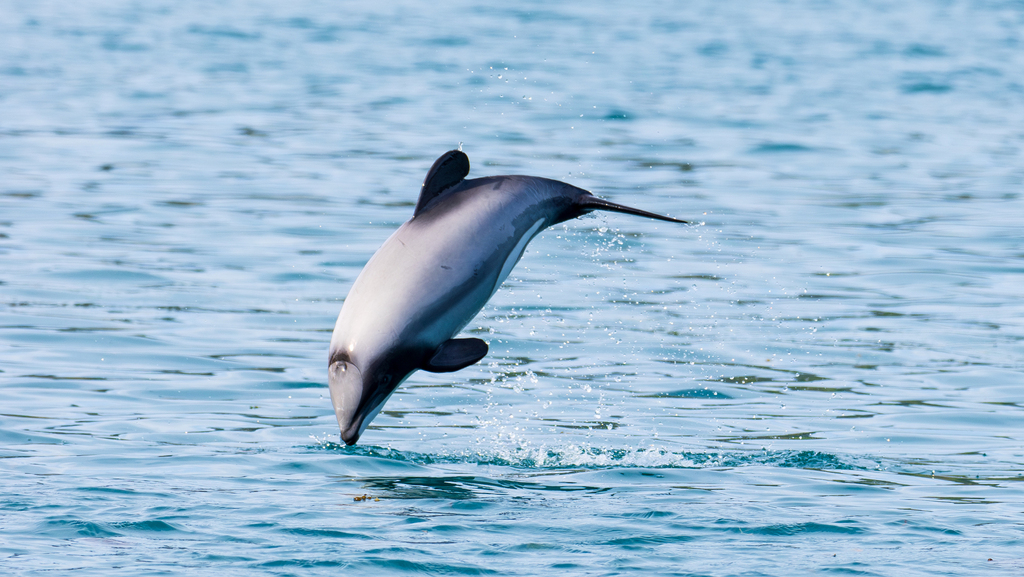
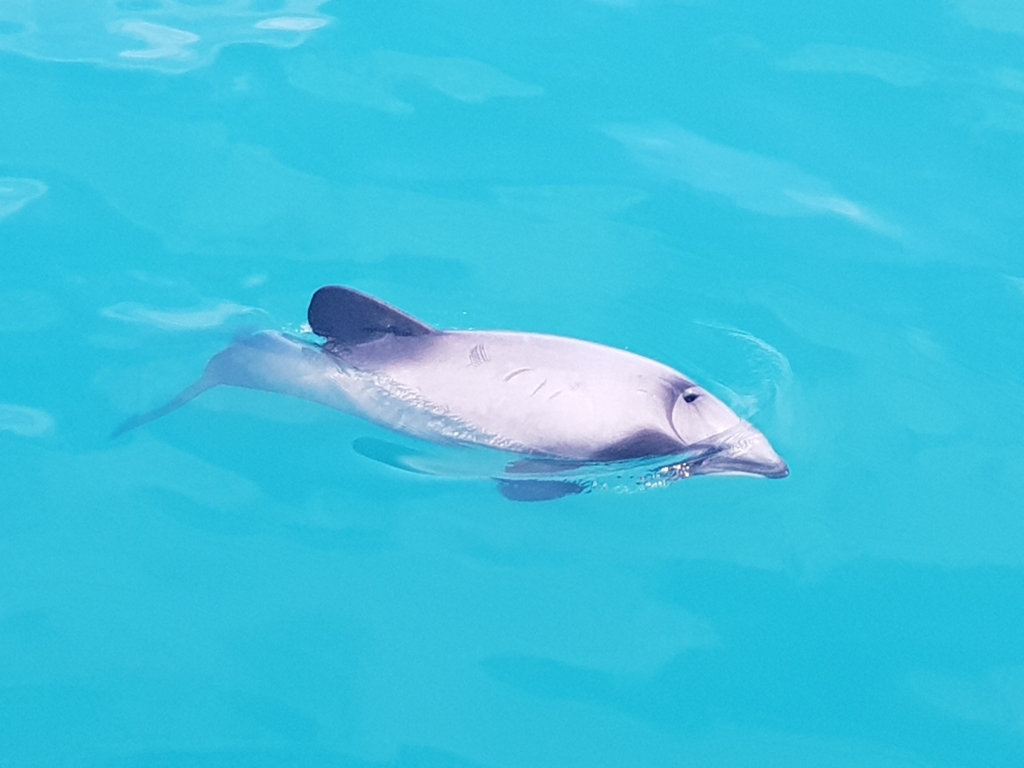
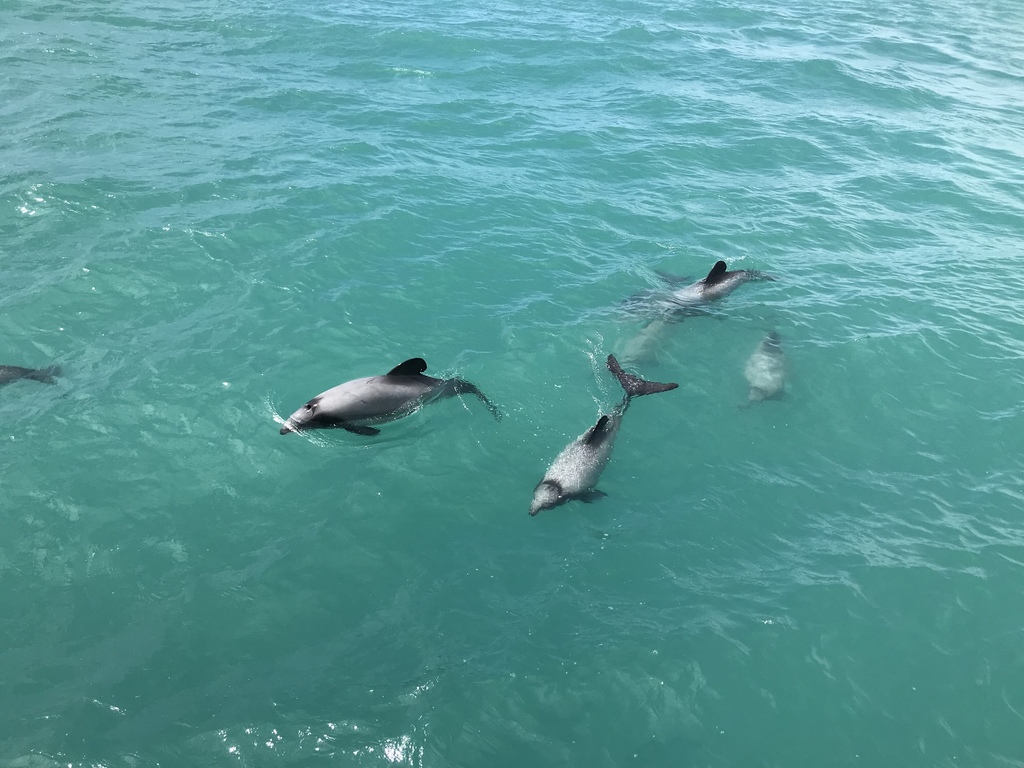
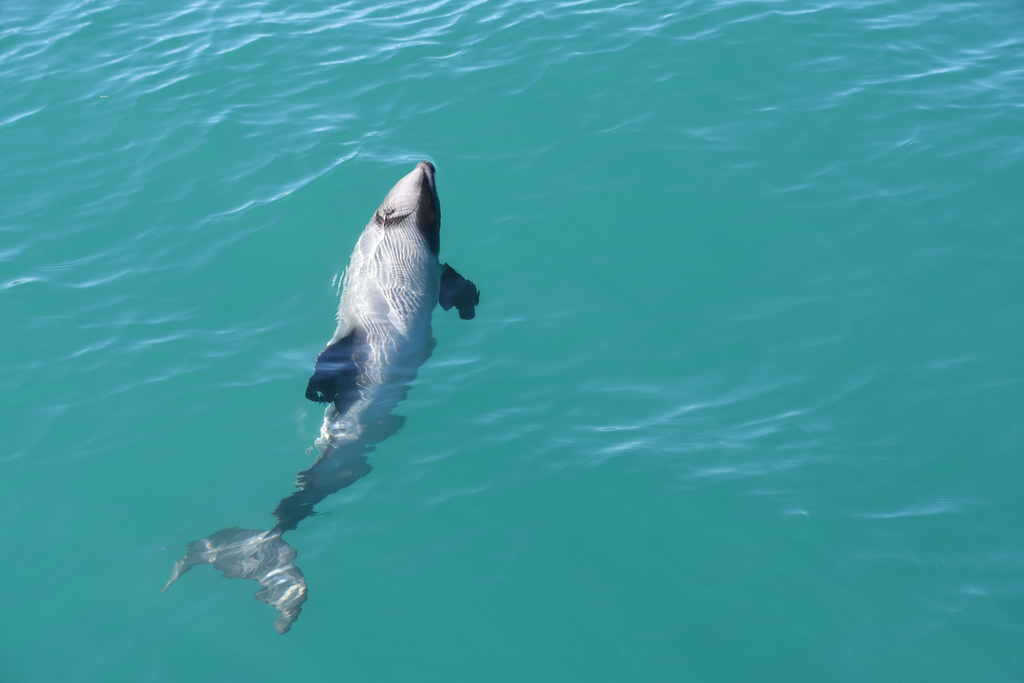
Photos show the species, not always the places on this page.
Length
About 1.2 to 1.6 m (3.9 to 5.2 ft); females are slightly longer than males
Weight
About 40 to 60 kg (88 to 132 lb); the highest published weight is 57 kg (126 lb)
Next to a person
About as long as an adult is tall, and about as heavy as a small adult
What it eats
A generalist that prefers small prey, mostly under 10 cm. Prey includes red cod, flatfish, ahuru, New Zealand sprat and squid.
Around people
Calm, give space
How it lives
Hector's dolphins live about 20 years, and photo-ID studies have followed individuals past 22. Males mature at about 6 to 9 years and females first calve at about 7 to 9. Females have 4 to 7 calves in a lifetime, one every 2 to 3 years, mostly in spring and summer. Newborns are 60 to 80 cm long and weigh 8 to 10 kg. About 36 percent die in their first six months.
Where it goes
Hector's dolphin lives only in New Zealand coastal water, mainly around the South Island, and generally stays in shallow water close to shore. The Māui subspecies lives only off the west coast of the North Island, between Maunganui Bluff and Whanganui, usually in water under 20 m deep. The sources I opened do not give home-range distances.
We only draw a journey on the map when scientists have tracked it or clearly documented it. For this animal we have not found one yet.
Populations
The South Island population was estimated at 14,849 dolphins in 2017 (95 percent range 11,923 to 18,492). The Department of Conservation gives roughly 15,000 dolphins older than one year. The Māui subspecies off the North Island is Critically Endangered. The latest estimate, from 2020 to 2021, is 54 animals aged one year or older (95 percent range 48 to 66), and the true number may now be under 40. Banks Peninsula Marine Mammal Sanctuary was expanded in 2020 to about 14,310 sq km, with gillnet limits out to 4 nautical miles. The species is Endangered on the IUCN Red List and on CITES Appendix II.
Meet it respectfully
Keep a slow, steady speed and let the dolphins come to you. Never chase, touch, feed or swim hard toward them, and keep boats clear of mothers and calves. Fishing nets, disease and a very small genetic pool are the main threats, so avoid anything that adds boat noise or crowding. I did not read the current viewing rules, so follow the rules and guidance of your operator and the Department of Conservation.
Fun fact
Tap the bulb to light it up.
It is the smallest dolphin species and is found only in New Zealand.
Its rounded dorsal fin is said to look like one of Mickey Mouse's ears.
Females have only 4 to 7 calves in a lifetime, so the population recovers slowly from losses.
Hector's dolphin in the Ocean Atlas
Places we have researched where this animal is recorded. It is never guaranteed, and some places are for watching from the boat only.
Travel with usComing soonTrusted referralExploringOn pause, story onlyEthics pass
Country colour: pink where we travel, blue where we are exploring or refer, grey for story only.
 New Zealand
Sources for this page
- Wikipedia, Hector's dolphin
- Wikipedia, Māui dolphin
- New Zealand Department of Conservation, Hector's dolphin
- GBIF, IUCN Red List category (Endangered)
- SeaLifeBase, Cephalorhynchus hectori
- bioRxiv, 2020, Updated population viability analysis for Hector's and Maui dolphin
Facts checked 5 October 2026. Photos: Unsplash licence, or Creative Commons as shown on each photo.
Work in ocean travel?
We are always happy to hear from exceptional local operators, accommodation, conservation organisations and destination experts. If your work fits responsible, small-group ocean travel, we would love to learn more.
Partner with Ocean Calling7-day freediving course in Coron, Palawan
CHF 1,480