
Katuali (Niue sea krait)
Laticauda schistorhyncha
Found only in Niue, the katuali is a quiet banded sea krait of reefs, intertidal rocks and sea caves. Look, never handle.
Vulnerable (IUCN, 2010) means it is at high risk of extinction in the wild.
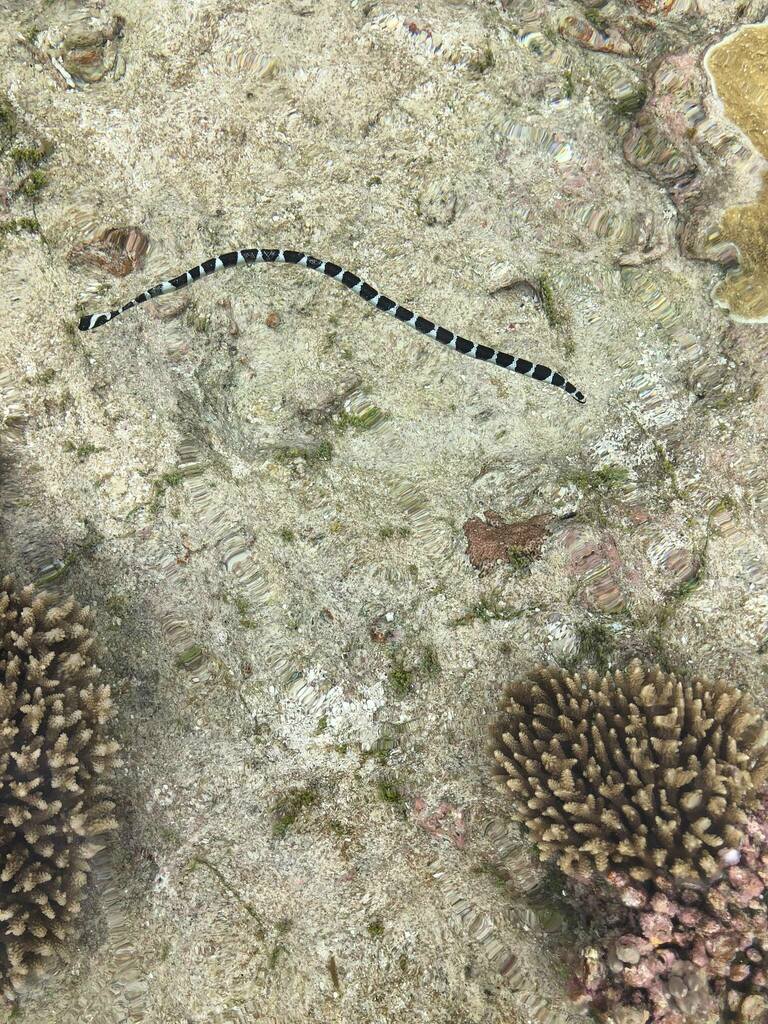
Photos show the species, not always the places on this page.
Length
Adults about 0.77 m (2.5 ft) for males and 0.86 m (2.8 ft) for females, in total length. Some summaries say up to about 1 m (3.3 ft), but this is not confirmed.
Weight
Not reliably measured
Next to a person
Usually less than half as long as an adult is tall
What it eats
Its exact diet is not well studied. Sea kraits in general hunt mostly eels on coral reefs, and they usually come on land to digest.
Around people
Potentially dangerous, respect
How it lives
The katuali lives only in Niue. It spends most of its adult life in the sea and has a flat, paddle-like tail for swimming. It comes on land to rest, digest, shed its skin, mate and lay eggs. Females lay eggs in dry cracks in sea caves, and the young crawl to the sea after they hatch. It is highly venomous, like all sea kraits, but usually calm unless it is handled.
Where it goes
Resident. It is found only in the waters of Niue, and no movement between islands is known.
We only draw a journey on the map when scientists have tracked it or clearly documented it. For this animal we have not found one yet.
Populations
This species lives in one small island nation only, so its whole world range is tiny. It was assessed as Vulnerable by the IUCN, in an assessment published in 2010. In Niue it is reported as common, especially near the intertidal areas on the west side. We did not find a recent population count.
Meet it respectfully
The katuali is highly venomous but usually calm. Snorkel and swim slowly, look without touching, and never handle it, even if it is caught in fishing gear. Never corner a katuali in a cave, crack or rock pool, and do not crowd it when it rests on land. Do not disturb the dry cave cracks where females may lay eggs. In Niue it is a protected species.
Fun fact
Tap the bulb to light it up.
It lives nowhere else on Earth but Niue.
Its scientific name schistorhyncha means split snout, after a divided scale on the tip of its nose.
Its whole world range is only about 181 km², one of the smallest of any sea krait.
It is a different species from the yellow-lipped and blue-lipped sea kraits, and the blue-lipped sea krait is also found, rarely, in Niue.
All 44 people-made records of the katuali in the GBIF database come from Niue. It lives nowhere else.
Source: GBIF occurrence records
Katuali (Niue sea krait) in the Ocean Atlas
Places we have researched where this animal is recorded. It is never guaranteed, and some places are for watching from the boat only.
Travel with usComing soonTrusted referralExploringOn pause, story onlyEthics pass
Country colour: pink where we travel, blue where we are exploring or refer, grey for story only.
 Niue
NiueSources for this page
- Lane & Guinea, 2010, IUCN Red List assessment
- iNaturalist, Katuali
- Gherghel et al., 2016, ZooKeys
- GBIF occurrence records
- Reptile Database, Laticauda schistorhyncha
- Government of Niue, 2020, Sixth National Report to the CBD
- WoRMS, Laticauda schistorhyncha
Facts checked 26 September 2026. Photos: Unsplash licence, or Creative Commons as shown on each photo.
Work in ocean travel?
We are always happy to hear from exceptional local operators, accommodation, conservation organisations and destination experts. If your work fits responsible, small-group ocean travel, we would love to learn more.
Partner with Ocean Calling7-day freediving course in Coron, Palawan
CHF 1,480