
Nomad jellyfish
Rhopilema nomadica
A pale bell drifting with the current, arriving with the season and the wind. No sighting is ever a promise, and this is an animal to watch from a distance.
Not Evaluated means the IUCN has not assessed this species, so there is no Red List category to report. It is an invasive species in the Mediterranean rather than a threatened one.


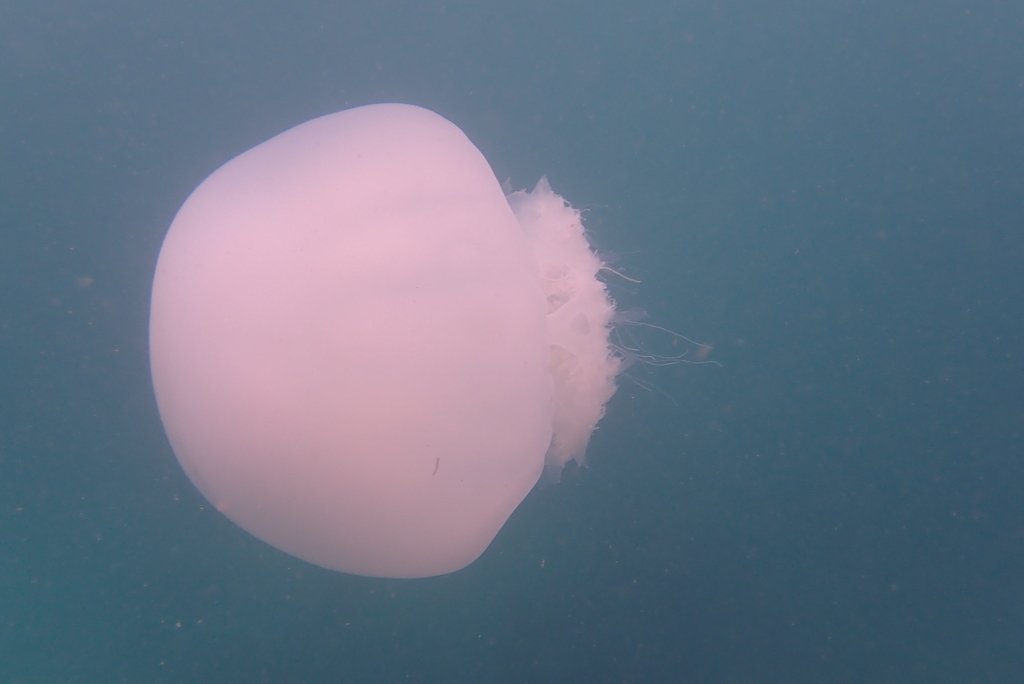
Photos show the species, not always the places on this page.
Length
Bell usually about 30 to 60 cm (12 to 24 in) across; some winter animals are reported up to about 90 cm (35 in). One Cyprus press report says up to 1 m.
Weight
Large adults are reported at up to about 10 kg (22 lb). The sources opened give no fuller weight range, so treat this as an upper figure.
Next to a person
A typical bell is about as wide as a large dustbin lid, and the biggest reported are close to the width of a doorway.
What it eats
Plankton, taken from the water as it drifts. It is described as a plankton feeder; the sources opened do not give a detailed prey list.
Around people
Calm, keep clear
How it lives
It has two body forms. The free-swimming jellyfish reproduces sexually, and a small polyp that lives on the seabed reproduces asexually. Polyps can survive several years and can make cysts that give dense populations within weeks. In lab tests, young jellyfish are released mostly at 20 to 26 C, and release speeds up as Levantine waters warm, around mid-April. The species is recorded in waters of about 16 to 31 C. Summer swarms are common, and winter animals can be larger.
Where it goes
A drifter that goes where the currents carry it. Young jellyfish can travel about 200 to 300 km over 2 to 3 months, and the drift from Egypt to Israeli beaches takes about 55 to 60 days on average. In Cyprus, a local marine biologist quoted in the press said a visit can last from several days to 1 or 2 months, depending on temperature and waves.
We only draw a journey on the map when scientists have tracked it or clearly documented it. For this animal we have not found one yet.
Populations
Not evaluated by the IUCN. It is native to the Indian Ocean; DNA work links Mediterranean animals to ones from Tanzania. The first Mediterranean record was in 1977 off Israel, although a 1938 photo from Haifa port suggests it was there earlier. Large yearly swarms were common on the Israeli coast by the mid-1980s, and it later spread north-west to Turkey, Greece, Malta, Tunisia, Sicily and Sardinia. It is listed among the worst invasive marine species in European seas. In Cyprus, 2024 press reports placed sightings around Protaras and Paralimni and up to the Vasiliko power plant area. No reliable population count was found.
Meet it respectfully
Watch from the surface and keep clear. Never touch it with bare hands, and do not chase, feed or bait it. If a bell is near, swim away calmly. Authorities quoted in the Cyprus press advise rinsing a sting with vinegar or seawater and seeing a doctor if symptoms last or if you have allergies. Swarms are seasonal and unpredictable, so no one can promise to see one.
Fun fact
Tap the bulb to light it up.
The painful sting comes from filaments on the frilly mouth arms, which carry stinging cells.
It entered the Mediterranean from the Indian Ocean, probably through the Suez Canal, and it is called a Lessepsian migrant.
Swarms can block the seawater intakes of power and desalination plants and clog fishing nets.
Nomad jellyfish in the Ocean Atlas
Places we have researched where this animal is recorded. It is never guaranteed, and some places are for watching from the boat only.
Travel with usComing soonTrusted referralExploringOn pause, story onlyEthics pass
Country colour: pink where we travel, blue where we are exploring or refer, grey for story only.
 Cyprus
 Egypt
Egypt France
 Israel
 Lebanon
 Türkiye
Sources for this page
- Wikipedia, Rhopilema nomadica
- SeaLifeBase, Rhopilema nomadica
- Frontiers in Marine Science, 2022
- bioRxiv, 2024, molecular evidence for migration
- Financial Mirror, 2024
- WoRMS, Rhopilema nomadica
- GBIF, IUCN category lookup
Facts checked 5 October 2026. Photos: Unsplash licence, or Creative Commons as shown on each photo.
Work in ocean travel?
We are always happy to hear from exceptional local operators, accommodation, conservation organisations and destination experts. If your work fits responsible, small-group ocean travel, we would love to learn more.
Partner with Ocean CallingNew: mobula rays in La Ventana, May 2027
CHF 2,720