
North Pacific right whale
Eubalaena japonica
A black back with no dorsal fin, breaking the surface of cold northern water. These whales are very rare, and no sighting is ever a promise.
Endangered (IUCN, assessed 2017) means it faces a very high risk of extinction in the wild. The northeast Pacific group is Critically Endangered.
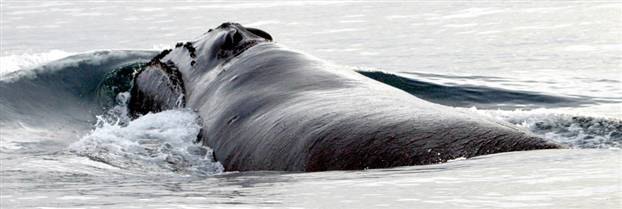
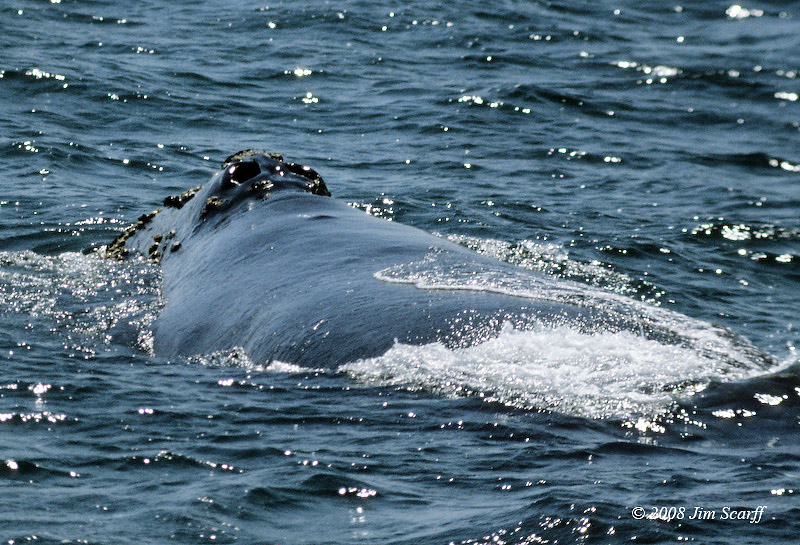

Photos show the species, not always the places on this page.
Length
About 15 to 19 m (49 to 62 ft); NOAA gives 45 to 64 ft (about 14 to 19.5 m)
Weight
Typically 50,000 to 90,000 kg (110,000 to 198,000 lb); NOAA says up to 100 tons without giving the unit
Next to a person
Longer than a city bus and as heavy as many elephants
What it eats
Zooplankton, mainly copepods such as Calanus marshallae, plus krill and other small animals. It skims food by swimming slowly with its mouth open, and needs dense patches of prey to feed well.
Around people
Rare, give space
How it lives
A stocky baleen whale with no dorsal fin, a very large head about a quarter of its body length, and rough patches of skin called callosities. NOAA says it lives at least 70 years. Where it breeds and calves is unknown.
Where it goes
The eastern group is seen in the southeastern Bering Sea in summer and autumn, and the western group feeds in the Sea of Okhotsk and around the Commander and Kuril Islands. No winter ground has been found, and scientists do not know where these whales migrate in winter, breed or give birth.
We only draw a journey on the map when scientists have tracked it or clearly documented it. For this animal we have not found one yet.
Populations
Endangered worldwide (IUCN, assessed 2017); the northeast Pacific group is Critically Endangered. Fewer than 500 whales are thought to remain in the North Pacific, and fewer than 50 in the eastern group, with only about 28 in the Bering Sea (NOAA). The Marine Mammal Commission gives 31 to 50 for the eastern group, and Wikipedia gives over 300 for the western group. Before 1835 there may have been 20,000 to 30,000. It has been listed as Endangered under the US Endangered Species Act since 1970, and is on CITES and CMS Appendix I.
Meet it respectfully
If you are ever near one, keep well back and let the whale set the pace. NOAA guidance on its species page asks vessels to stay at least 100 yards (about 91 m) away and to limit watching to 30 minutes or less. Never chase, touch, feed or bait a whale, and slow down, because ship strikes and fishing gear are major threats. Rules differ by place. Follow local rules and your guide.
Fun fact
Tap the bulb to light it up.
It has no dorsal fin or bump, and a very broad, black back.
It feeds by skimming, swimming slowly with its mouth open through patches of tiny animals.
Scientists still do not know where these whales spend the winter, breed or give birth.
North Pacific right whale in the Ocean Atlas
Places we have researched where this animal is recorded. It is never guaranteed, and some places are for watching from the boat only.
Travel with usComing soonTrusted referralExploringOn pause, story onlyEthics pass
Country colour: pink where we travel, blue where we are exploring or refer, grey for story only.
 Canada
 Japan
Japan North Korea
 Russia
 South Korea
 United States
Sources for this page
- NOAA Fisheries, 2026
- Marine Mammal Commission, 2026
- Wikipedia, North Pacific right whale, 2026
- SeaLifeBase, 2026
- GBIF (IUCN Red List category), 2026
Facts checked 5 October 2026. Photos: Unsplash licence, or Creative Commons as shown on each photo.
Work in ocean travel?
We are always happy to hear from exceptional local operators, accommodation, conservation organisations and destination experts. If your work fits responsible, small-group ocean travel, we would love to learn more.
Partner with Ocean CallingNew: tiger sharks in Fuvahmulah, January or March 2027
from CHF 2,900