
Northern fur seal
Callorhinus ursinus
A dark head, a thick coat and a crowd of pups on a rocky beach. Fur seals come ashore on their own schedule, and no sighting is ever a promise.
Vulnerable (IUCN, assessed 2015) means it faces a high risk of extinction in the wild, and the listing is linked to the fall in pup numbers on the Pribilof Islands.
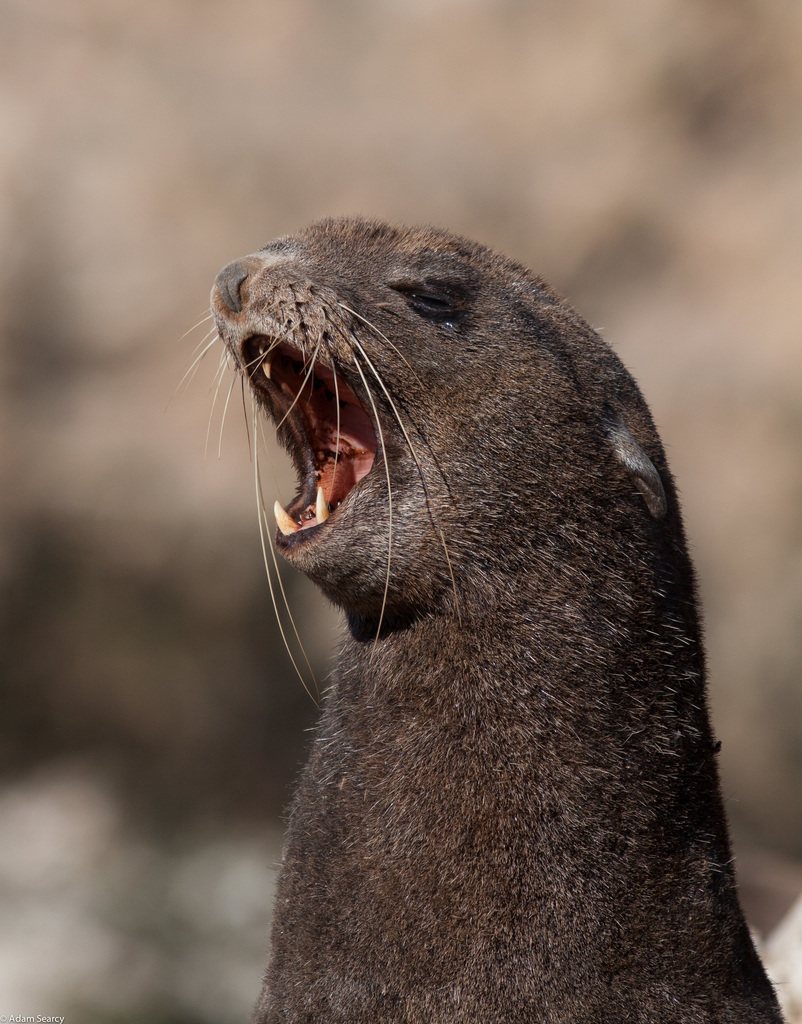
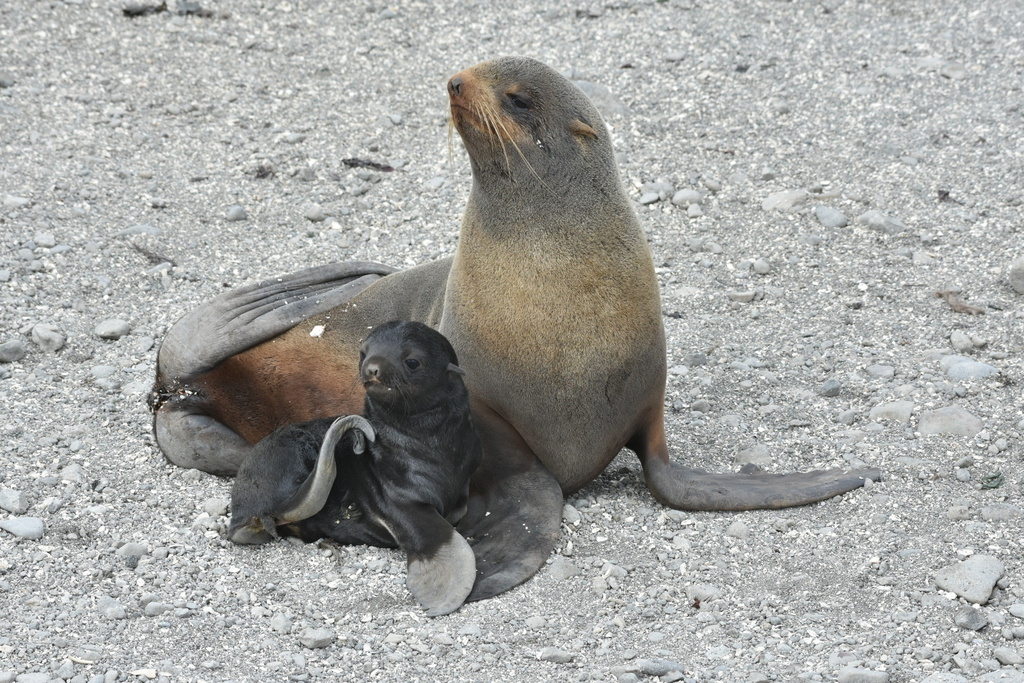
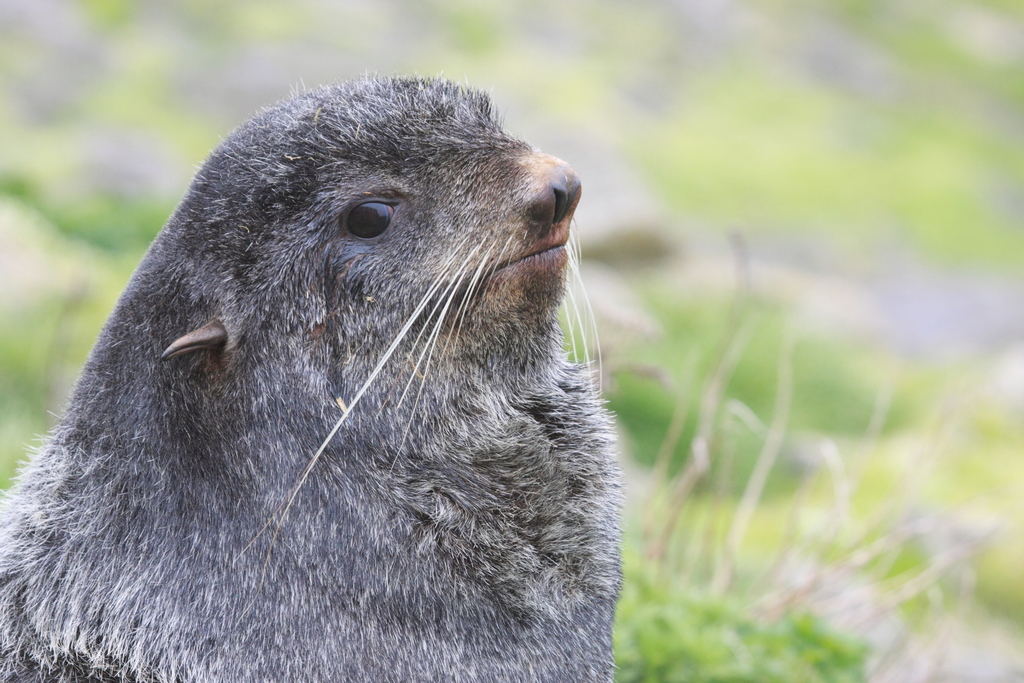
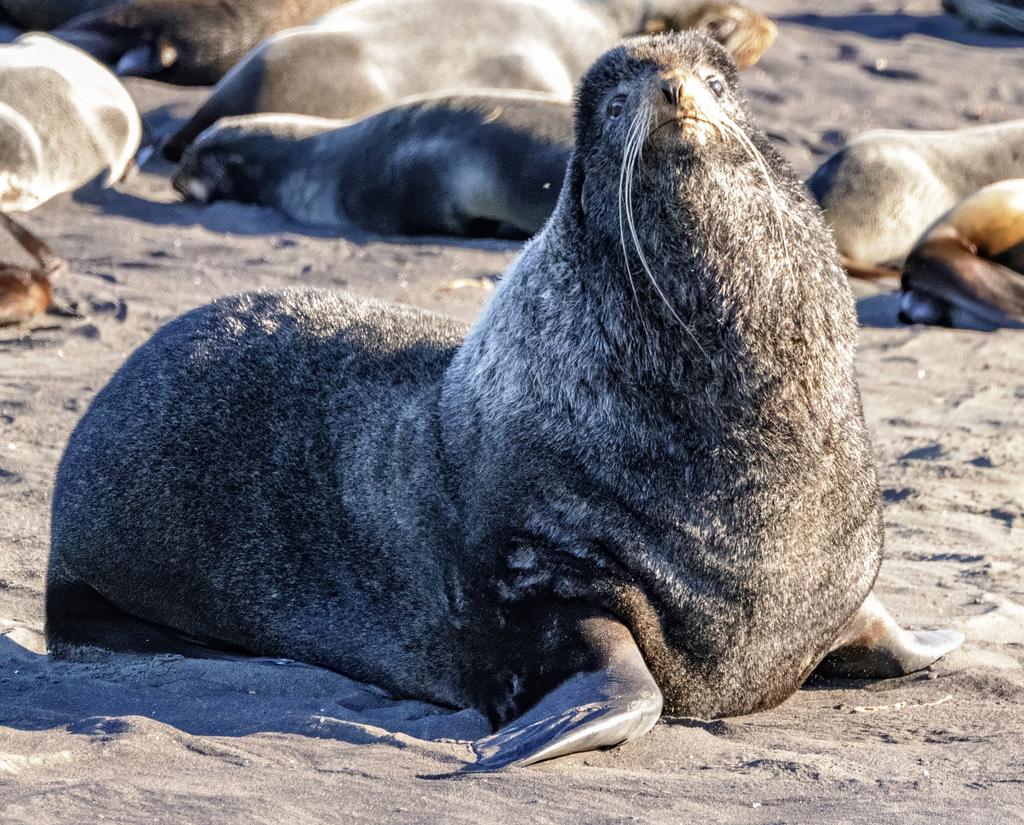
Photos show the species, not always the places on this page.
Length
Males up to about 2.1 m (6 ft 11 in); females up to about 1.5 m (4 ft 11 in)
Weight
Males up to about 270 kg (600 lb); females about 40 to 54 kg (88 to 120 lb). Newborn pups weigh about 5.4 to 6 kg (12 to 13 lb)
Next to a person
A large male is a little longer than a tall adult and as heavy as three or four adults. A female is about as long as a short adult and as heavy as a small adult.
What it eats
Fish and squid, taken as they are available. Walleye pollock is the main prey on the Bering Sea shelf. Other prey includes sand lance, herring, mackerel, sardine, anchovy and squid. One source counts 53 fish and 10 squid species in the diet. They mostly feed alone.
Around people
Calm, give space
How it lives
Northern fur seals breed on crowded island rookeries. Older males arrive first, in May, and hold ground without feeding. Females arrive from about mid-June and give birth a few days later. One male may mate with up to about 50 females. Pregnancy lasts about a year because the fertilised egg pauses for about four months before it implants. Mothers make feeding trips of up to about a week and recognise their own pup by its voice. Pups nurse for 3 to 4 months, and weaning is abrupt, typically in October. In the wild, males live up to about 18 years and females up to about 27.
Where it goes
Northern fur seals spend the summer breeding season on a few island rookeries and most of the rest of the year at sea. In winter the animals move south. Seals from Russian rookeries regularly enter Japanese and Korean waters, and Alaskan animals travel along the eastern Pacific to British Columbia and as far south as Baja California.
We only draw a journey on the map when scientists have tracked it or clearly documented it. For this animal we have not found one yet.
Populations
The species was estimated at about 1.1 million animals, with roughly half breeding on the Pribilof Islands. NOAA reports the Eastern Pacific stock at 626,618 seals (2019) and the California stock at about 15,018 (2022). Pup production on the Pribilof Islands was the lowest in 100 years in 2016, and that stock has been listed as depleted under the US Marine Mammal Protection Act since 1988. In Russia, about 20 percent of the world population breeds on four rookeries on the Commander Islands, two on Bering Island and two on Medny Island, and one source gives 200,000 to 250,000 animals there. Other breeding groups are about 100,000 on Tyuleniy Island and 60,000 to 70,000 in the central Kuril Islands. I did not find a Russia-wide trend in the pages I read. The IUCN lists the species as Vulnerable (assessed 2015).
Meet it respectfully
Watch from a distance and keep your voice low. Fur seal rookeries are crowded, and males guard their females closely, so never walk toward a harem. Pups gather in groups on the beach while their mothers feed at sea, so do not approach or handle a pup, which is not necessarily abandoned. Never chase, touch, feed or bait a seal, and give seals in the water room too. In US waters NOAA asks people to watch seals from at least 50 yards (about 46 m). I did not read the rules for the Commander Islands or Russian reserves, so follow your guide and local rules.
Fun fact
Tap the bulb to light it up.
Males are 30 to 40 percent longer than females and more than four times heavier.
A fertilised egg waits about four months before it implants, so a pup born this summer comes from last summer's mating.
The 1911 North Pacific Fur Seal Convention was the first international treaty to address wildlife conservation.
Northern fur seal in the Ocean Atlas
Places we have researched where this animal is recorded. It is never guaranteed, and some places are for watching from the boat only.
Travel with usComing soonTrusted referralExploringOn pause, story onlyEthics pass
Country colour: pink where we travel, blue where we are exploring or refer, grey for story only.
 Canada
 Japan
Japan Russia
 United States
Sources for this page
- NOAA Fisheries, Northern fur seal, 2026
- NOAA Fisheries, Northern fur seal research in Alaska, 2026
- Animal Diversity Web, University of Michigan, Northern fur seal
- Wikipedia, Northern fur seal, 2026
- Wikipedia, Commander Islands, 2026
- Seabird Youth Network, Northern fur seals on the Commander Islands
- GBIF Backbone with IUCN Red List category, 2026
Facts checked 5 October 2026. Photos: Unsplash licence, or Creative Commons as shown on each photo.
Work in ocean travel?
We are always happy to hear from exceptional local operators, accommodation, conservation organisations and destination experts. If your work fits responsible, small-group ocean travel, we would love to learn more.
Partner with Ocean Calling7-day freediving course in Coron, Palawan
CHF 1,480