
Omura's whale
Balaenoptera omurai
A slim grey whale lunging through warm shelf water, seen by few people, and no sighting is ever a promise.
Data Deficient (IUCN, assessment amended 2019) means there is not enough information to judge how close it is to extinction. It is not a sign that the species is safe.


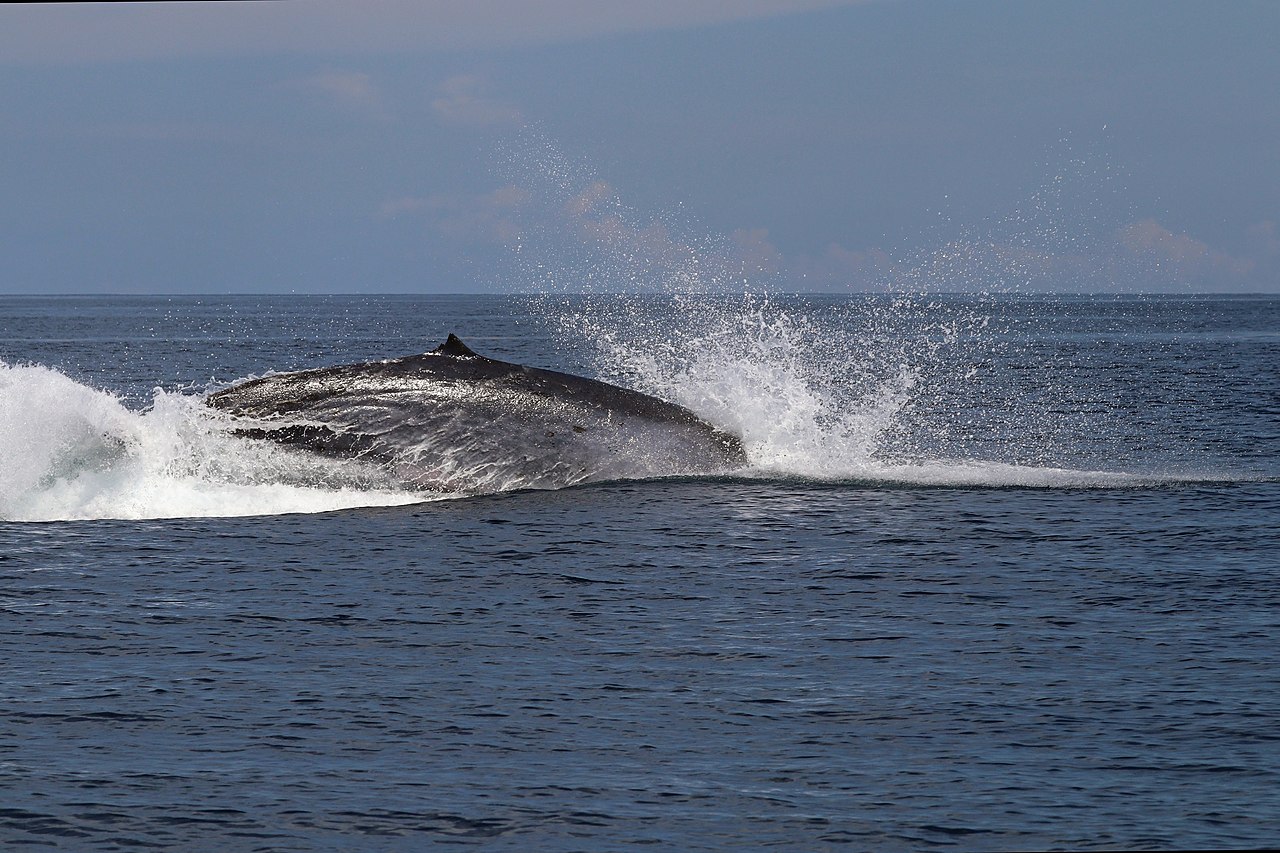
Photos show the species, not always the places on this page.
Length
Adults about 9.6 to 11.5 m (31.5 to 37.7 ft) in the specimens measured; the type specimen was 11.03 m (36.2 ft). Calves are estimated at 3 to 5 m (9.8 to 16.4 ft)
Weight
Not well documented; no reliable weight range was found in the sources read
Next to a person
About six to seven times as long as an adult is tall, a little shorter than a fin whale
What it eats
Krill. Two krill species, Euphausia diomedeae and Pseudeuphausia latifrons, have been named as prey. Lunge feeding was seen in at least half of encounters off Madagascar, and no fish were visible during those observations.
Around people
Rare, give space
How it lives
Omura's whales are usually seen alone, or as mother and calf pairs. In the Madagascar study, 36 of 44 sightings were of single whales and the rest were pairs, mostly mothers with calves. They produce a slow, low song at 15 to 50 Hz, repeated every 2 to 3 minutes. Researchers aged specimens up to 38 years. Calves seen in both August and November suggest a long or year-round calving season.
Where it goes
Off northwest Madagascar, researchers found whales that stayed in shallow shelf waters, and one mother was seen again in later years with a calf. Most sightings there fell in October and November, though local reports suggest they may be present all year. Elsewhere their movements are not well known.
We only draw a journey on the map when scientists have tracked it or clearly documented it. For this animal we have not found one yet.
Populations
There is no reliable global population estimate. The IUCN lists the species as Data Deficient, with the assessment amended in 2019. Off northwest Madagascar, 18 to 20 individuals were identified between 2011 and 2014, and all sampled adults shared one mitochondrial haplotype, which may point to a small population. Wider range records reach the tropical Indo-Pacific and Atlantic.
Meet it respectfully
Keep a quiet, steady distance and let the whale decide how close to come. Never chase, surround, touch, feed or bait it, and never place a boat in its path. Give extra room to mothers and calves. Shallow shelf water brings Omura's whales close to fishing nets and boat traffic, so slow, predictable boat handling matters. Follow your guide and local rules, and expect many outings to pass without a sighting.
Fun fact
Tap the bulb to light it up.
It was described as a new species only in 2003, and it was not studied alive at sea until the 2010s.
Its lower jaw is darker on the left side and white on the right, an asymmetry shared with some other rorquals.
It has a single ridge along the top of its snout, while Bryde's whale has three.
Omura's whale in the Ocean Atlas
Places we have researched where this animal is recorded. It is never guaranteed, and some places are for watching from the boat only.
Travel with usComing soonTrusted referralExploringOn pause, story onlyEthics pass
Country colour: pink where we travel, blue where we are exploring or refer, grey for story only.
 Indonesia
 Madagascar
 New Caledonia
 Solomon Islands
 Taiwan
 Vietnam
Sources for this page
- Wikipedia, Omura's whale, 2026
- CMS, Balaenoptera omurai species page, 2026
- Cerchio et al., 2015, Royal Society Open Science (PMC)
Facts checked 5 October 2026. Photos: Unsplash licence, or Creative Commons as shown on each photo.
Work in ocean travel?
We are always happy to hear from exceptional local operators, accommodation, conservation organisations and destination experts. If your work fits responsible, small-group ocean travel, we would love to learn more.
Partner with Ocean CallingSwim with humpback whales in Moʻorea, September 2027
from CHF 4,500