
Round stingray
Taeniurops grabatus
A dark, almost circular ray resting under a ledge or half buried in sand. It is often calm, but no sighting is ever a promise.
Near Threatened (IUCN, 2021) means it is close to qualifying as threatened, or may qualify soon. Heavy fishing in parts of its range is the main concern.
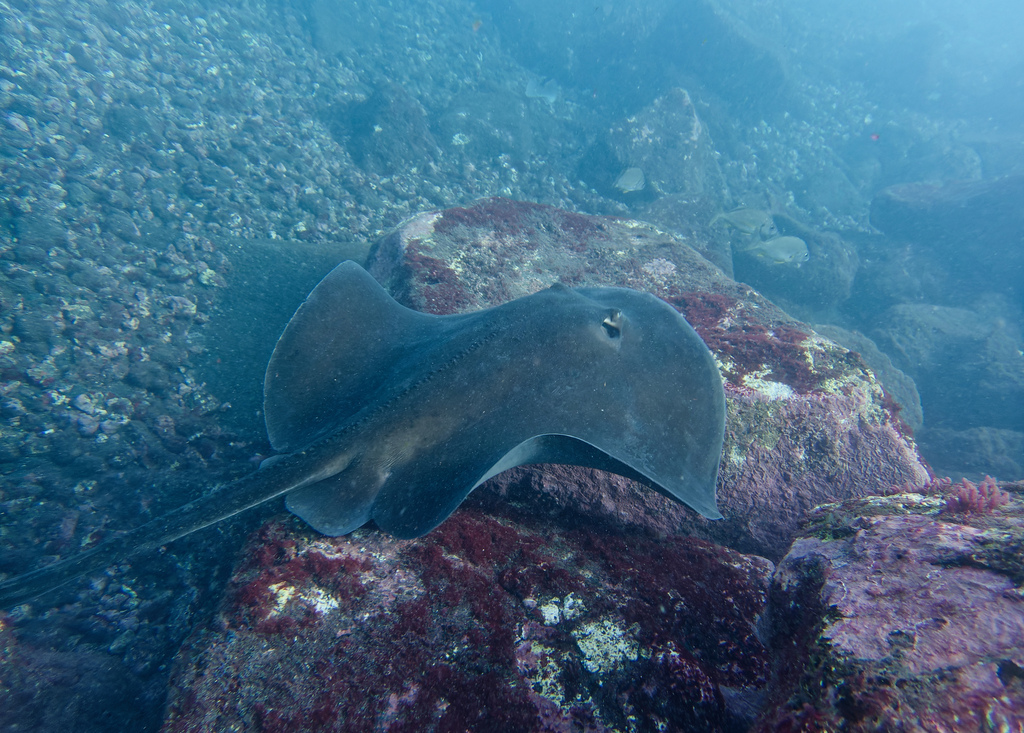
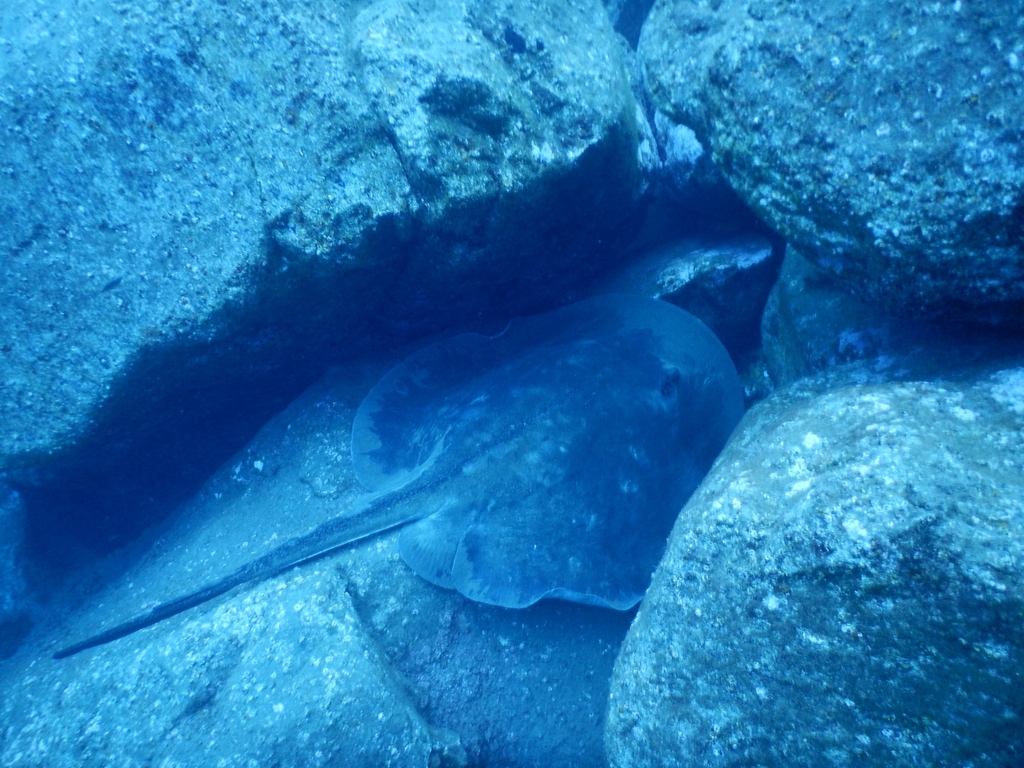
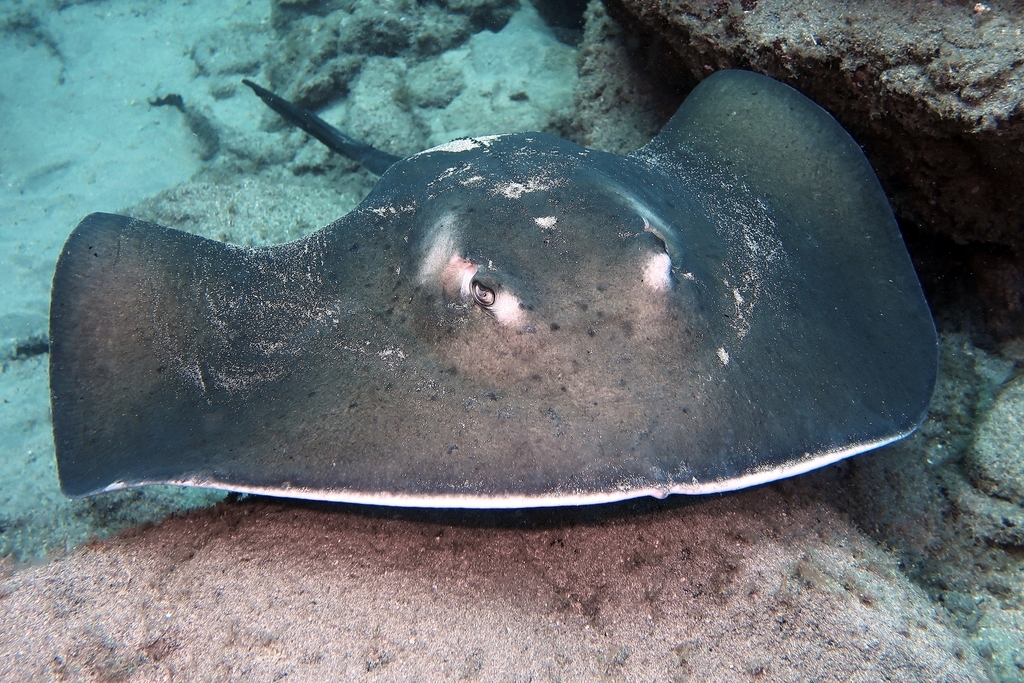
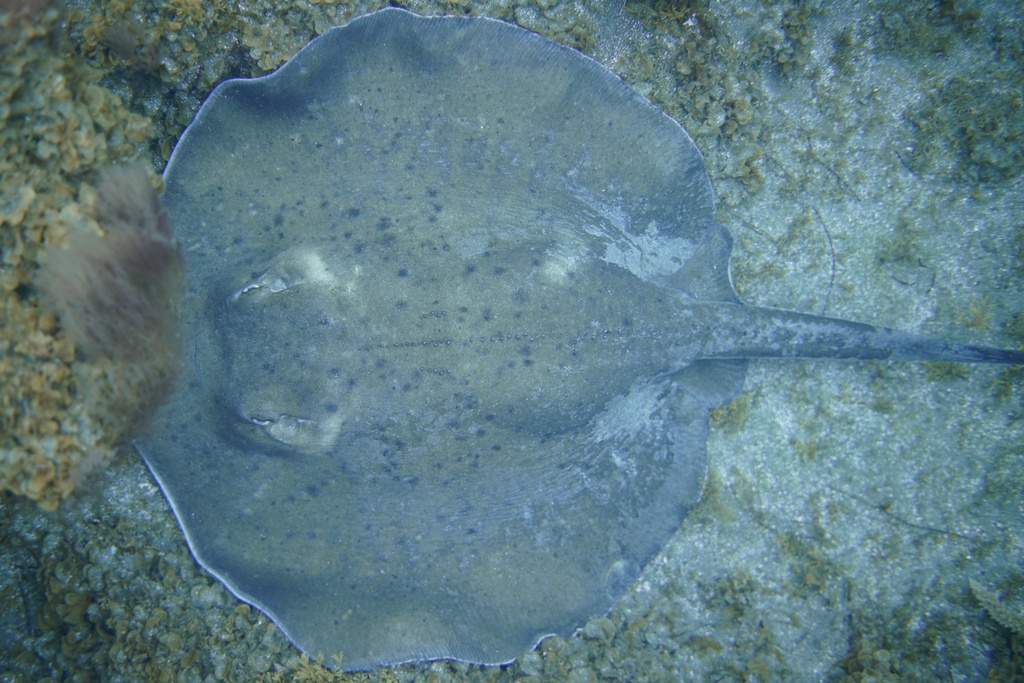
Photos show the species, not always the places on this page.
Length
Disc width typically up to about 1 m (3.3 ft). Total length is typically up to about 1.5 m (4.9 ft). Reports of 2.5 m (8.2 ft) exist, but one source thinks these may be misidentifications.
Weight
Up to about 84 kg (185 lb) published by FishBase. Wikipedia gives up to 150 kg (330 lb), so sources differ.
Next to a person
A large adult's disc is about 1 m across, a little over half the height of an adult person.
What it eats
Bottom-living fishes and crustaceans.
Around people
Calm, give space
How it lives
By day it is often found partly buried in sand or sediment, under ledges, or lying in open spaces between reefs. It moves away only if closely disturbed. It lives on sand, mud and rock-sand on the coastal shelf, from about 10 to 300 m. Young are born live: the embryos are fed first by yolk, then by the mother through special uterine structures. Litter size is not known. Cleaner shrimp have been recorded removing parasites from it.
Where it goes
Described as sedentary, resting under ledges and in caves by day. The sources I read do not describe longer movements.
We only draw a journey on the map when scientists have tracked it or clearly documented it. For this animal we have not found one yet.
Populations
Near Threatened (IUCN, 2021), with no population trend given. It occurs in the eastern Atlantic from Mauritania to Angola, including the Canary Islands, Madeira and Cape Verde, and in the southern Mediterranean from Tunisia to Egypt. It is caught in bottom trawls and trammel nets and eaten in some regions, though it remains common in some places. No specific data on how fishing affects its numbers were found.
Meet it respectfully
This ray is usually docile, but it has a venomous spine. Keep your distance, never touch, chase, feed or bait it, and do not hover over a resting animal or corner it in a cave. Look before you put hands or knees on sand, where it may be buried. I did not read local rules for this species, so follow your guide and local regulations.
Fun fact
Tap the bulb to light it up.
It has venomous tail spines about 50 to 66 mm long with serrated edges, yet it is described as fairly easy to approach and retreats if disturbed.
It is a frequent sight on dives around the Canary Islands.
The name "round stingray" is also used in California for a different, much smaller ray, Urobatis halleri.
Round stingray in the Ocean Atlas
Places we have researched where this animal is recorded. It is never guaranteed, and some places are for watching from the boat only.
Travel with usComing soonTrusted referralExploringOn pause, story onlyEthics pass
Country colour: pink where we travel, blue where we are exploring or refer, grey for story only.
 Cabo Verde
 Côte d'Ivoire
 Ghana
Ghana Israel
 Nigeria
 Senegal
 Spain
SpainSources for this page
- Wikipedia, Round fantail stingray, 2026
- FishBase, Taeniurops grabatus, 2026
- Sharks and Rays, Round stingray, 2026
- Elasmodiver, Round stingray, 2026
- Wikipedia, Round stingray (Urobatis halleri), 2026
- GBIF, IUCN category lookup, 2026
Facts checked 5 October 2026. Photos: Unsplash licence, or Creative Commons as shown on each photo.
Work in ocean travel?
We are always happy to hear from exceptional local operators, accommodation, conservation organisations and destination experts. If your work fits responsible, small-group ocean travel, we would love to learn more.
Partner with Ocean Calling7-day freediving course in Coron, Palawan
CHF 1,480