
Shepherd's beaked whale
Tasmacetus shepherdi
One of the least-known whales on Earth, with only a handful of confirmed sightings at sea. No sighting is ever a promise.
Data Deficient (IUCN, 2018) means there is not enough information to judge its risk of extinction.

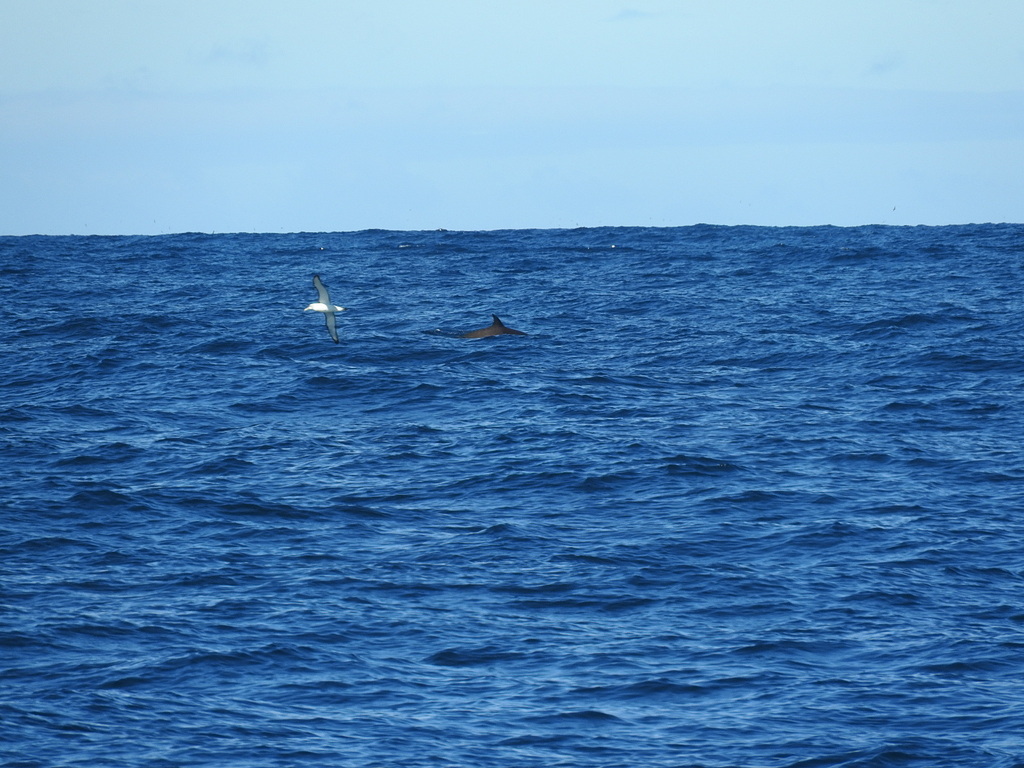
Photos show the species, not always the places on this page.
Length
About 6 to 7.1 m (20 to 23 ft); calves are about 3 m (10 ft) at birth
Weight
About 2.3 to 3.5 tonnes (5,100 to 7,700 lb), from one source. Another source gives no adult mass
Next to a person
About three and a half to four times as long as an adult is tall, and as heavy as roughly 30 to 45 adults
What it eats
Fish and squid, with some bottom-living prey. Stomach contents from stranded whales included Argentine hake, orange roughy, lanternfish and deep-sea squid.
Around people
Very rare, give space
How it lives
Shepherd's beaked whales travel in small groups of about 2 to 14. They are deep divers, making dives of about 5 to 15 minutes to depths below 500 m (1,640 ft). Surface intervals last about 4 to 17 minutes. Nearly all knowledge comes from strandings, mainly in New Zealand and the Chatham Islands.
Where it goes
Shepherd's beaked whale is found in cool temperate waters of the Southern Hemisphere, around New Zealand, Australia, Argentina, Tristan da Cunha and the Juan Fernandez Islands. It was long thought to range between about 33 and 50 degrees south, but a 2024 stranding at Exmouth, Western Australia, at about 21 degrees 48 minutes south, extended the known range northward. No movement or migration pattern is described.
We only draw a journey on the map when scientists have tracked it or clearly documented it. For this animal we have not found one yet.
Populations
Southern Hemisphere, all around the pole in cool temperate waters. There are no population estimates. The IUCN lists it as Data Deficient (2018), which means there is too little information to judge its risk. It is on CITES Appendix II. Plastic debris and longline hooks have been found in the digestive tracts of stranded animals, and other threats named are fishing nets, boat strikes and underwater noise.
Meet it respectfully
Sightings at sea are extremely rare, so any encounter is a privilege. Keep boats slow, quiet and well back, and let the whale move on its own terms. Never chase, approach, touch, feed or bait it. I did not read any local viewing rules for the countries where it occurs, so follow your guide and local regulations. A sighting is never guaranteed.
Fun fact
Tap the bulb to light it up.
It has a full set of functional teeth in both the upper and lower jaws, which is its defining feature.
A 2024 stranding at Exmouth in Western Australia extended its known range about 600 km further north.
It was first described scientifically in 1937.
Shepherd's beaked whale in the Ocean Atlas
Places we have researched where this animal is recorded. It is never guaranteed, and some places are for watching from the boat only.
Travel with usComing soonTrusted referralExploringOn pause, story onlyEthics pass
Country colour: pink where we travel, blue where we are exploring or refer, grey for story only.
 Australia
 New Zealand
Sources for this page
- GBIF (IUCN Red List category), 2026
- Wikipedia, 2026
- Animal Diversity Web, 2026
- Australian Journal of Zoology, northernmost record of Shepherd's beaked whale, 2025
- MarineBio Conservation Society, 2026
Facts checked 5 October 2026. Photos: Unsplash licence, or Creative Commons as shown on each photo.
Work in ocean travel?
We are always happy to hear from exceptional local operators, accommodation, conservation organisations and destination experts. If your work fits responsible, small-group ocean travel, we would love to learn more.
Partner with Ocean CallingGili Trawangan in 5 days
from CHF 790