
Tahiti petrel
Pseudobulweria rostrata
A dark-backed, white-bellied petrel far out over warm Pacific water. It is seldom seen, and no sighting is ever a promise.
Near Threatened (IUCN, 2018) means it is close to qualifying as threatened. Its numbers are suspected to be falling, mainly because of introduced predators and mining, and there is little quantitative data.
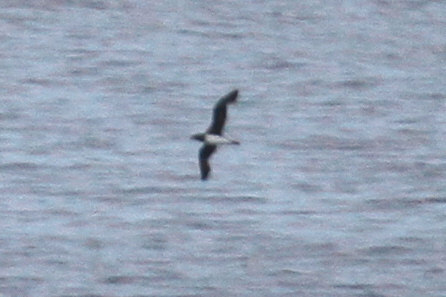
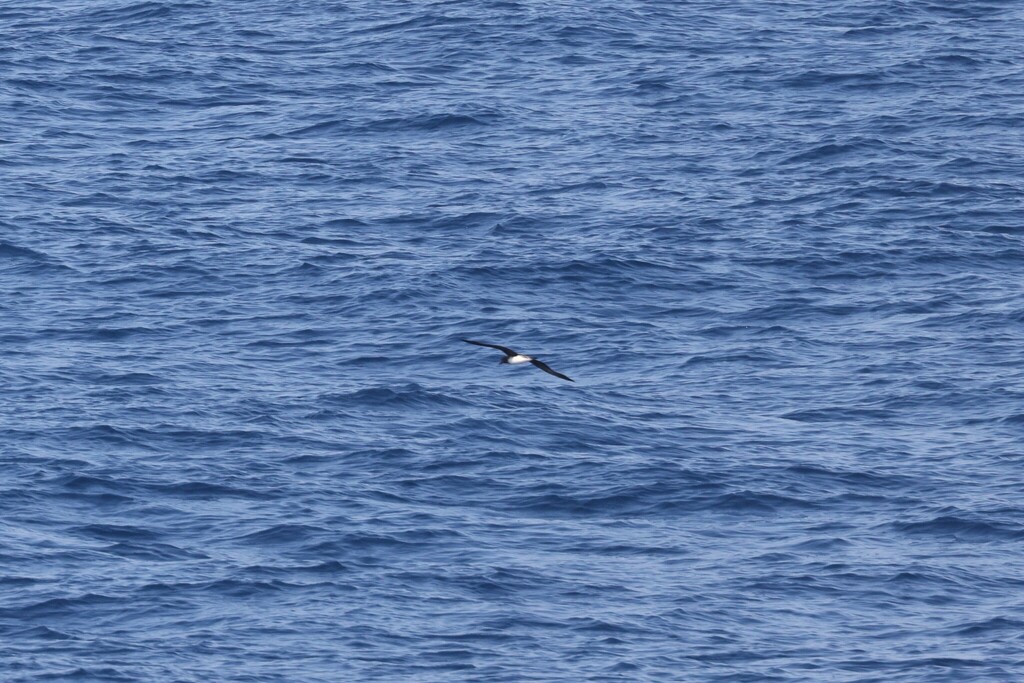
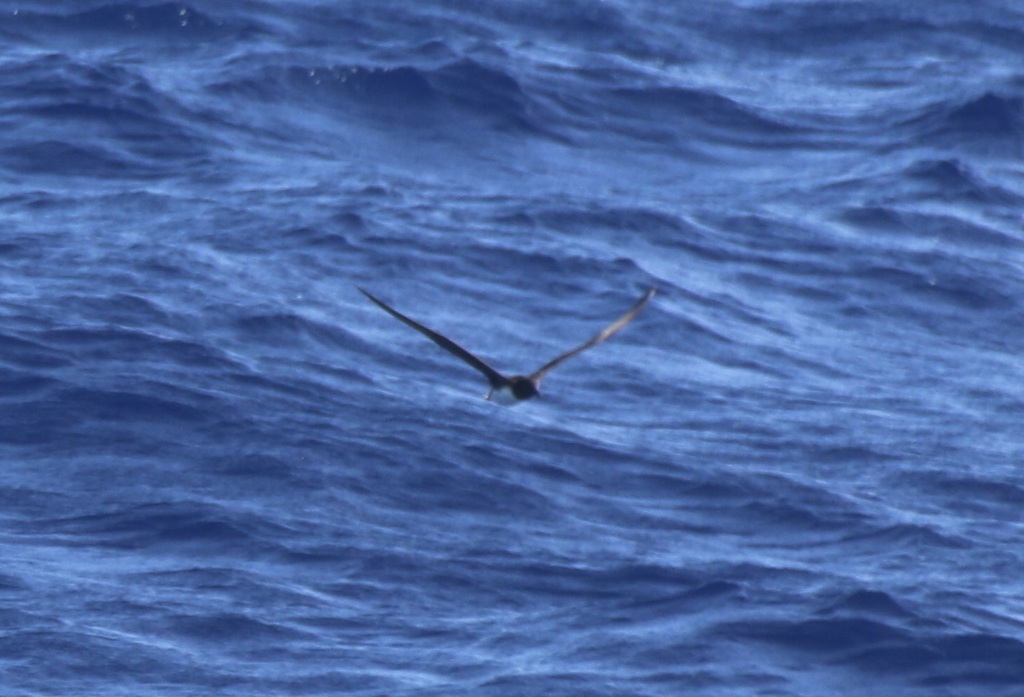
Photos show the species, not always the places on this page.
Length
About 38 to 42 cm (15 to 16.5 in) long, with a wingspan averaging about 104.5 cm (41 in)
Weight
About 315 to 506 g (11 to 18 oz)
Next to a person
A wingspan of about a metre, roughly an adult's hip height. It weighs about as much as two or three apples.
What it eats
It hunts at the surface rather than diving. Its diet includes deep-sea fish, squid and fish from near the seabed, such as hatchetfish and snake mackerels. This suggests it may scavenge, or feed on prey that rises toward the surface at night.
Around people
Distant, watch quietly
How it lives
It nests in deep burrows and rock crevices, often high in the mountains, up to about 1,900 m by one source. In New Caledonia, breeding goes on through the year rather than in a single season. Incubation takes about 55 days and raising the chick about 120 days. In one New Caledonia study only 32% of nesting attempts succeeded. Birds nest on a few Pacific islands.
Where it goes
Tahiti petrels spend most of their lives over the open Pacific and come to land only to breed. They prefer warm surface water above about 25 C. Outside breeding they range widely, and the non-breeding range includes Australia, Guam and Micronesia. Vagrants have been recorded in Central and South America, Asia and Oceania.
We only draw a journey on the map when scientists have tracked it or clearly documented it. For this animal we have not found one yet.
Populations
Near Threatened (IUCN, 2018), with a suspected decline and few hard numbers. The world population is put at 10,000 to 20,000 breeding birds, or about 20,000 to 30,000 in total. Two subspecies are recognised: one nests in American Samoa, the Gambier, Marquesas and Society Islands, and the other in New Caledonia and Vanuatu. Breeding groups are reported to be declining, with fewer than 500 pairs in the Marquesas and fewer than 1,000 on Tahiti. At a nickel-mining site in New Caledonia, night calls and nesting areas fell sharply between 2004 to 2007 and 2017 to 2018. At sea, a survey found a 35% drop in the eastern tropical Pacific between 1988 to 1990 and 1998 to 2000.
Meet it respectfully
Most sightings are brief, distant flybys from a boat. Keep the boat steady and well back, and never chase the birds. Do not use chum, bait or bright lights to draw them in, because light pollution is a known cause of juvenile deaths. Never land on or enter a nesting site without a permitted guide. I did not read local rules for this species, so follow your guide and local rules.
Fun fact
Tap the bulb to light it up.
Its main threats on land are introduced rats and cats, and loss of nesting habitat to mining.
It hunts at the surface and takes deep-sea fish such as hatchetfish.
The calls of the two subspecies differ. The Tahiti form gives a long series of whistles ending in a hoot.
Tahiti petrel in the Ocean Atlas
Places we have researched where this animal is recorded. It is never guaranteed, and some places are for watching from the boat only.
Travel with usComing soonTrusted referralExploringOn pause, story onlyEthics pass
Country colour: pink where we travel, blue where we are exploring or refer, grey for story only.
 Australia
 Costa Rica
 El Salvador
 Fiji
Fiji French Polynesia
 Indonesia
 Kiribati
 Mexico
 New Caledonia
 Nicaragua
 Norfolk Island
 Panama
 Papua New Guinea
 Taiwan
 Vanuatu
Sources for this page
- GBIF, IUCN category, 2026
- Wikipedia, Tahiti petrel, 2026
- Pagenaud et al., 2022, PLOS ONE
- Pagenaud et al., 2021, Bird Conservation International
Facts checked 5 October 2026. Photos: Unsplash licence, or Creative Commons as shown on each photo.
Work in ocean travel?
We are always happy to hear from exceptional local operators, accommodation, conservation organisations and destination experts. If your work fits responsible, small-group ocean travel, we would love to learn more.
Partner with Ocean CallingShop with Ocean Calling
Visit the Ocean Calling storefront on Amazon.
As an Amazon Associate I earn from qualifying purchases. You are not only choosing products that respect the ocean, you are also helping us keep going: paying our local partners fairly and keeping our retreats ethical, sustainable and honestly priced for you. 💗