
Undulate ray
Raja undulata
A patterned ray resting on sand in the shallows; undulate rays go about their quiet business, and no sighting is a promise.
Near Threatened (IUCN, assessed 2023 according to FishBase) means it is close to qualifying for a threatened category, mainly because of fishing pressure on a large, slow-growing skate.
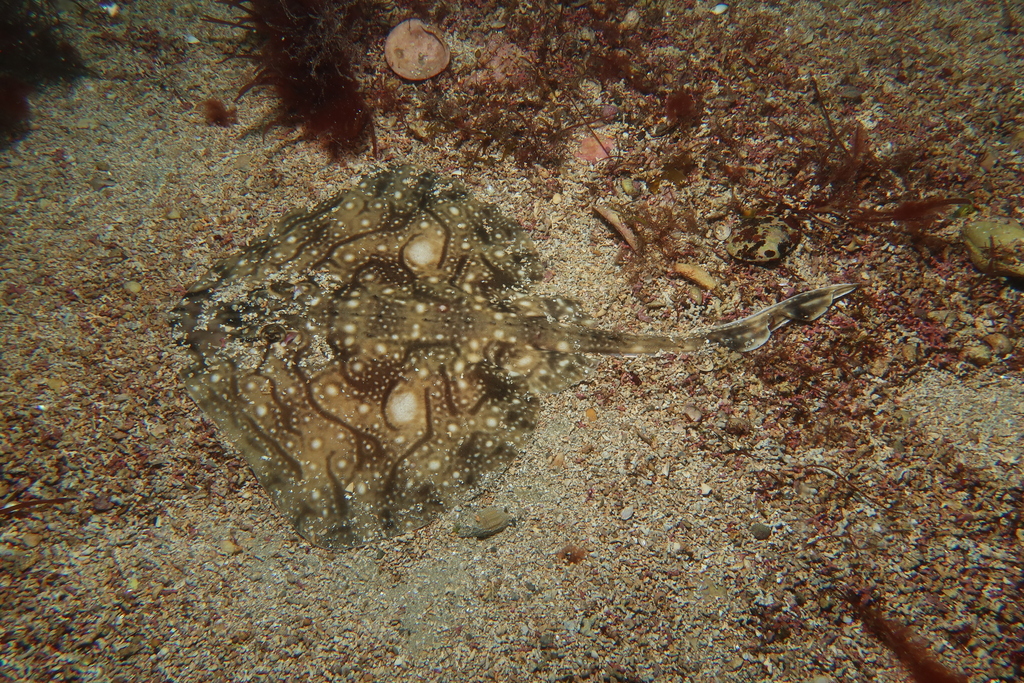
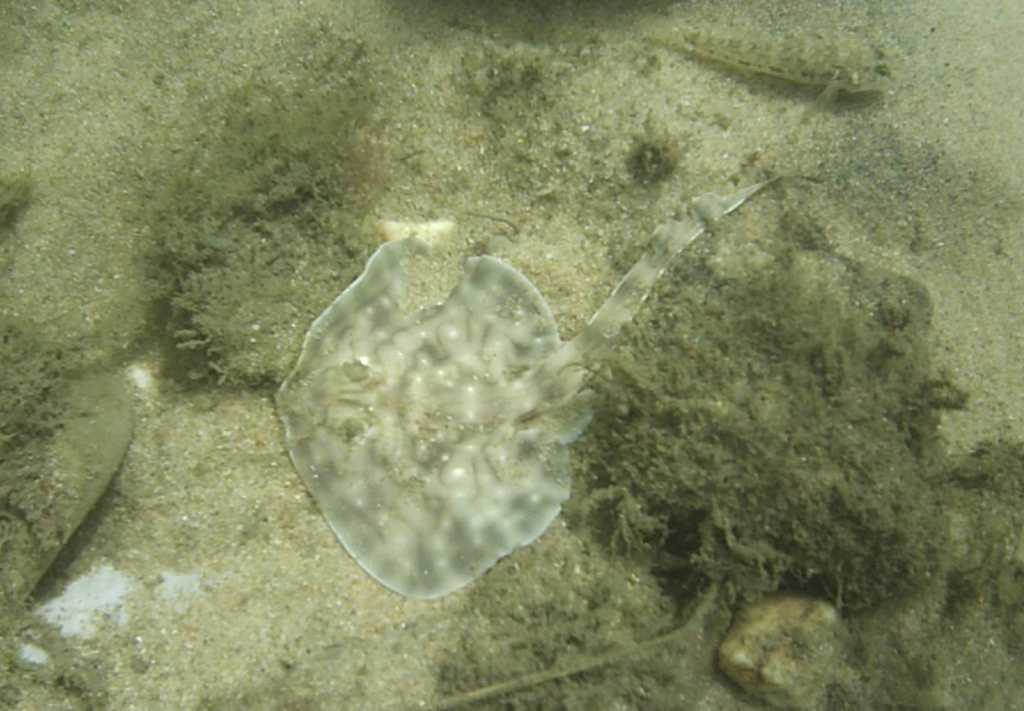
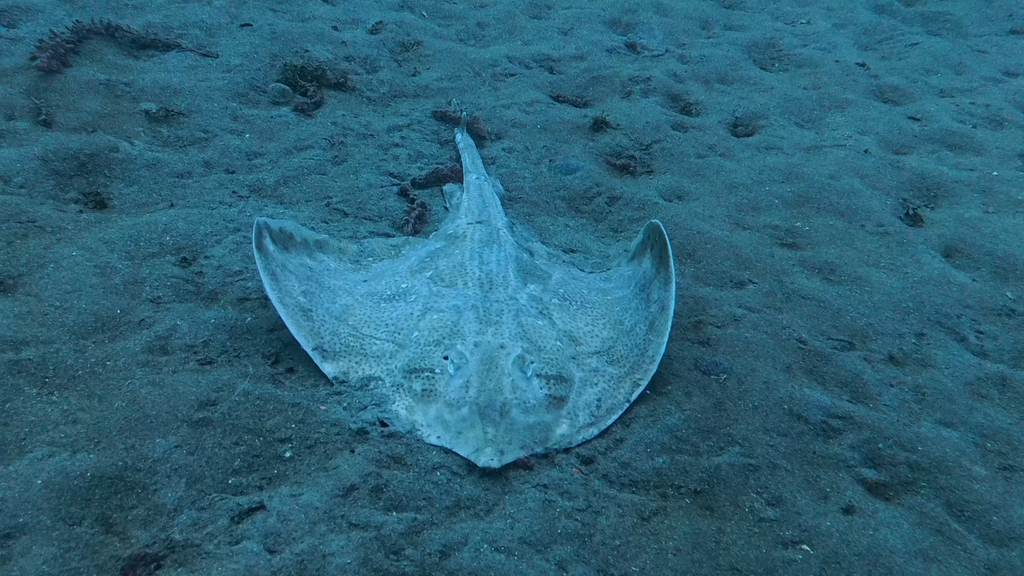
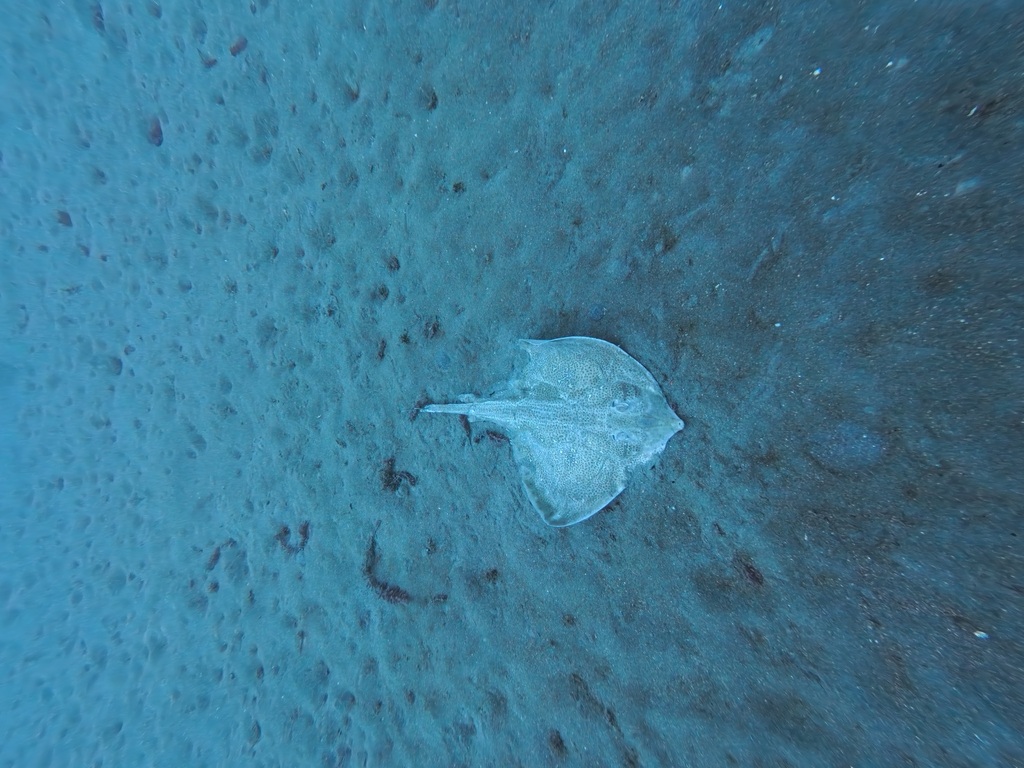
Photos show the species, not always the places on this page.
Length
Up to about 100 cm (39 in) total length in FishBase and Wikipedia. A 2012 review gives a maximum of at least 114 cm (45 in).
Weight
Typically about 4.5 kg (10 lb); up to about 10 kg (22 lb) is reported by Wikipedia. FishBase gives no weight.
Next to a person
The largest are about as long as a four- to five-year-old child is tall, and a typical one weighs about as much as a small baby
What it eats
Small fish, crustaceans, molluscs and other animals that live on the seabed.
Around people
Calm, give space
How it lives
It lays eggs. The egg cases, often called mermaid's purses, are oblong capsules with stiff pointed horns at the corners, about 7 to 9 cm long without the horns. Laying runs from March to September, and about 30 eggs a year are reported for one female. Females mature at about age 9 and males at about age 8. Size at maturity is about 80 to 85 cm, and about 84 cm for females in Portuguese waters. It lives on sandy, muddy or gravelly bottoms, mostly at 50 to 200 m according to Wikipedia. A 2012 review says it is most abundant in coastal waters shallower than 50 m, often near large estuaries, rias and bays. FishBase gives 20 to 200 m. Lifespan is not given in the sources I opened.
Where it goes
Its distribution is patchy, with sites of local abundance such as the central English Channel and the coasts of Ireland, France, Spain and Portugal. I did not find tracking data in the sources I opened. A 2026 modelling study projects that suitable habitat could shrink and shift south under one climate scenario, which is a projection and not an observation.
We only draw a journey on the map when scientists have tracked it or clearly documented it. For this animal we have not found one yet.
Populations
IUCN Near Threatened; FishBase gives the assessment date as 15 April 2023. A 2012 review says an earlier assessment listed it as Endangered, because of its large size, patchy distribution and risk of local depletion. Since 2009 the European Union has prohibited commercial fisheries from landing it. It occurs from southern Ireland and England to Senegal and in the western Mediterranean, and the south coast of the British Isles is the northern edge of its range. It can be locally abundant, and in places it is the dominant skate. I did not find a total population count.
Meet it respectfully
It rests on sand and mud and can be hard to see, so look before you put hands, knees or fins down. Hover well above it, keep your distance and let it leave when it wants. Never chase, touch, lift or feed it. Follow local rules and your guide.
Fun fact
Tap the bulb to light it up.
The egg cases have stiff pointed horns at the corners and are about 7 to 9 cm long without the horns.
Since 2009 the European Union has prohibited commercial fisheries from landing undulate rays.
Females mature at about age 9 and males at about age 8.
Undulate ray in the Ocean Atlas
Places we have researched where this animal is recorded. It is never guaranteed, and some places are for watching from the boat only.
Travel with usComing soonTrusted referralExploringOn pause, story onlyEthics pass
Country colour: pink where we travel, blue where we are exploring or refer, grey for story only.
 France
 Germany
 Ireland
 Netherlands
 Portugal
 Spain
Spain United Kingdom
Sources for this page
- FishBase, Raja undulata, 2026
- Wikipedia, Undulate ray, 2026
- Shark Trust, Undulate ray
- GBIF, IUCN Red List category lookup, 2026
- Ellis, McCully and Brown, 2012, Journal of Fish Biology
- Turan et al., 2026, Biology
Facts checked 5 October 2026. Photos: Unsplash licence, or Creative Commons as shown on each photo.
Work in ocean travel?
We are always happy to hear from exceptional local operators, accommodation, conservation organisations and destination experts. If your work fits responsible, small-group ocean travel, we would love to learn more.
Partner with Ocean Calling7-day freediving course in Coron, Palawan
CHF 1,480